admin
admin
work at his 16 hectare plot which is part of Lot 1, a subdivision of the farm.
Since his move to the farm, life has improved for the better. Every year he has added something to the family assets from the proceeds of his farm. He now proudly boasts of two ox-drawn ploughs, a scotch cart and seven herd of cattle, a nice three-roomed house, television and solar power fitted in his house.
“That is the work of my four years toil in the fields. This has been my wish and I am finally realising my dream. This is the beauty of the country’s empowerment programmes. There has also been massive improvement in the lives of beneficiaries. I am proud that the years I spent on my new plot have not been wasted,” said Nyangeresi.
He added: “I would like to urge other young people across the country to try farming. Mukoma muvhu mune mari (My brother, there is money in the land). If you don’t have any land, apply for it before it is too late and start reaping the goodies that it brings to the people.
Those who are rubbishing the land reform programme are doing it because they do not know what they are missing. Those youths who refused to take up the land when offered are now regretting that they lost a chance of a lifetime.”
A visit to any of the three tobacco auction floors, Boka Tobacco Floors, Premier Tobacco Floors, and Tobacco Sales Floor clearly show that money has changed the way of life for the bulk of the farmers at the country’s auction floors.
The farmers have thrown away their old tattered overalls for designer jeans, caps and jackets. They now put on work suits instead. They can now show that they have joined the big time.
While most workers have to wait for the end of the month, get a few dollars that they say have failed to do anything meaningful following many years of jobbing, resettled farmers have done wonderful things over a short period of time.
Some now boast of herd of 20 cattle, others have bought trucks to ferry their produce to markets while others have chosen the luxury of buying top of the range vehicles. They are indeed benefiting from their national inheritance, the land, a priced possession that for over a century was in the hands of white former farmers.
Knowing the benefits of owning the land, the colonial master with the aid of successive repressive laws kept indigenous Zimbabweans at bay and confined to the semi-arid unproductive areas of the country while he enjoyed country fertile soils in high rainfall areas.
But since the advent of the land reform programme in 2002, that is a thing of the past. Indigenous farmers have entered the agriculture industry and are now smiling all the way to the bank. They are reaping the rewards of tilling the land and prepared to show the world that Africa can indeed chart its own destiny.
Although indigenous farmers were indeed sidelined they never doubted their ability and skill to turn the vast underutilised pieces of land in the hands of the few white farmers into productive lands. Today evidence of the land reform programme is there for everyone to see.
That has been the beauty of the country’s land reform programme, an exercise that has seen the once marginalised Zimbabweans entering the sector. It’s a clear sign of the independence that Zimbabweans have been agitating for over the years. Indeed independence to benefit from the country’s resources without having to wait for the crumbs that fall from the whiteman’s table.
Over 300 000 indigenous farmers now own and are working on their land compared to 5 000 white farmers who controlled the greater part of arable land in the country at 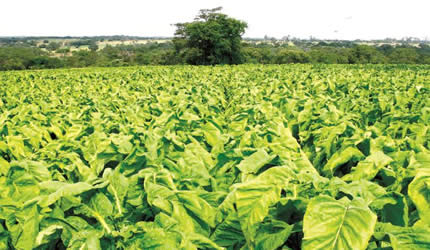 independence.
The former commercial farms are now full of the glitter of resources spread among the people. The once open lands are now green under different crops. Even tobacco that used to be an elitist crop has been transformed into the new farmer crop.
Mr Garikai Chuma of Buffalo Downs in Karoi said he was enjoying the fruits of land and will never give it up.
“I also have to dress and drive a car like any other person in the country. After all the sectors, agriculture is the most lucrative of all the productive sectors in the country.
Those who want to contribute to the building of the nation and also earn a living should try joining the agriculture sector and particularly the ever growing tobacco sector.
“I bought this truck last year and I am hoping when I deliver the next batch of bales and get paid I will pay a deposit for a 100 Horse Power tractor.
The tractor I already have, a 50 Horse Power, is showing signs of aging and I now need a bigger and better machine. I have since constructed a little mansion at my farm and my parents’ home.
“My parents have access to DSTv in their home. We are fortunate to have been under the visionary leadership of leadership of President Mugabe. Look at the entire continent. Where else do you find indigenous farmers enjoying the fruits of their labour like what is happening in Zimbabwe? Try to separate me and the land and you will be calling for real confrontation, it will be war,” he said.
Another farmer Colleta Michael of Mvurwi said he had never owned a proper bed. He had a single iron bed given to him by his father.
“I grew up sleeping on the floor and always dreamt that when I had money, I would buy two beds. The dream seemed unattainable until when I got an opportunity to try tobacco farming at a friend’s plot five years ago. I started with a hectare and after enjoying the rewards I have never looked back. I have since gotten my own plot and encouraging others to apply for the land.
“Imagine with my first pay cheque from tobacco I managed to build a three roomed house. I also managed to buy a television and a double bed. With successive earnings from the plot I have since acquired a small generator, five cattle, some goats and sheep and bought my children a good bed. I am now able to send my children to school.
Indeed my life has changed and I intend to make sure my children get a better life to than what I had said,” the Mvurwi-based farmer.
Guruve farmer, Mrs Emmah Mufanechiya said her life had improved dramatically since she benefited from the land reform programme and started growing tobacco and soya beans on a big scale.
“We could not afford to buy decent food and clothing. I used to have problems paying school fees for my children, but these days I pay school fees for the whole year once I sell my crop at the auction floors,” she said.
Mrs Mufanechiya said she had built a decent house for her family and will always be grateful to the ZANU- PF Government on the wonderful move the avail land to the marginalized Zimbabweans.
Karoi farmer Mr Herbert Ziome (24) said tobacco production was the best way to indigenisation.
“With this economy not everyone can be formally employed. Most youths have ventured into tobacco growing and we are doing well. We can compare well with other youths who went far with their education and got employed,” he said.
Statistics released by the Tobacco Industry and Marketing Board indicate that 82 of the farmers delivering their crop to the three auction floors were small-scale who benefited from land reform. As such the tobacco sector is now almost 99 percent indigenised. For the 2012/13 season the number of registered grew to 87 860 from 65182 farmers in the previous season and 35,749 in 2011.
Boka Tobacco Floors operations manager, Mr Moses Bias said business was brisk because of the land reform.
“For the past three years, we have an increase in tobacco deliveries due to land reform because most the farmers who come here are new farmers. At least 8 000 deliveries of bales we get each day are brought by new farmers who benefited from land reform.”
Youth Empowerment and Indigenisation Minister Saviour Kasukuwere said the indigenisation of tobacco production has been achieved thanks to the successful land reform programme started by Government in 2002.
“It is my wish that, like in all other economic sectors, the process of indigenisation and empowerment be taken further along the value-addition chain of the tobacco industry and my ministry will always be there to assist in the implementation of this policy,” he said.
Speaking at the 33rd Independence Anniversary celebration in Harare last week President Robert Mugabe acknowledged the role of Agriculture the revival of the economy. Agriculture grew by 4,6 per cent in 2012 led by tobacco, cotton and sugar. Tobacco accounted for 10,7 per cent of Gross Domestic Product and is set to continue its leading role economy.
Even the critical organisation like the Commercial Farmers Union has started to acknowledge importance of the land reform programme and has now given up the fight against land reform after realizing the futility of the exercise.
Even the West that once wished us evil is beginning to realise that they can no longer put a good programme and are acknowledging the importance of the country land ownership regime.
No matter how much bad mouthing the programme has received, it has clearly shown that the policy was a tool designed to empower the majority of Zimbabweans.



 Online Reporter