Online Reporter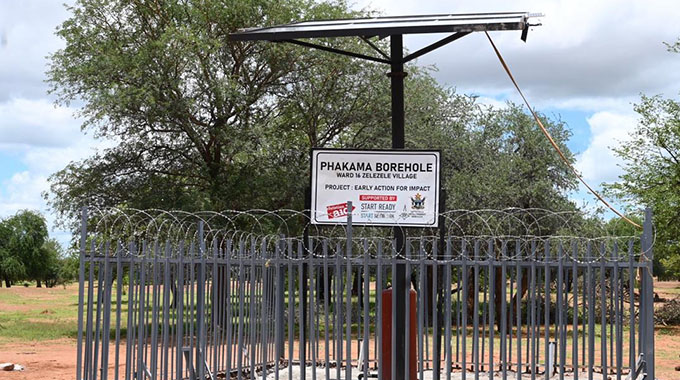
Sukulwenkosi Dube-Matutu, [email protected]
MORE than 350 households across four wards in Gwanda District have received a significant boost in water access, thanks to the installation of solar-powered boreholes under a transformative project that is also benefitting livestock, schools, and business centres.
The initiative, spearheaded by Lutheran Development Services (LDS) with support from Start Network through Christian Aid under the Early Impact for Action project, has brought much-needed water infrastructure to Wards 11, 16, 19 and 20.
As part of the programme, five existing boreholes were upgraded with solar power and connected to 10 000-litre storage tanks. Pipelines were laid to distribute water to community taps, business centres and two primary schools. Additionally, livestock watering troughs have been installed, now serving 11 040 animals — including 5 210 goats, 4 770 donkeys and 1 060 cattle.
Local villagers have warmly welcomed the development, noting it has alleviated years of water scarcity, a burden that disproportionately affected women and girls.
“Our borehole had become old and unreliable. We would queue for hours and sometimes leave empty-handed. Now, we can collect water from several points simply by turning on a tap. The long queues and heavy strain are behind us,” said Ms Nokuthula Ncube from Zenzele Village in Ward 16.
Mr Owen Sibanda from Ngoma Village in Ward 20 echoed the sentiment, highlighting the relief it has brought to livestock farmers.
“We used to drive our animals up to 10 kilometres for water, especially during the dry season. This project has made life much easier,” he said.
LDS Programme Co-ordinator, Mr Ulibile Gwate, explained that the borehole upgrade forms part of a broader strategy to address challenges brought on by the El Niño-induced drought.
“In Gwanda, the project implemented a two-phase intervention with support from Start Network through Christian Aid. The first phase was essentially a study to establish the priorities of communities affected by the El Niño-induced drought in 10 wards of Gwanda. The study revealed that the major priorities were centred on water availability and access, as well as seed provision for the 2024/25 farming season,” he said.
Under the project, 4 000 households received 2kg each of sorghum (SV4) and cowpeas, while 400 households were provided with fodder seed in the form of sun hemp and velvet bean.
Mr Gwate noted that a second phase is now underway to consolidate and sustain the progress made.“This second phase will reinforce systems and secure investments from the first phase of the project.
“Communities will be empowered with knowledge on how to better maintain and utilise infrastructure such as water schemes and irrigation systems, thereby strengthening community ownership and capacity for sustainable development,” he said.
He added that the intervention will also enhance public-private partnerships between farmers, seed houses, and suppliers of equipment and farming inputs. This, he said, will help forge robust linkages between communities, suppliers and markets.