Online Reporter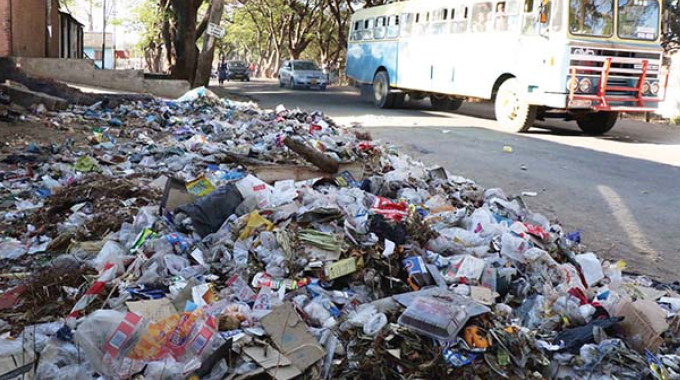
Tariro Mhlanga
Urban councils in Zimbabwe are battling to manage municipal solid waste as they struggle under tight budgets, inadequate and often malfunctioning equipment and inefficient and unreliable collection practices.
Thirty-nine registered companies and co-operatives across the country are working alongside councils to fight pollution. These companies offer a variety of services from waste collection to recycling or repurposing of waste paper or plastic.
Plastics account for approximately 51,6 percent of the total waste deposited at landfills. Thirty-three percent of this is low-density polyethene (LDPE), the soft plastics such as plastic bags.
The other 18 percent is a mixture of polyethylene terephthalate (PET) and high-density polyethylene (HDPE) used for making packaging such as beverage bottles and detergent bottles.
Unfortunately, most of the plastic waste does not end up in landfills, instead finding its way into rivers, open areas and streets. High population density has accelerated the unsustainable consumption and waste of plastic, leading to immense pressure on the environment.
Impact on the environment
Plastic pollution affects all land, freshwater and marine ecosystems. The persistence of plastic in the environment (approximately 450 years) has made plastics one of the most pressing global challenges. Zimbabwe is not exempt from this challenge.
As plastic is exposed to the elements, it breaks down into microplastics and nanoplastics. These can be found in the soil, in water bodies, even in the air, persisting for longer than the lifetimes of most living things.
Microplastics and nano plastics are absorbed into living systems and these chemical contaminants have been shown to bioaccumulate and biomagnify. Studies have linked the presence of microplastics in organisms to reproductive disorders causing even more damage to biodiversity.
Aquatic ecosystem’s destruction is another effect of plastic pollution through ingestion of plastics and entanglement in plastic waste. As dumpsites proliferate, animal habitats are disrupted, threatening both aquatic and terrestrial biodiversity. Dumped plastics serve as transport for invasive species of flora and fauna further disrupting existing ecosystems.
The manufacture of plastics is energy-intensive, relying heavily on fossil fuels, which emit significant amounts of greenhouse gases during the combustion process. The processes of extraction and refining of petroleum for plastic production are major sources of greenhouse gases, and in this way, plastics contribute greatly to climate change.
In an attempt to lower the amount of plastic waste, some users have chosen burning as their preferred method of disposal. As plastics burn, they emit hazardous toxins. These toxins include dioxins and furans, volatile organic compounds, heavy metals and hormone disruptors. This burning is not only hazardous to health but also impacts negatively on climate change.
Microplastics and nanoplastics in soil cause disruptions in photosynthesis. The presence of these plastic residues in the soil can also damage the soil structure, negatively impact plant roots and affect beneficial soil micro-organisms.
All this adds up to reduced agricultural productivity.
As plastics make their way into drainage systems, blockages are created, which leads to a plethora of human illnesses, from cholera, to scabies and malaria. This increases the pressure on an already ailing health system and puts human lives at risk.
What can be done?
Government and the regulatory authorities
In order to reduce plastic pollution as well as mitigate its effects, monitoring is necessary. Plastic pollution affects all four spheres of the environment; hence, it is crucial that monitoring efforts address each of them.
As Zimbabwe is committed to meeting the Sustainable Development Goals (SDGs) 6, 8 and 13 by 2030, it is imperative that a more aggressive approach to environmental monitoring be included in the action plan.
In May 2026, Bumira Environmental Consultancy will host a national workshop and exhibition on environmental monitoring. The focus will be on exploring practical solutions to environmental monitoring, showcasing innovative technologies and strengthening collaboration across sectors.
The latest advances in the technology being used to monitor air, water and soil for the presence of microplastics and nanoplastics will be discussed in detail at the workshop. Practical demonstrations of the available and emerging technology in tracking plastic pollution on land and on water will be carried out at the exhibition.
Stakeholders will get the opportunity to witness new technology in use and network with other concerned parties to map a cohesive plan of action together.
Local Government, waste collection and recycling companies and co-operatives
Local Governments can mitigate plastic pollution by investing in environmental education for residents, encouraging waste separation and recycling. By improving the regularity of waste collection, residents can also depend less on dumping or burning their waste.
Organisations that use plastic packaging can partner with recycling companies to buy back packaging from consumers. Beverage production companies, for example, could buy back used containers from customers at a minimal price to encourage recycling.
Public-private-partnerships should be promoted, where local authorities work with private organisations to arrange for the separation, transportation and recycling of plastic ideally close to where the waste is produced.
At present, recycling centres are found only in large metropolitan areas. This makes recycling of plastic economically unwise for councils far away from Harare, Bulawayo and Masvingo.
Creating and maintaining easily accessible collection points for plastic waste will also go a long way towards reducing plastic pollution. Companies benefit greatly from this initiative as they work towards their environmental, social and governance (ESG) goals and attempt to operate sustainably.
Local Governments should get involved in monitoring plastic pollution. By using technology such as drones and GIS mapping, councils will be able to trace pollution back to the source and better enforce laws and bylaws protecting the environment.
By viewing plastics as a potential source of revenue and not just waste, councils may begin to address the plastic pollution issue and contribute to job creation and building the economy.
Learning institutions
The exhibition and workshop that will be held by Bumira Environmental Consultancy will provide an opportunity for institutions of higher learning to gain first-hand access to emerging technologies in plastic pollution monitoring and control.
By learning directly from manufacturers on how to use the technology, learning institutions will emerge as trainers of trainers, and can disseminate the knowledge across the country to a wider target audience.
Citizens
There is a need for conscious reduction in the demand for plastics, as this will ultimately reduce the amount of waste. Reusing and repurposing plastic containers and bags will go some way towards the reduction of plastic pollution and all its effects.
The use of reusable cloth bags or baskets for shopping will also reduce the amount of plastic released into the environment.
Separation of waste will encourage recycling as the separated waste can be handed to waste pickers without them having to pick through mixed waste.
Citizens take part in the circular economy, which aims at keeping materials in use for as long as possible, extracting maximum value from them. Jobs and new business opportunities are created in the recycling and manufacturing sectors supporting economic growth.
Plastic pollution is the physical manifestation of deferred responsibility. From indiscriminate littering to unreliable collection practices to the absence of real-time monitoring. The science cannot be disputed: microplastics bioaccumulate, greenhouse gases intensify, and ecosystems are destroyed.
Solutions exist; regular collection, conscious consumption, rigorous monitoring and recycling locally. As Bumira Environmental Consultancy convenes stakeholders in May 2026, the question is not whether we can afford to monitor our environment closely, but whether we can afford the continued cost of inaction.