Chronicle Editor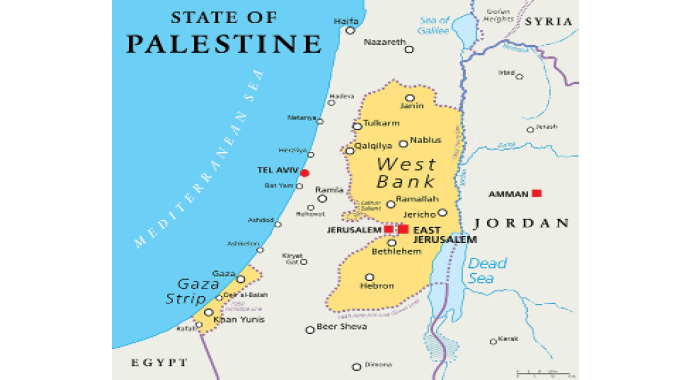
Wallace Musakanyi
THE history of the state of Palestine has been written in blood and tears.
Its existence has been marred by a series of hurdles that restrains it from enjoying the rights that are at the disposal of all other sovereign states because it is not recognised as a State.
Basically, Palestine does not actively participate in international relations because it is not a full member of organisations such as the United Nations, International Monetary Fund and World Bank.
As such, in a move to champion the Palestinian cause, the United Nations General Assembly in 1977 declared the 29th of November as the International Day of Solidarity with the Palestinian people.
To the Palestinians, the day is also symbolic because on that same day in 1947 the United Nations General Assembly adopted resolution 181 which approved the partition plan which included the creation of an Arab and a Jewish State on the Palestinian territory.
This was later followed by the declaration of the state of Israel on 14 May 1948 thereby erasing Palestine on the world map and rendering the Palestinians stateless since it was no longer recognised as a State henceforth.
The non-recognition of Palestine as a State especially by most Western States among them, USA, UK, Australia, France, among others, is a mere social construction based on securing its strategic and foreign policy interests in the Middle East as they chose to ally with Israel, a rival of Palestine.
This is because, Palestine fulfils the international law prescriptions that must be met for any country to be recognised as a state. Specifically, article 1 of the Montevideo Convention expressly states that a State as a person of international law should possess specific features, that is a permanent population, defined territory, effective government and must have the capacity to enter into relations with other states.
Solidarity with Palestine is imminent in pressuring its recognition so as to unlock its full potential, in diplomatic, political, social and economic avenues which has been plagued by its non-recognition.
In line with the aforementioned convention, Palestine has a well defined territory, it established its borders which are known as the “Green Lines” which are recognised by the United Nations, European Union and scores of countries. Its territorial integrity has also been adversely recognised by the United Nations Security Council through the resolution 242.
Moreover, the Central Bureau of Statistics also enshrined that Palestine has a total of five million people, with three million living in the West Bank and the remaining two million residing in the Gaza strip.
The Palestine Liberation Organisation (PLO), a political body consisting of various political parties is also recognised as the defacto government (the one in effective control of Palestine) that represents Palestine at key and high level summits and forums.
Palestine in accordance with the Montevideo Convention has also been able to enter into relations with other states, currently it has managed to secure bilateral recognition from 137 countries and has also managed to establish embassies, missions and general delegations in many countries as an indication to its stability to enter into relations with other countries.
International law is the campus that directs the practice of States in the international system, in the same context all the legal prescriptions that are expressly underlined by international law to be followed during state recognition are intertwined with the existence of Palestine as a state as noted above.
The non-recognition of Palestine as a State by other countries is meant to advance the narrow and selfish interests of States at the expense of institutions, values and prescriptions that smoothen relations between States thereby increasing cooperation and unity for a common purpose in the international system.
Palestine’s non-recognition as a State has been costly and a disservice that has also crippled its governance infrastructures. This is because only recognised States can be full members of intergovernmental institutions like the United Nations.
At the heart of the UN are the principles of equality among nations and sovereignty, however, by default Palestine has continued to be degraded, belittled and bullied by other States because of that.
Its main political nemesis Israel has also been committing unspeakable atrocities towards Palestine which ranges from house demolitions, air and drone strikes accompanied by repressive measures among them harassment and arbitrary arrests, to mention just a few. Nevertheless, all these are tantamount to crimes against humanity that are outlawed by international law.
However, basing on the fact that Palestine is not recognised as a State it does not have the power to bring claims against other countries like Israel that has been committing war crimes and crimes against humanity before the International Court of Justice, an international court that tries disputes that arises between and among States. This is detrimental especially to Palestine as it perpetuates the continuation of these aggressive acts.
Zimbabwe has constantly been supporting the solidarity of the State of Palestine and the first step in doing so was by recognising it as a State together with other countries in the African Union.
At the cornerstone of Zimbabwe’s foreign policy especially under the New Dispensation has been hinged on the respect of sovereignty and against this background, the Government has persistently been calling for the independence of Palestine to be respected.
Bilateral relations between Zimbabwe and Palestine are also being amplified especially during these contemporary times when Zimbabwe is forwarding the “a friend to all and enemy to none” mantra in the conduct of its foreign relations.
Recently, the Palestine embassy in Hardres partnered Music for Development Choir for the production of a song titled Save Palestine, an advocacy song that is premised on lobbying for peace.
The solidarity with the Palestinian people is imminent and only meaningfully realised after the recognition of the State of Palestine especially against a backdrop were it actually fulfils the demands setup by the Montevideo Convention. It will also enable Palestine to be an active participant in international relations, especially through the United Nations, a key multilateral-based organisation housing all sovereign States.
Wallace Musakanyi is a University of Zimbabwe Masters in Politics and International Relations final year candidate at the University of Zimbabwe. He can be contacted on [email protected]



 Online Reporter