admin
admin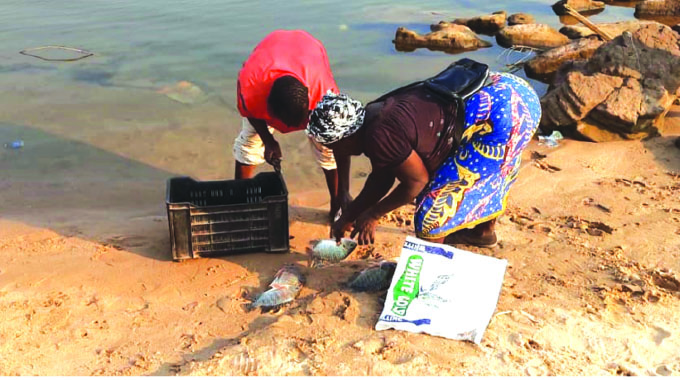
Walter Nyamukondiwa in BINGA
Deli Muzamba wakes up at 5am to check her fish nets at the confluence of Masumu and Zambezi rivers, just as Abigail Dube sets out on a 15km journey by foot to buy fish when Deli and other fishers dock.
Their synchronised routines are a microcosmic reflection of fishers and buyers in the fishing industry’s value chain in Matabeleland North’s Binga district an other fishing camps along the Zambezi River and Lake Kariba.
In this case, fishers catch fish to supply buyers who sell to restaurants in Binga and as far as Bulawayo City.
Abigail is often accompanied by several women with buckets as they walk from Donga — off the Binga-Dete Road to Kalulwe Fishing Camp, through Chilila Fishing Camp.
Chilila Fishing Camp catches are generally low, therefore buyers prefer to walk the extra 4,5km for a better chance of getting more fish.
They trudge through a rocky mountain range with plain and mostly thorny deciduous trees, which have shed their leaves in anticipation of the imminent rains.
For Abigail, getting enough fish to satisfy her market in Binga used to be a day’s work, guaranteeing her enough time with her family every night and better returns.
Of late, she — along with other buyers —needs at least two days to get 10kg of fish before setting off on her journey to Binga Centre. On bleak days, she hardly gets 3kg of fish, a pain she shares with fishers who have seen their daily catches dwindling over the years.
The bleak days have been increasing in recent years!
Deli’s story takes a similar route.
The verdict among fishers is out on what could be hitting their industry so hard, with climate change being a lived reality rather than a theoretical phenomenon.
Findings are that poor rainfall patterns leading to receding water levels and human induced shocks have been at the heart of a faltering industry.
The fishers are a fountain of knowledge on what could be affecting fish catches, threatening to throw many people on the streets.
Already, some fishing camps are almost ghost compounds as fishers trade their boats and nets for alternative sources of livelihood.
Fishing co-operatives such as Bwacha, Katuya, Twite, Mbila and Masumu, among others, have lost members, while some compounds which used to be a hive of activity have slowed down and are now almost deserted.
They fail to raise the required statutory fees which can be anything up to US$80 depending on the size of the co-operative.
“Things have really changed. You could have smelt fish, either dried or fresh, as you entered the compound,” said Laina Dube at Mbila Fishing Compound.
“We used to have around 300 people at this compound, with most of them surviving by selling fishing, but numbers have really gone down to around 50 in recent years as some go back to their rural homes or move to other ventures for survival.”
Reduced catches have a domino effect on other ancillary activities such as grocery shops and community beer outlets.
Gifton Dumani, a shop owner at the same compound said business had slowed down as the Zambezi River withholds its once bountiful harvest of fish.
“Reduced catches have a knock-on effect on people’s purchasing power. Sales have considerably gone down. It is not what it used to be,” he said.
Another proprietor at Kalulwe Fishing Camp also shared the same sentiments.
Changing climatic conditions are affecting gillnet and Kapenta fishing alike.
The local fountain of wisdom has aggregated the source of this downturn in the fishing industry to less than usual rainfall, a dreaded back peddling crustacean, the growing scourge of poaching, a harsh and parochial regulatory authority and a weed control intervention that wiped away the bad together with the good.
Climate change
The community recalls that levels last rose closer to the highest flood point in 2018 which saw catches improve significantly.
More water means weeds which fish feed on and use to lay eggs are submerged in water.
Kalulwe Fishing Camp chairman Michael Simazaza said fish had moved deeper into the river owing to lack of vegetation which provides shelter and food.
“It is now mostly sandy and rocky on the shoreline as vegetation is left out of the water,” he said.
Records from the Zambezi River Authority (ZRA) which manages the Zambezi River, Lake Kariba reservoir and other installations show that rainfall patterns had been erratic in the last 10 years.
The 2017/18 rainfall season saw higher inflows of water compared to the following two seasons and the previous years.
In 2018, the Kariba South Power Station expansion project was commissioned, adding another 300MW to the national grid.
Incidentally, the preceding years have been marked by low water levels, a development fishers said could be leading to high loss of water to feed the increased appetite for power generation.
“I do not know what is happening in Kariba. I think they are now using up a lot of water resulting in the river remaining low,” said Nkululeko Siakwasiya, who doubles as a fisher and buyer.
The SADC region seasonal forecasts have been projecting normal to above normal rains in recent years, including the coming 2022/23 season.
ZRA said it was developing an Environmental and Climate Change Policy whose overall aim was to provide a framework for mainstreaming and co-ordinating climate change actions.
These include development of dams along the shared portion of the Zambezi River between Zimbabwe and Zambia.
The development of the Batoka Gorge Hydro-Electric Scheme is expected to help the management of water and mitigate against climate change.
Unintended consequences?
The local traditional knowledge system has identified the loss of three types of weeds as leading to the dwindling catches.
They trace the varnishing of the weeds to 2018 when a move to control the invasive water hyacinth weed was made.
Said Nomatter Mukuli: “There were three types of weeds we grew up seeing along the Zambezi River and in our area.
“They started disappearing in 2018 and there was a team which sprayed some chemicals in a bid to control the weed that floats in water which was traditionally not found in the river. We do not know who was behind the move, but the chemical must have also killed our indigenous weeds.”
Shonhiwa Munkuli described the indigenous weeds thus: “One of the weeds was like grass, survived in water, the other one was like tripe while the other one was leafy. Fish loved feeding and living in the weeds.”
In its annual report, ZRA said the water hyacinth weed was being controlled biologically through weevils, natural water level variations, wind, low nutrient levels and wave action.
Left uncontrolled, the invasive weed forms a mat on the water surface, reducing oxygen and cutting sunlight.
The crayfish
While fishers in Lake Kariba have reported fewer crayfish, the story is different for people in Binga who say they are more often than not likely to see them caught on the nets.
Fishers said the back peddling crustaceans have amply demonstrated their predatory nature.
“The creatures are too many. Hardly do we draw out a net without having them as the majority. You find that they harm the few fish caught on the net. We also think they disturb the breeding of fish,” Nkululeko Siakwasiya.
So what do they do with the large haul?
“We either throw them back into the water or on land. They are a menace,” he continued.
The alien specie, native to Australia, was allegedly released into Lake Kariba from where they were being bred in Zambia.
Apart from attacking fish, they also damage nets with their claws.
They are a delicacy in Zambian hotels, but they have no established market in Zimbabwe, let alone Binga.
Regulation and enforcement
Zimbabwe Parks and Wildlife Management Authority (Zimparks) rangers have come under fire for constricting local fishers while turning a blind eye or facilitating the smooth operations of poachers from Zambia.
The Zambian poachers have taken over most islands on the Zimbabwean side, using prohibited fishing nets and methods such as trawling and driving fish with noisy artefacts which are continuously plunged in water.
“If we want to go to the islands we are prohibited, but we see Zambians coming in with their fridge laden boats, camping there,” said Mukuli.
The poachers are said to be bringing rangers good for the right to fish undisturbed.
Fishers said they were being restricted to fishing only two hours in the morning from 6am to 8am and from 4pm to 6pm.
Fishing outside those times results in boats being impounded, attracting a fine of US$150 with fish being confiscated.
Zimparks rangers were allegedly going after set nets and removing fish for personal consumption.
“We can no longer operate freely as Zimparks changes the rules of the fame anyhow,” said Siakwasiya.
“The torment we go through surpasses that of some who has committed murder or has killed an elephant. We are put under tight surveillance and harsh conditions, but any effort to preserve the resource is being freely enjoyed by Zambian fishers. They are making money at our expense.”
The Zambian legislative framework regard fishing as recreation whereas locally it is a regulated activity where fishers need to pay permit fees to Zimparks and the local authority.
Zimparks did not respond to written questions after promising to look into the issues raised.
There is a general belief that there are more fishers now than before which is putting pressure on the resource.
Possible solutions
Fishers are unequivocal about the need for a September to December shutdown to ameliorate the situation as fish breed during that period.
The practicality of its implementation remains to be seen as most people sorely depend on fishing for a living.
Zimbabwe Kapenta Producers Association chairman Mr Chartwell Tanga Kanhema said the annual shutdown was one of the interventions for future sustainability of the fishing industry.
The Food and Agriculture Organisation (FAO) has recommended collective reduction of fishing boats to allow optimum and sustainable returns.
For Kapenta, a study has shown that Zimbabwe needs to reduce the number of boats from around 400 to 275, while Zambia reduces its fleet from over 1 000 to 225 boats.
It also recommends alternative livelihoods to take people away from fishing.
Litembani Kufeni has called for capacitation in irrigation so that she can go into farming in the arid region of Binga.
Already, the Tonga community has been farming on the banks of the river, with calls for irrigation equipment to move them away from the river channel.
There have been calls to promote downstream industries like making of life jackets.
It remains to be seen whether collective human effort can turn the tide of climate change and re-engineer some regulations to promote smooth and sustainable fishing.
This story was funded by Women In News SIRI Real Grant Project.



 Online Reporter