

 admin
admin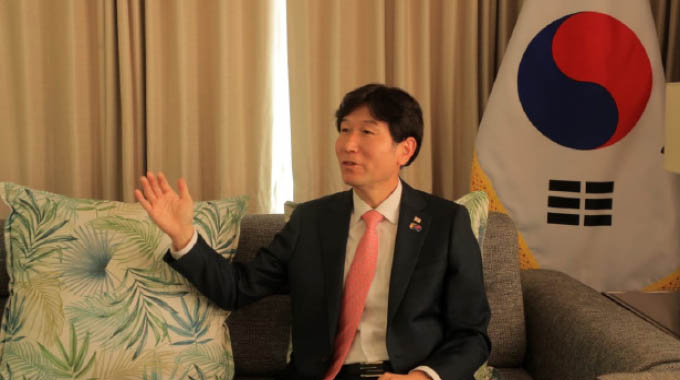
Gibson Nyikadzino
The Interview
In June this year, South Korea joined the growing trend of inviting leaders of African governments for a summit intended to boost cooperation and diplomacy. Africa’s rich mineral resources and its potential as a vast export market are now at the top of South Korea’s agenda. In this report, Gibson Nyikadzino (GN), Herald Correspondent speaks to South Korea’s Ambassador to Zimbabwe, Park Jae Kyung (PJK) on trade, investment and cooperation opportunities that can be tapped by Zimbabwe and South Korea.
GN: Which direction are Zim-South Korea relations taking? South Korea has a strong scientific research and innovation base. How can South Korea and Zimbabwe strengthen ties on the industrialisation front?
PJK: In Korea, when we think of research and development (R&D), its budget in that regard compared with the total GDP, we are on top of the world. But it is not from the government sector, it is the government plus the private sector together. So, about 75 percent is from the private sector that are global brand companies like Samsung, LG and others. Government sector budget is about 25 percent.
When we think of Korea’s history of industrialisation and digitalisation, we have two important institutions. Korea Institute of Science and Technology (KIST) and Korea Advanced Institute of Science and Technology (KAIST). So, KIST is a think tank, a research institute. And KAIST is the research education, the universities focusing on the Msc and PhD degrees. So, when we compare in Zimbabwe, this KIST may be similar to the Scientific Industrial Research and Development Centre (SIRDC) and KAIST is similar to the Harare Institute of Technology (HIT). Therefore education, learning and training provide the talent and skills for the global brands.
GN: So, from the 1970s, what was the key area of industrial investment which KIST was looking into? What was the primary area of industrial evolution?
PJK: In the 1970s, we continued with innovative technologies, developed computers and pneumonia vaccines, as we also engaged in the pharmaceutical sectors as well. And in the 1980s, through R&D we had optical fibre which was used for telecommunication lines. We made this from the laboratories, from the think-tank research institutes, but at the same time, it was collaborated heavily with academia, of course, but also with the industry. The industrialists had their own R&D sector, but in the industrialisation period, it was more of state-led R&D. And now, the portion of the private sector is 75 percent of R&D and 25 percent state-led. So, the private sector is still there, but still the collaboration is working based on trust and confidence.
GN: What lessons can Zimbabwe draw from your experiences?
PJK: It is about collaboration. You have the SIRDC where the Korea Agricultural Support Centre is located. SIRDC is a national think tank and it covers not just agriculture, it covers lots of things. They are dealing with so many science and technology issues including weather forecasting, climate, geology or geometry and numerous other areas. There should be ways to encourage collaboration. If HIT can also be involved, then may be the kind of synergy will be there. That is exactly what we did based on our experience in the 1970s, 1980s and onwards. Involving startups, the young entrepreneurs from the lab is important. Even from the university, they can do it. It is all about the ecosystem, the environment, how to promote collaboration.
GN: Following the Korea-Africa Summit, how are the relations between Zimbabwe and South Korea moving to strengthen cooperation on climate change, food security and sustainable development issues?
PJK: Globally, when we discuss the climate change issue, on one side, it is about the mitigation issues, reducing the carbon emissions. On the other, its about the adaptation. It is about the resilience. Zimbabwe is not a big emitter. Everybody knows the US and China are the biggest emitters. We now need to harness electric vehicles (EVs). You have the critical minerals for this – lithium. Then on the resilience adaptation side, it is about the irrigation issues and how to respond. Through the Korea Programme for Innovation on Agriculture (KOPIA) in Africa we are forging deeper agriculture and trade cooperation with Zimbabwe and other African countries to help countries on the continent bolster food production, fight hunger and respond to climate change challenges. SIRDC and KOPIA are working on various initiatives to support and uplift the livelihoods of smallholder farmers in Zimbabwe.
GN: What scholarships are you giving to Zimbabwean students?
PJK: We have big scholarship programmes for many developing nations. But I always think the number is still too small. Every year, about 10 Zimbabwean students benefit from the Korean scholarship programmes. So far up to now, about 400 Zimbabwean students have received scholarships since the late 1990s. We want to expand the number and the fields of study as well. We are discussing specific fields of study with the Skills Audit Ministry. They are very much interested in benchmarking of skills audit and developments. Very soon, a big delegation is going to visit Korea to see how Korea has invested in people through education and research and development. They also plan to visit the KAIST. After their visit, may be we can design a specific scholarship programme for Zimbabwe.
GN: Is there any orientation for the students you give scholarships since you have no cultural centre here in Zimbabwe?
PJK: Before the scholarship recipients leave for Korea, we have orientation. The alumni are also there. And then the embassy staff also give presentations and orientation to them in order to reduce culture shock. It is important to continue to have cultural activities for Zimbabwean people to understand better and more about Korea, and vice versa. In Korea now, thanks to the summit meeting and presidential visit, we are seeing an encouraging number of visitors to Zimbabwe. For example, in 2022 about 1 000 Koreans visited Zimbabwe and last year more than 10 000 visited your country. We are planning to have more cultural activities.
GN: What are the low-hanging investment opportunities for South Korean companies? What are the main exports by Zimbabwe to Korea?
PJK: From Zimbabwe to Korea, the major export is tobacco and to some extent artworks and some plants. Zimbabwe is also exporting agricultural products such as blueberries, coffee and tea. But in order to increase Zimbabwe’s exports, the government must support exporters and enhance their productivity levels. For areas of investment, the answer is very simple: mining. Zimbabwe has vast mineral resources including lithium which is in high demand for electric vehicles (EVs). The whole global trend is about carbon emissions reduction and climate change. Despite the fluctuating prices, lithium is a very important mineral for Zimbabwe. Price decreases are temporary. In the year 2030, 2040, 2050, the global demand for EVs and demand for lithium and other critical minerals will continue to rise and rise again. So, you have that important weapon for your economy. The Korean government and companies are keen on diversifying. Hyundai and KIA, our two car manufacturing companies, their focus is now growing on EVs.



 Online Reporter