Online Reporter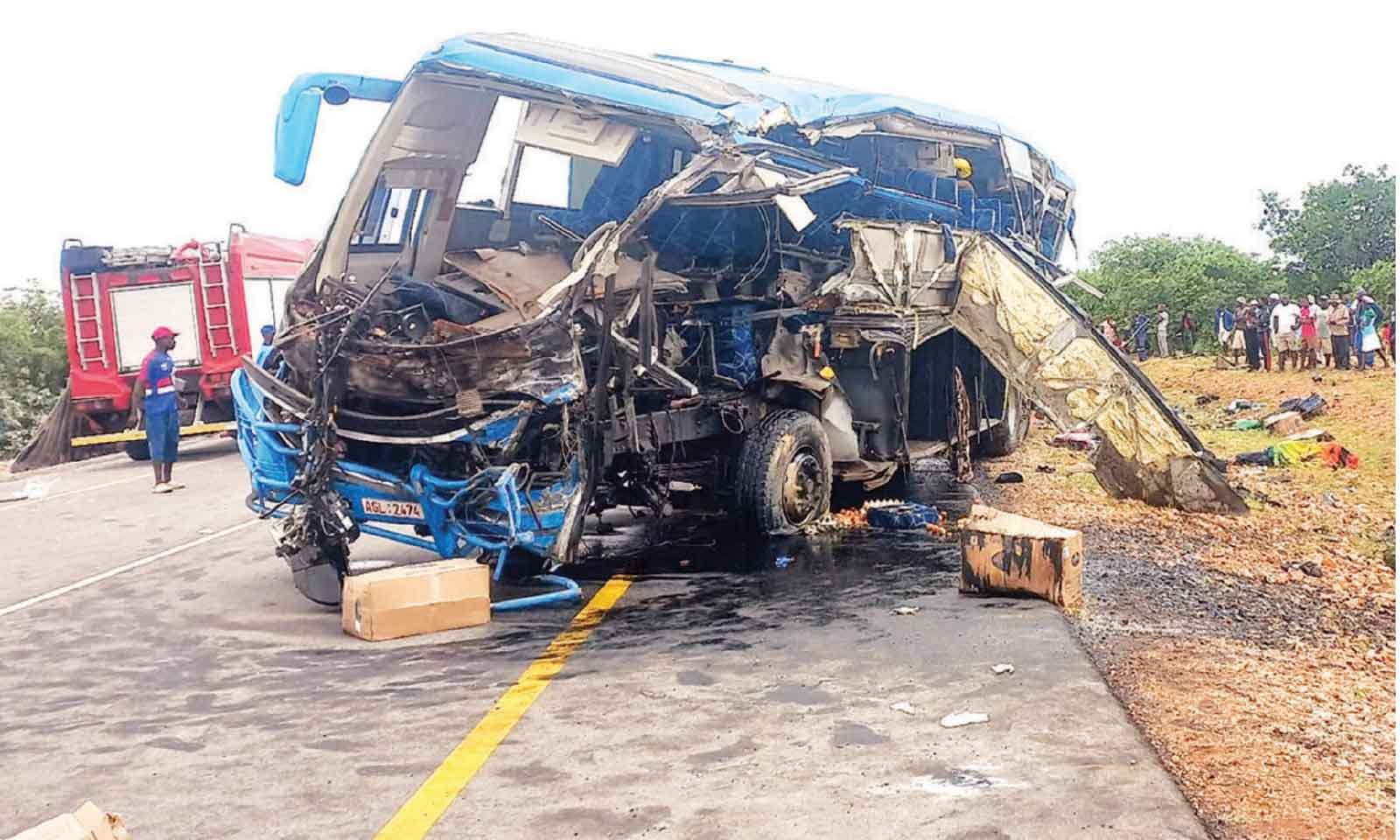
Munesu Munodawafa
The festive season road safety campaign period is running from December 15 to January 15, which is a period of 30 days.
Regrettably, we have not started well.
You may be aware that we launched the festive season campaign yesterday (December 17).
But unfortunately, the number of road accidents so far are already disturbing.
We have already lost about 26 people.
And that is worrisome.
And when you look at December 17, again, the number is slightly over 20 people who have died on our roads due to negligence.
I call it negligence because, as you saw, the Honda Fit vehicle that was involved in an accident was carrying 10 people.
There is a problem with that number.
A Honda Fit should not carry 10 people.
It should not carry more than six people.
So, there is a problem already.
That is outright negligence.
And I hope the law will visit whoever was responsible for that.
We also had another incident involving another Honda Fit on the other side, in Makuti.
Again, it was carrying about eight people. There lies the problem.
So, we have not started well at all.
But that is only giving us additional strength.
It has forced us to restrategise and take a stance that will not allow this to get out of hand.
Why Christmas period is the most dangerous period
Well, I think the reasons are clear.
Firstly, I want to move away from the notion that the high incidence of road accidents is a result of some supernatural powers.
If you look at the basics, this is a period where a lot of people travel to be with their families and friends. Naturally, there is a lot of traffic on our roads.
Now, there are a number of issues that arise because of that.
Firstly, just the sheer number of vehicles on the roads helps increase the probability of an accident.
The other reason could be that some people may not have been using their cars for the better part of the year; maybe because it had a defect.
But all of a sudden, they need it to travel as family.
But because the car was not being used owing to a mechanical defect — maybe it was not insured or the wipers, brakes and lights were not working — that alone raises the probability of accidents.
The third factor is that the festive season, by definition, is a season for merrymaking.
Unfortunately, that may include drinking alcoholic drinks and, in some cases, some people engage in substance abuse in the name of merrymaking.
And when people drink, when people take anything intoxicating, it simply means their response rate is adversely affected — It is scientific; it is biological.
There is nobody who drives better when they are under the influence of anything.
Review
We conducted a detailed review of road accidents that occurred during the Heroes and Defence Forces holidays in August together with the Ministry of Transport and Infrastructural Development.
The review confirmed that the majority of road accidents in Zimbabwe are largely attributable to driver behaviour.
When you break this down, the main contributing factors include inattention, speeding, unsafe overtaking, overloading and driving without due care.
These are the factors that came out.
In addition, we noted a slight increase in single-vehicle accidents.
These are incidents where a vehicle crashes without the involvement of another vehicle, often as a result of speeding, drunkenness or inattention.
The irony is that many of these single-vehicle accidents are occurring on some of our best roads.
This clearly points to excessive speeding, which is very unfortunate.
While we all appreciate and commend the Second Republic, under the leadership of His Excellency the President, for the remarkable progress in infrastructure development — and we also acknowledge the work being done by Honourable Minister Felix Mhona — it was never the intention that these improved roads be turned into racecourses.
Besides being illegal, it is wrong and it can lead to loss of lives.
Holiday deployments
We have significantly increased our deployment on the roads for the holiday season. You may recall that last year we had 55 patrol teams.
This year, we have further scaled up our presence to 61 teams nationwide, comprising both static and mobile units.
Of these, 34 teams are static while 27 are mobile patrols.
This enhanced visibility is a key feature of the campaign.
Secondly, the campaign places equal emphasis on enforcement and education, with the former being particularly rigorous this time.
There will be zero tolerance for violations such as overloading.
Where overloading is detected, passengers will be offloaded without compromise.
While this may be inconvenient, such measures are necessary to save lives.
The police are also expected to issue a statement reinforcing this approach.
Thirdly, we have deployed smart enforcement vehicles in greater numbers than before.
These vehicles will be actively checking all vehicle documentation.
On the positive side, this technology will minimise unnecessary delays for compliant motorists, as the system can quickly detect any defects or irregularities in vehicle paperwork.
To be clear, enforcement teams will be working collaboratively to check insurance, road worthiness and compliance with Zinara (Zimbabwe National Road Administration) and ZBC (Zimbabwe Broadcasting Corporation) requirements.
Any vehicle found to have outstanding or invalid documentation will be impounded and only released once all requirements have been met.
In some cases, this may mean owners only recover their vehicles next year, but these tough measures are unavoidable.
In addition, new breathalyser kits recently acquired have been deployed on selected roads, with adequate consumables provided to ensure consistent testing where necessary.
All these measures are now in place, and we are determined that this festive season will record a marked improvement in road safety.
Electronic traffic management
The Vehicle Inspectorate Department (VID) has taken delivery and currently has two vehicles equipped to detect traffic offences.
I am also aware that ZBC will be taking delivery of five or more similar vehicles, while Zinara already has these vehicles in operation.
I mention these agencies because, although a vehicle may be deployed by a specific institution such as ZBC, it is capable of detecting all compliance issues.
The technology is the same across the board.
A vehicle operated by ZBC, for example, can detect defects, Zinara compliance, licensing issues and other related matters.
This means it does not matter where you are stopped or which agency is manning the roadblock.
Any defects or non-compliance will be detected, and motorists will be held accountable.
Where necessary, tickets will be issued.
The smart vehicles are fitted with software that is linked to the Central Vehicle Registry (CVR).
Once the camera scans a vehicle’s number plate, all compliance information is instantly retrieved.
This includes ZBC licensing, insurance status, Zinara payments, outstanding tickets and any other obligations.
Because all this information is housed within the CVR, the system also shows vehicle ownership details.
The same applies to vehicles that may have been flagged or detained by VID.
Once those details are entered into the system, they remain there.
If the vehicle has not been cleared, that history will appear as soon as the number plate is scanned, and the vehicle will be impounded.
Final message
First and foremost, avoid travelling at night if you can.
Visibility is poorer at night, and the risks are much higher.
Secondly, do not overload and do not speed.
We are also in the rainy season, and while we are grateful for the rains, the beginning of the season is particularly tricky.
Motorists must ensure that their wipers are working properly, be mindful that roads can be slippery and understand that braking distances may be affected.
There is also the issue of crossing flooded rivers.
We strongly urge motorists not to attempt to cross flooded rivers under any circumstances.
Drivers must ensure they are properly licensed and authorised to drive the vehicles they operate, particularly public service vehicles.
Age limits and licence classes must be observed.
We are increasingly seeing cases, especially in urban centres like Harare, of people driving without valid licences, which is extremely worrying.
Road safety is everyone’s responsibility.
Pedestrians should wear brightly coloured or reflective clothing, especially at night, to improve visibility.
Passengers also have a role to play.
We have observed instances where drivers are placed under pressure.
Drinking and driving remains a major concern.
If you intend to drink, get a designated driver, use a taxi or leave your car behind.
The attitude of “I have always done it this way” can easily cost lives and ruin families.
Motorists should also avoid using mobile phones while driving. Do not text or make calls while behind the wheel.
We recently held a seminar on the issue of use of cellphones and driving.
One of the shocking statistics which came out is that a driver is up to 23 times more likely to be involved in an accident when using a phone.
Even a few seconds of distraction can result in travelling a dangerous distance without proper attention.
These may sound like basic issues, but if we all observe them — and if we are courteous to one another on the road, even if it costs us a few minutes — we will save lives.
Losing a few minutes is far better than losing a life.
Mr Munesu Munodawafa is the managing director of the Traffic Safety Council of Zimbabwe. He was speaking to our reporter Debra Matabvu.