

 admin
admin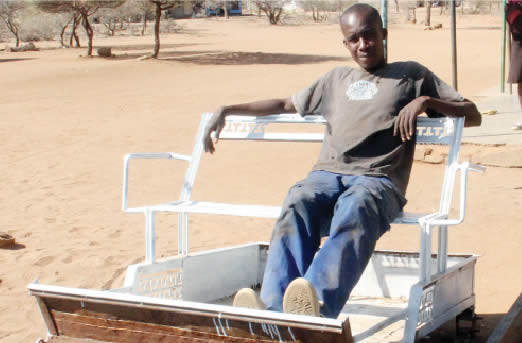

Obey Sibanda
UPON visiting Manama Mission Hospital in Gwanda, Matabeleland South Province, one is greeted by a packed parking lot of mini scotch carts dropping off pregnant women, the elderly and other sick people. “Spinkara”, as these carts are popularly known among the locals, have become the most popular mode of transport in this rural community.
The spinkara is a small strong and dependable form of transport drawn by two donkeys and used to carry a maximum of three people. The trailer is designed and engineered to withstand the toughest conditions, making it easy to navigate through the district’s poor roads.
It consists of an axle with bearings and wheels that turn separately. The standard sized body can be extended to carry light loads such as baby clothes and food stuffs. Spinkaras are popular because they are affordable and accessible.
Before the introduction of the spinkara, needy villagers from different parts of the district had a torrid time accessing health care services due to poor road networks and long distances between their homesteads and the hospital. Also, the poor road network in the area made it difficult for vehicles and ambulances to navigate.
Those who managed to reach the hospital through other means would still encounter transport problems getting back to their homes.
The most affected areas were Mapati, Halisupi, Mankonkoni, Fumukwe, Mbizo, Oliphant and Gungwe, which all depend on Manama Mission Hospital for medical care.
Villagers from Mankonkoni were the worst affected as they had to walk almost 20 kilometres to reach the hospital.
They narrated horror stories of women delivering at home or on their way to the hospital and of others dying while on verandahs of shops at various business centres as they waited for transport to the hospital.
Sibusiso Nare, a pupil at a local secondary school told of a chilling experience.
She witnessed her mother giving birth while on the verandah of a store at Mankonkoni Business Centre after they had failed to get transport to ferry them to the hospital.
“It’s so sad that the shopping centre is a hive of activity yet there’s not a single clinic. Most villagers can’t afford to get transport to the hospital. Five years ago, I was sitting at the verandah of the store with my mother patiently waiting for transport to take us to Manama Hospital. At around midnight, she went into labour and gave birth while on the verandah before we could make it to the hospital. At one point I was worried she would die because she was bleeding heavily,” said Nare.
Mankonkoni communal lands village head Amos Nyathi said: “The incident of the woman who gave birth at a shop verandah is just a tip of an iceberg. There’re actually more of such incidents that used to happen in the village. People would die on pavements due to delayed medical assistance.”
Villagers would walk long distances from their homesteads to the shops with the hope of getting transport to the hospital from business people who would be going to Gwanda to buy goods for restocking.
Sadly, they ended up spending days and nights at the centre. But, since the introduction of spinkaras, this has become a thing of the past.
“Spinkaras are a gift that came at the most opportune time. Actually, we view them as the hand of God. Now, almost every homestead has one,” said Nyathi.
There are several reasons for the lack of transport alternatives in this part of the district, including the reluctance of rural people to use public transport.
Also, the low population density does not generate the traffic volumes needed to sustain public transport.
The poor state of roads combined with inadequate transport services has an adverse impact on access to the already costly rural health centres and schools.
Farmers are unable to transport their produce to the market and in the few cases they are able to do so, they are made to pay a lot of money as the few vechicles available take advantage of high demand for their services.
For most people in the region, spinkara riding is the only affordable form of transport. It is also a leisure activity and numerous sub-cultures and lifestyles have evolved around the use of spinkaras.
For rich families, spinkaras are mainly used for recreation, as a lifestyle accessory or a symbol of personal identity.
However, while riding a spinkara can be enjoyable and has been beneficial to many families, it has left a trail of injuries and deaths.
Spinkaras are particularly susceptible to accidents due to their relative instability.
Unexpected and abrupt changes on the road surface can be harmful, causing even the most careful and experienced rider to lose control of the spinkara and veer into the path of a car or plunge into a ditch or river.
A nurse at Manama Mission Hospital only identified as MaNdlo said: “Injuries from scotch-cart accidents occur mainly to young boys who enjoy the thrill of speed and fail to take necessary precautions. Victims of scotch-carts usually sustain head injuries.”
Last year, a 10-year-old boy from Bulilima was crushed to death after a scotch cart he was travelling in overturned and hit him on the head.
In Mwenezi, a 34-year-old man died on the spot and two others escaped unhurt when a 200-litre drum of water on a donkey-drawn scotch cart they were travelling in slid backwards and hit him.
Another boy from Mwenezi in the Chief Maranda area died last year when a donkey-drawn scotch-cart he was travelling in hit a tree stump and overturned near Rutenga Business Centre.
The police have repeatedly warned members of the public not to allow children to travel in scotch-carts alone.
They also urge adults not to leave scotch-carts with children on board unattended because animals can behave awkwardly and children will not be able to control them.



 Bongani Ndlovu
 Online Reporter