admin
admin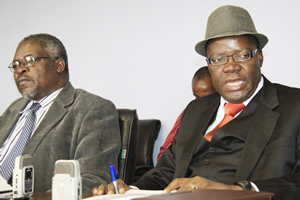
Research Unit, the World Bank, the Zimbabwe Strategic Economic Research and Analysis Programme and the African Capacity Building Foundation.
The forum comes amid concerns over slow economic growth due to underperforming agriculture and revenue inflows, which saw Government revise earlier growth forecasts.
Addressing the media in Harare yesterday on the seminar and progress on the 2012 National Population Census, Finance Minister Tendai Biti said the forum sought to find solutions to the current economic challenges.
“We will be conducting a high-level economic forum under the theme ‘Unleashing Zimbabwe’s Economic Potential’ over the period 29 to August 30, 2012,” said Minister Biti.
“The high-level forum will bring together high-level internal and external experts in various fields . . . from economic growth promotion, macro-economic stabilisation, infrastructure development, public finance management, trade promotion and financial sector reforms,” he said.
The forum will focus on strategies for leveraging productive sectors, such as agriculture, mining, tourism and manufacturing, through discussions on identified research topics.
Research areas include promoting sustainable and inclusive economic growth, prudent macro-economic management policies, debt management, cash budgeting, financing for investment and promoting competitiveness and job creation.
Recommendations from the discussions would also guide the 2013 National Budget consultations and crafting of future policy. Due to a number of economic challenges facing the economy, Minister Biti has revised his 9,4 percent economic growth forecast to 5,6 percent while the International Monetary Fund reviewed its earlier 5,5 percent forecast to 4,7 percent.
The Confederation of Zimbabwe Industries and Reserve Bank Governor Dr Gideon Gono have already declared an economic crisis and called for urgent solutions to halt the crisis.
Dr Gono cited the causes of the crisis as resource constraints, policy inconsistencies and the effect of sanctions imposed by Western countries.
Minister Biti revised his 2012 growth forecast, citing poor performance in agriculture and reviewed his 11,7 projected growth to a 5 percent decline as a result of the effects of the weather, acute lack of funding and input shortages.
Tobacco, on which growth in agriculture was largely expected to leverage, failed to meet its projected target of 150 million kg only settling at about 130 million kg.
Minister Biti also revised his US$4 billion national budget to US$3,4 billion due to limited inflows into the fiscus.
The manufacturing sector has failed to recover meaningfully due to lack of funding and old equipment. According to Industry and Commerce Minister Welshman Ncube, the industry requires over US$2,5 billion to retool.
The mining industry, which accounts for about 60 percent of foreign exchange inflows, is battling to raise production and requires about US$5 billion to recapitalise over the next five years.
Minister Biti said Government was also working on strategies to address the RBZ debt issue, lender of last resort function, high bank charges and underperforming loans on banks’ balance sheets.


 Online Reporter