Online Reporter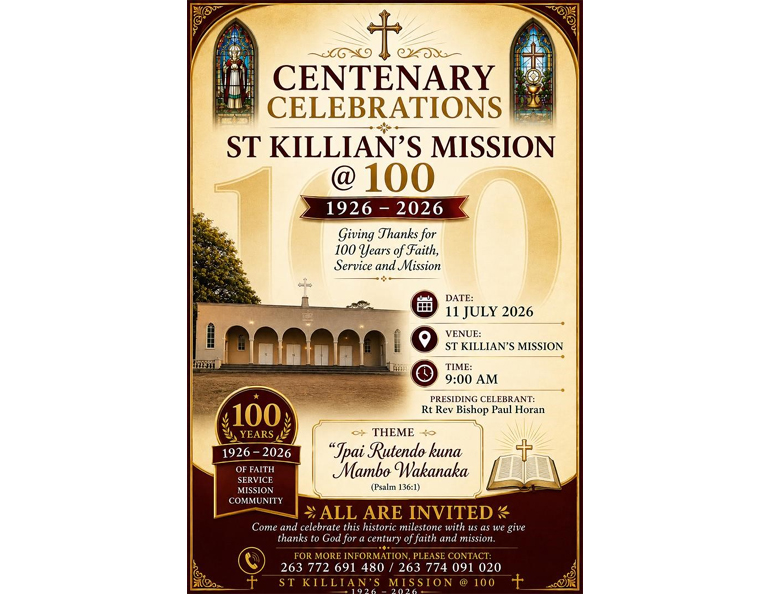
Tendai Gukutikwa
Post Reporter
STANDING quietly among weathered buildings that have witnessed generations of prayer, lessons and community gatherings, St Kilian’s Mission carries the memory of a century-long journey that began in humility.
What began as a small outstation founded on faith and sacrifice has grown into a centre of worship, education and community transformation, shaping generations across Makoni and beyond.
As the mission marks 100 years since its official establishment in 1926, it reflects on a remarkable story built by missionaries, priests, religious sisters, teachers, catechists and parishioners whose dedication has sustained its vision through changing times.
The old structures scattered across the grounds bear witness to a narrative that began more than a century ago – one of faith, perseverance and service.
Although formally established in 1926, the roots of St Kilian’s Mission stretch back to 1918 when Mariannhill Missionaries, from Triashill Mission, began evangelising communities in the area.
At the time, St Kilian’s and St Barbara’s operated as outstations of Triashill Mission.
Early mission activity is believed to have started at Gukurwere Mountain, near the local dip tank, before the present site was established on land donated by one of the first converts, Mr Michael Jack Nyamusamba.
The first missionaries worked in difficult conditions, using simple pole-and-dagga structures for worship, teaching and community meetings. Those modest beginnings laid the foundation for an institution that would become a major centre of the Roman Catholic life and education. Education became one of St Kilian’s strongest pillars from the outset.
In 1920, St Kilian’s Primary School opened, among the earliest learning institutions in the area. It later developed into a boarding school, giving children from surrounding communities access to education while instilling discipline, values and leadership.
Over the decades, the school produced men and women who went on to serve society meaningfully. Among its former learners are former Makoni Central Member of Parliament and Finance Minister, Honourable Patrick Chinamasa, and businessman, Mr David Masukume. The arrival of Brother Theophil of the Mariannhill Missionaries on December 2, 1925 marked another milestone, as he became the first religious to reside permanently at the mission.
His presence signalled the transition of St Kilian’s from a visiting outstation to an established mission community.
The Mariannhill Missionaries continued their work until 1929, when responsibility passed to the Jesuits. The Jesuit era brought further growth.
One of the most significant achievements was the construction of the first permanent church, consecrated in 1936, replacing temporary structures and became a lasting symbol of the growing Catholic community.
The Jesuits also expanded pastoral work by establishing several outstations.
Father Hector is remembered for his commitment to reaching communities beyond the mission, travelling from village to village on horseback with his horse, Bob, spreading the gospel and establishing new Christian communities.
In 1948, administration was passed to the Carmelites. Their 64-year tenure, the longest under one congregation, was marked by significant growth in education, pastoral work and community development.
Among the first Carmelites to serve were Fathers Ambrose Roche, Luke Flynn and Barty McGivern.
One of their early contributions was drilling the mission’s first borehole, improving water access for the mission and surrounding communities. The Carmelites also welcomed several congregations of religious sisters whose work transformed education and social welfare.
The Presentation Sisters arrived in 1951, the first religious sisters at St Kilian’s.
They taught in classrooms, instructed catechism, trained local women in handicrafts and assisted the sick, extending the mission’s work beyond the church.
The Little Children of Our Blessed Lady Sisters later joined, continuing similar work in education and pastoral care.
Perhaps the biggest milestone came in 1965 with the opening of the secondary school. The Religious Sisters of the Sacred Heart of Mary (RSHM), who arrived in 1964, played a key role in establishing the institution alongside Carmelite priests and lay missionaries.
The school opened with 44 learners – 32 boys and 12 girls – under its first headmistress, Sister Consilia. From those modest beginnings, St Kilian’s High School grew into one of the region’s most respected learning institutions.
Dormitories, classrooms, a science laboratory and other facilities were constructed, supporting academic and personal development. The school’s progress was interrupted by the liberation struggle, which forced the primary and secondary schools to close in 1976.
Both institutions reopened in 1983, continuing the mission’s long tradition of education.
One figure indelibly linked to St Kilian’s history is Father Joseph Vernon Neville. Serving from 1966 until his death in 2000, Father Vernon left a lasting impact on the spiritual and social life of the community. He expanded pastoral outreach by establishing new outstations, including St John the Apostle and St Francis, Mount Jenya.
He also played a key role in the construction of the new church, consecrated in 1977, working with Brother Ignatius Muzunde and local catechists.
Beyond the church, Father Vernon taught English and Bible Knowledge, promoted sport, supported the building of staff houses and established a social centre. Many in the community still recall his compassion towards vulnerable families.
His legacy endures in the buildings he helped to develop and in the lives he touched.
In 2001, the Handmaids of Our Lady of Mount Carmel Sisters joined the mission, continuing the tradition of religious sisters serving through education and pastoral ministry.
A new chapter opened in July 2012 when the Carmelites handed over the administration to the diocesan clergy, marking the start of further growth and renewal.
Since then, the mission has expanded its role within the Diocese.
Some former outstations have become independent communities, including St John’s Parish in Odzi and St Faustina Mission, established in 2024.
Today, St Kilian’s serves about 1 200 parishioners across 11 outstations, under the leadership of Father Nyambiti and Father Chidamoyo, assisted by catechist, Mr Nyambabvu.
The mission has also seen renewed development. At St Kilian’s Primary School, improvements include a computer laboratory, renovated classrooms, Wi-Fi connectivity, solar power and a new classroom block.
Academic performance has risen, with pass-rates climbing from below 60 percent to above 80 percent.
The school now has 333 learners, 21 teachers and two ancillary staff under head, Mr Madzima. St Kilian’s High School has undergone similar transformation.
The construction of a modern Science laboratory, Advanced Level complex, school hall, multi-purpose sports court and the acquisition of a new school bus have reshaped the institution.
Academic excellence defines the school, with 90,48 percent Ordinary Level pass-rate and 100 percent Advanced Level pass-rate.
With more than 500 learners, 31 teachers and 15 ancillary staff under head, Mr Zivanai, the school continues to prepare learners for higher education and national development.
As St Kilian’s celebrates its centenary, its greatest measure of success remains the people whose lives it has shaped.
In over 100 years, the mission has produced priests, religious leaders, teachers, professionals, businesspeople and public servants who continue to contribute to Zimbabwe’s development. The centenary is therefore not only about historic buildings and milestones, but about honouring the generations who built and sustained the mission.
From the Mariannhill Missionaries who planted the first seeds of faith, to the Jesuits, Carmelites, religious sisters, diocesan priests, teachers, catechists and parishioners who carried the vision forward, each generation has added a chapter to St Kilian’s story.
The mission’s historic buildings — the old priest’s house, churches, schools, convents and laboratories — represent more than structures. They are reminders of devotion, sacrifice and a shared belief in the power of faith and education.
A century on, St Kilian’s Mission stands as proof of what can be achieved when communities work towards a common vision.
As it enters its next century, the mission carries forward the values that guided its pioneers: faith, service, education and hope. From a humble outstation to a thriving centre of worship and learning, St Kilian’s Mission remains a place where generations continue to find inspiration and opportunity.