

 Online Reporter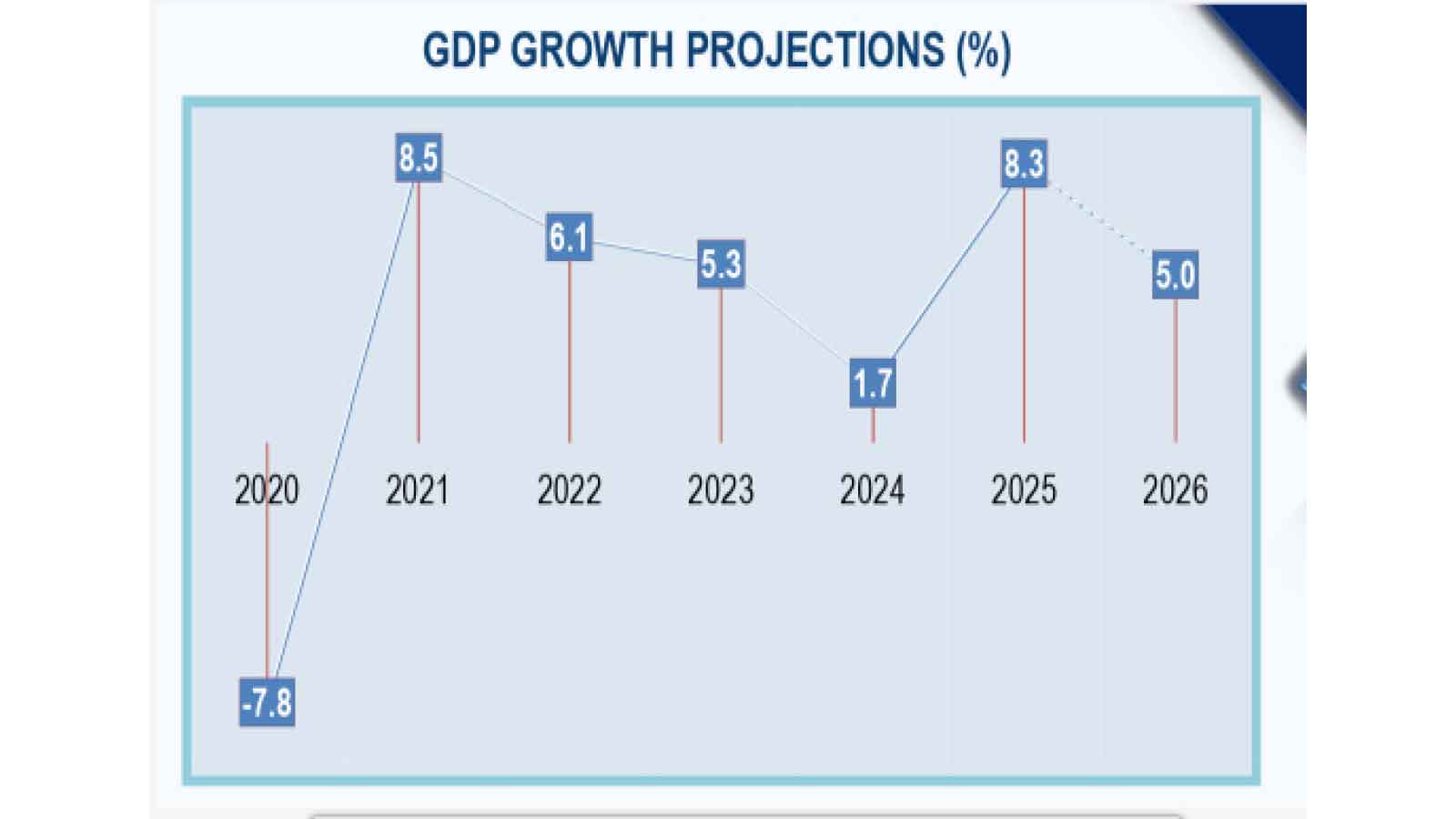
Nelson Gahadza
Senior Business Reporter
Zimbabwe’s stable inflation environment has created the conditions for stronger-than-expected growth, with the economy expanding by 6,8 percent in the first quarter of 2026, putting it on track to outperform the Government’s initial full-year growth forecast of 5 percent.
Presenting the 2026 Mid-Term Budget and Economic Review in Parliament yesterday, Finance, Economic Development and Investment Promotion Minister Professor Mthuli Ncube said disciplined macroeconomic management had delivered low and predictable inflation, strengthened confidence in the Zimbabwe Gold (ZiG) currency and provided a solid platform for sustained economic expansion despite global uncertainties.
He said the combination of price stability, robust economic activity and ongoing structural reforms demonstrated that Government policies were beginning to deliver tangible results, positioning Zimbabwe to accelerate progress towards attaining Vision 2030.
“The economy performed impressively at 6,8 percent during the first quarter of 2026. This is much higher compared to about 4 percent during the same period in 2025.
“If we continue on this trajectory, it is possible to meet or surpass the 8,3 percent recorded in 2025 for the full year of 2026,” Prof Ncube said.
The first-quarter performance has already exceeded the Government’s original 2026 growth projection, raising prospects of another year of robust economic expansion following last year’s strong recovery.
Prof Ncube attributed the improved outlook to a stable macroeconomic environment characterised by low inflation, prudent fiscal management and growing confidence in the local currency.
“Inflation developments during the first six months of 2026 reflected a stable and predictable macroeconomic environment, devoid of inflationary pressures, supported by a sound macroeconomic balance sheet and growing confidence in the local currency,” he said.
He noted that month-on-month inflation remained consistently below the Government’s five percent benchmark throughout the first half of the year, with the only notable increase occurring in April after conflict in the Middle East triggered higher global oil prices, resulting in increased domestic fuel costs.
“Month-on-month inflation remained low and stable, well below the current 5 percent threshold, with the notable exception of a temporary increase in April 2026 due to the effects of the Middle East war on international oil prices and subsequent increases in domestic fuel prices,” he said.
The temporary spike, he added, did not alter the broader inflation outlook, with underlying price pressures remaining firmly contained.
Annual inflation averaged 4,4 percent between January and June before easing further to 3,2 percent in July, the lowest annual inflation rate recorded in decades.
“In the month of July 2026, annual ZiG inflation was 3,2 percent, the lowest inflation we have seen in decades.
This development showed that the underlying inflationary pressures remained contained and that inflation expectations continued to be well anchored,” Prof Ncube said.
He said the stable inflation environment had significantly improved predictability for businesses and households, allowing firms to plan production, investment and pricing with greater certainty while supporting long-term economic decision-making.
Prof Ncube said preserving macroeconomic stability remained central to the Government’s strategy of transforming Zimbabwe into an upper middle-income economy by 2030.
“While the country has made commendable progress towards the realisation of Vision 2030, there is a need to accelerate the implementation of strategies and policy reforms in the medium term to ensure that the Vision is attained,” he said.
He noted that Zimbabwe must increase per capita income by at least US$1 400 between 2026 and 2030 to attain upper middle-income status.
The minister also pointed to improving external sector performance as further evidence of strengthening economic fundamentals.
Foreign currency receipts increased by 47,8 percent to US$10,7 billion during the first six months of 2026, compared with US$7,3 billion recorded during the corresponding period last year.
Meanwhile, the current account posted a surplus of US$606,3 million in the first quarter, reinforcing the country’s improving external position and overall macroeconomic stability.
Prof Ncube said macroeconomic stability was being reinforced by wide-ranging regulatory reforms aimed at reducing the cost of doing business and improving Zimbabwe’s competitiveness.
He told Parliament that 61 percent of approved reforms relating to licences, permits, levies and fees had been implemented by June 2026 following President Mnangagwa’s January 2025 directive to eliminate unnecessary regulatory burdens.
The reforms span 12 key sectors, including agriculture, manufacturing, mining, financial services, transport, tourism, construction, energy, telecommunications, broadcasting, health, and wholesale and retail, with Cabinet having completed its review of all priority sectors.
“The review includes removal of unjustifiable and redundant licences and permits, the streamlining of duplicative and overlapping regulatory requirements through the consolidation of licensing functions under single regulatory authorities, as well as the review and reduction of fees and levies that were increasing the cost of production and service delivery,” Prof Ncube said.
Among the most significant measures already implemented are reforms in the transport sector, where the Road Access Fee has been abolished, first-time vehicle registration fees reduced from US$500 to US$50, change-of-ownership charges cut from US$515 to US$95, and route permit fees lowered from US$75 to US$20.
The requirement for garage inspection reports, which previously cost US$25, has also been scrapped.
In the mining sector, licence fees for artisanal and small-scale miners have been substantially reduced relative to those paid by large-scale operators, while livestock producers stand to benefit from the elimination or significant reduction of 96 regulatory fees after the Government found that compliance costs for a typical small beef farmer exceeded 400 percent of annual revenue.
Government has also moved to harmonise and cap similar fees charged by local authorities to improve consistency, transparency and predictability across the regulatory framework.
To ensure reform momentum is sustained, Prof Ncube said a second phase of the exercise is now under way to review licences, permits, levies and fees not covered in the initial programme, as well as regulations affecting sectors outside the original priority list.


