Chronicle Editor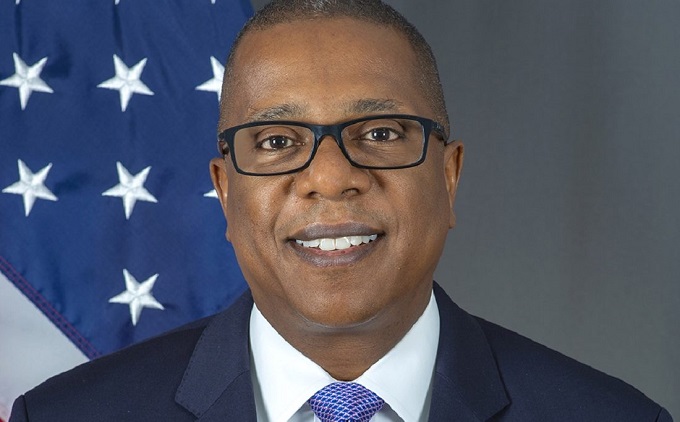
Tawanda Musarurwa, Harare Bureau
Standard Chartered Bank has been fined US$18 million for violating the United States Department of the Treasury’s Office of Foreign Assets Control (OFAC)’s sanctions on Zimbabwe in a development that exposes misrepresentations by US Ambassador to Zimbabwe Brian Nichols.
Ambassador Nichols told Capitalk FM yesterday that the sanctions had no adverse effect on the Zimbabwean economy and that businesses were immune to the sanctions.
“Zidera is a roadmap to better relations with the US and international community. There’s no economic impact of Zidera on Zimbabwe thus far, because Zimbabwe has not met the requirements for new lending,” said Ambassador Nichols.
“The largest Zimbabwean businesses are not under targeted sanctions. Issues with access to foreign exchange, rule of law and ease of doing business, these impede growth and economic progress in Zimbabwe.”
But he was exposed for lying through his teeth as it emerged that Standard Chartered Bank, a global bank with operations in Zimbabwe, received punishment from OFAC.
OFAC said the punishment is for over 1 795 transactions worth close to US$77 million that were done by Standard Chartered Bank New York and Standard Chartered Bank Zimbabwe.
“Between May 2009 and July 2013, Standard Chartered Bank Zimbabwe processed transactions to or through the United States involving Zimbabwe-related Specially Designated Nationals (SDNs) or entities owned 50 per cent or more, individually or in the aggregate, by one or more Zimbabwe-related SDNs.
“These transactions constituted apparent violations of the Zimbabwe Sanctions Regulations (ZSR), 31 C.F.R. Part 541. Standard Chartered Bank will remit $18,016,283 to OFAC to settle civil liability relating to the apparent violations of the ZSR.
“[Standard Chartered and its Zimbabwe unit (SCBZ)] appear to have had actual knowledge regarding customer relationships that SCBZ maintained with persons identified on the SDN List over a period of several years,” said OFAC.
Zimbabwe’s sanctions are guided by the Zimbabwe Democracy and Economic Recovery Act of 2001 (Zidera), which puts paid to the deception that the sanctions are “targeted on certain individuals.”
The US maintains that the sanctions are ‘targeted’ at 56 companies and 85 individuals in the country.
According to Zidera, Zimbabwe must enforce the Sadc tribunal judgments on land before sanctions can be lifted. A provision of the Act reads:
“It is the sense of Congress that the Government of Zimbabwe and the Southern African Development Community (Sadc) should enforce the Sadc tribunal rulings from 2007 to 2010, including 18 disputes involving employment, commercial, and human rights cases surrounding dispossessed Zimbabwean commercial farmers and agricultural companies.
If not done, under section (c) of the of Zidera, the United States Secretary of the Treasury is ordered to “instruct the United States executive director to each international financial institution to oppose and vote against any extension by the respective institution of any loan, credit, or guarantee to the Government of Zimbabwe; or any cancellation or reduction of indebtedness owed by the Government of Zimbabwe to the United States or any international financial institution.”
The US$18 million fine is part of a broader $639 million settlement between Standard Chartered and OFAC as part of a combined US$1,1 billion settlement with federal, state, local, and United Kingdom government partners.
The London-based Standard Chartered paid $639 million for the Iran sanction violations, together with violations involving Cuba, Sudan, Burma, and Syria in what OFAC called that the “global settlement.”
The United States, through its OFAC, has over the years slapped companies with millions worth of fines for conducting business with or on behalf of sanctioned countries, firms or individuals.
Last week, a “sanctions policy statement” by one of the world’s 10 biggest financial institutions — HSBC — served to highlight the scope of the sanctions placed on Zimbabwe.
HSBC, which does not operate in Zimbabwe, reiterated its commitment to “sanctions laws and regulations of the European Union, Hong Kong, the United Kingdom, the United Nations, and the United States, as well as applicable sanctions laws and regulations in the jurisdictions in which HSBC operates.”
And among those policies which it said its entire group subsidiaries must comply with is restriction on “certain business activity involving, directly or indirectly, countries or persons subject to more selective or targeted sanctions programmes.”
“As of January 2018, the selective country programmes prohibit transactions and services relating to the provision of funding to the Government of Belarus or Government of Zimbabwe,” said HSBC.
Earlier in March, United States President Donald Trump extended sanctions against Zimbabwe by a year, claiming that new government’s policies continue to pose an “unusual and extraordinary” threat to American foreign policy.



 Online Reporter