Martin Kadzere
PLAYERS in the steel industry and related spheres believe the Government’s move to introduce import licences for certain steel products will have a positive impact on the development and expansion of the sector.
The regulations make import licences mandatory for specific iron and non-alloy steel products.
These include flat-rolled products, hot-rolled or twisted bars and rods.
The intervention will enable the Government to manage steel product imports effectively.
Zimbabwe — once a regional iron and steel production hub when the Zimbabwe Iron and Steel Company (Zisco) was still operational — is now poised to reclaim its former glory.
Zisco shut down major operations in 2008 due to a combination of factors.
The recent commissioning of Dinson Iron and Steel Company (Disco) — now Zimbabwe’s largest steel producer — marks a significant step towards the resurgence of the sector.
“It’s a dual win — protecting and developing our industry while opening doors for new players,” Dinson operations manager Mr Wilfred Motsi said in an interview with The Sunday Mail Business.
Regional peers like South Africa and Zambia have already shown the success of such restrictions.
Tanzania may hike steel import duties from 25 percent to 35 percent to shield local producers from foreign competition, aligning with Uganda and Kenya’s tariffs to boost domestic output.
South Africa is undertaking its most extensive steel tariff review in over 20 years, potentially increasing duties and import controls to protect its struggling local industry.
“We believe the Government could still do more to match the restrictions by other countries,” said Mr Motsi.
“The Government should also re-evaluate import licence requirements for products not yet manufactured domestically or for those that are produced but aren’t currently under licensing regulations.”
Engineering Iron and Steel Association of Zimbabwe chief executive officer Mr Matthias Ruziwa said the new regulations could boost capacity utilisation within domestic manufacturing and reduce the country’s reliance on imports.
“By prioritising local production and curbing external procurement, Zimbabwe’s steel sector is set to achieve greater self-sufficiency and contribute more robustly to the national economy,” he said.
Iron and steel imports topped US$256 million last year, with US$61,7 million recorded in the first three months of this year.
Grindale Engineering chief executive officer Mr Grison Muwidzi said the licensing regulations would significantly boost the local industry.
He, however, emphasised the need for complementary measures to promote value addition for iron and steel products.
“Restricting imports is a noble idea,” Mr Muwidzi explained.
“But it now requires more supportive measures to bolster local industries. We need to replicate the integrated steel industry we had during the Zisco era, when we had robust companies along the value chain, such as Lancashire Steel, Haggie Rand and Metal Box, which themselves became powerhouses.”
With primary raw materials for steel products production now readily available, Mr Muwidzi said, the focus should shift towards developing steel value-addition industries.
For Zimbabwe Institute of Foundries (ZIF) chief operations officer Mr Dosman Mangisi, import restrictions will encourage other industries to emerge and thrive.
Steel’s unique properties — strength, durability and versatility — make it the backbone of critical infrastructure like buildings, bridges and railways.
It is also an essential component in the fabrication of heavy machinery and vehicles, as well as household appliances and advanced technological components.
The industry also acts as a significant economic driver, creating jobs and fostering innovation throughout its extensive supply chain.
Supply of steel billets and pig iron by Dinson is now providing steel product producers with significantly improved raw materials for their manufacturing.
Before Dinson’s entry, the industry was relying on recycled steel, while others filled their needs through imports.
Demands
This strategically positions the country to become a major regional supplier of iron and steel products, leveraging its proximity to neighbouring markets that currently rely heavily on imports.
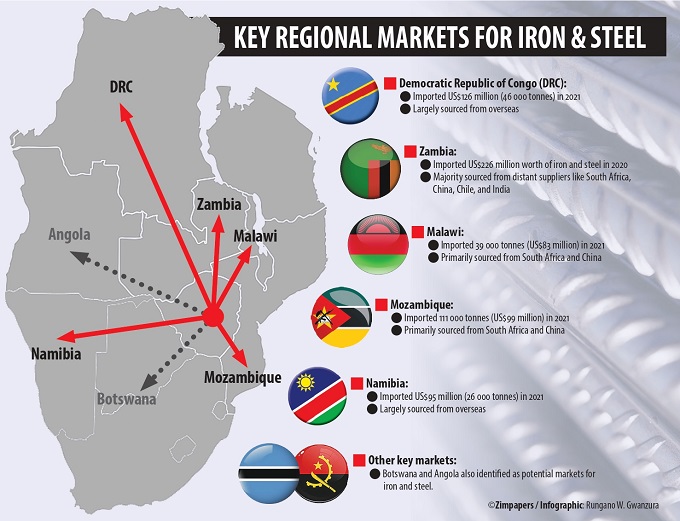
Key regional markets identified by ZimTrade, including Zambia, Botswana, Angola, the Democratic Republic of Congo (DRC), Malawi, Mozambique and Namibia, present substantial potential demand.
For instance, Zambia imported approximately US$226 million worth of iron and steel in 2020, with most of it sourced from distant suppliers like South Africa, China, Chile and India.
Similarly, Malawi imported around 39 000 tonnes (US$83 million) in 2021 and Mozambique 111 000 tonnes (US$99 million), primarily from South Africa and China.
Namibia and the DRC also reported significant import values in 2021, at US$95 million (26 000 tonnes) and US$126 million (46 000 tonnes), respectively, largely from overseas.
Zimbabwe’s ability to produce competitive products, particularly from new facilities like the Manhize iron and steel plant, positions it to significantly displace these imports from distant places.
By capitalising on shorter logistical distances and potentially lower costs, Zimbabwe can become a preferred supplier, boosting its export earnings and fostering regional industrial growth.