Online Reporter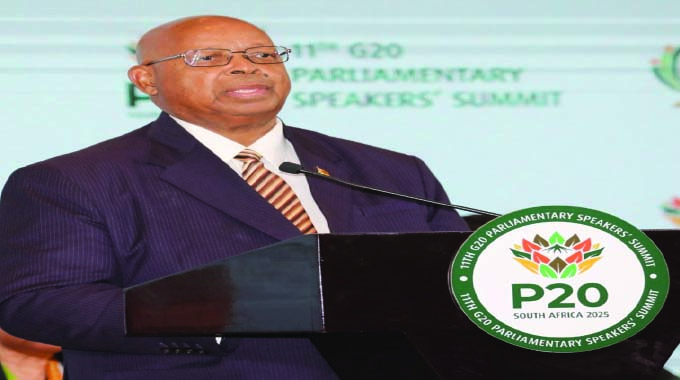
Peter Matika, [email protected]
SPEAKER of Parliament Advocate Jacob Mudenda has challenged legislators worldwide to rise above partisan and national interests by taking an active, decisive role in resolving global conflicts, fostering peace and reforming an international economic order that marginalises the developing world.
Speaking at the 11th edition of the G20 Parliamentary Speakers’ Summit (P20) held in Cape Town, South Africa recently, Adv Mudenda said parliamentarians must no longer be passive observers in the face of wars, injustice and economic inequities.
Instead, they should harness the power of parliamentary diplomacy to influence global decision-making and bridge geopolitical divides.
“Parliamentary diplomacy must act decisively where traditional avenues struggle, focusing on conflict resolution, peace-building, and fair dialogue rooted in the UN Charter,” said Adv Mudenda.
He drew parallels between the global crises of today — particularly in the Middle East and Eastern Europe — and the lessons ignored from World War II, noting that humanity continues to repeat the same mistakes that led to catastrophic loss of life.
“It was only after millions had died that people decided to sit down and end the war. Yet it appears humanity does not introspect or learn from history. The Second World War, which claimed 25 million lives, only ended through such dialogue,” said Adv Mudenda.
He commended South Africa’s leadership in advocating diplomacy grounded in international law, particularly its efforts at the International Court of Justice, which have won growing support from African and global partners.
Adv Mudenda urged parliaments across the world to back the two-state solution in the Middle East and to directly engage authorities in Israel and Palestine to ensure compliance with United Nations resolutions.
He also called for decisive parliamentary engagement in the Russia–Ukraine conflict, saying diplomacy must prevail over militarism.
“It will be important for selected countries and parliamentary leaders to engage directly with the authorities in Israel and relevant executives to fulfil the commitments set by the United Nations General Assembly, ensuring peace and security in the Middle East,” he said.
“The same applies in Eastern Europe. The conflict between Russia and Ukraine must come to an end, and parliamentary diplomacy is being called upon to intervene decisively.”
On global economic justice, Adv Mudenda denounced the financial and trade systems as heavily skewed against developing nations, particularly those in the Global South.
“Members of G20 governments control most of the world’s economy, yet Africa, which provides 40 percent of critical minerals, continues to suffer from inequitable trade and undervalued exports. It is unacceptable that the European union has enacted laws governing the exploitation of Africa’s minerals without proper consultation or fair compensation,” said Adv Mudenda.
He cited growing inequality, noting that just one percent of the world’s richest people control nearly half of global wealth, and said it is time for global governance to reflect justice, inclusion, and equity.
“Parliamentary diplomacy must achieve tangible results to create a world characterised by social justice, peace, and security, where all nations are respected in accordance with the United Nations Charter, Article 2(3) and (4). Let us march together towards this vision and we will achieve it,” said Adv Mudenda.
The G20 Parliamentary Speakers’ Summit (P20) — which represents over 85 percent of global GDP, two-thirds of the world’s population, and 75 percent of international trade — provides a platform for legislators to influence global policy on trade, climate change, sustainable development and peace.
The Inter-Parliamentary union (IPU), which supports the process, aims to strengthen parliamentary oversight and accountability in implementing G20 commitments and advancing the 2030 Agenda for Sustainable Development.
The forum initially focused on broad macroeconomic issues, but it has expanded its agenda to include trade, climate change, sustainable development, health, agriculture, energy, the environment and anti-corruption.
The involvement of the parliamentary community in G20 discussions began with a series of informal parliamentary speakers’ consultations, launched by Canada in 2010 and followed by South Korea in 2011, Saudi Arabia in 2012 and Mexico in 2013.
Starting at the fifth G20 Parliamentary Speakers’ Summit held in Argentina in 2018, the IPU has contributed to a more structured process.
G20 Speakers’ Summits (P20) aim to bring a parliamentary dimension to global governance, raise awareness, build political support for international commitments, and ensure that these are effectively translated into national realities.