

 admin
admin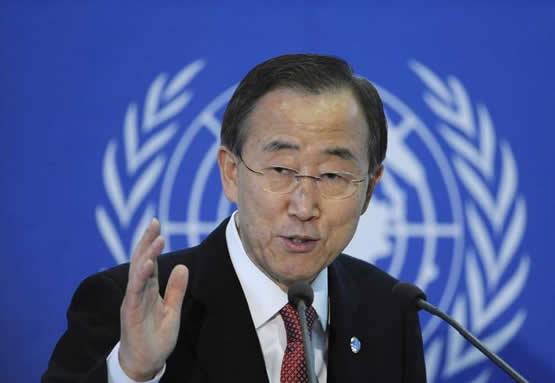
UNITED NATIONS/MOSCOW. — UN Secretary-General Ban Ki-moon appealed yesterday to major powers to stop sending weapons to all sides in Syria, as he opened the annual General Assembly summit.
“I appeal to all states to stop fuelling the bloodshed and to end the arms flows to all parties,” Ban told world leaders.
The UN chief also called on Syrian President Bashar al-Assad and the opposition — and “all those in this hall with influence over them” — to work immediately to arrange a second Geneva conference aimed at reaching a political solution.
“Military victory is an illusion. The only answer is a political settlement,” he said.
Ban’s appeal comes as the United States and Russia haggle over the language in a Security Council resolution meant to seal an agreement for Assad to give up chemical weapons.
US Secretary of State John Kerry was to meet his Russian counterpart Sergei Lavrov later in the day. Russia is the main supporter of Assad, while the rebels receive support from Western nations and Sunni Arab monarchies.
Meanwhile, the United States, supported by Britain and France, was pushing for an “illogical” UN Security Council resolution on Syria, a high-ranking Russian diplomat said yesterday.
The UNSC resolution must conform to the decisions of the executive council of the Organisation for the Prohibition of Chemical Weapons (OPCW) “without adopting Chapter VII of the UN Charter,” Deputy Foreign Minister Sergei Ryabkov told the State Duma.
Chapter VII says the Security Council may authorise that military force could be used if other sanctions prove ineffective “to maintain or restore international peace and security.”
“Chapter VII could be mentioned only in connection with a set of measures against violators in case a refusal of co-operation with the OPCW . . . or use of chemical weapons,” the Interfax news agency quoted Ryabkov as saying.
He believes Chapter VII paves the way to military action in some cases.
Moscow insisted there should be no mention of use of force against Damascus, nor automatic sanctions in the proposed UNSC resolution.
The diplomat warned that aggression against Syria had been postponed so far but not completely eliminated. He admitted contacts between Moscow and Washington were not proceeding smoothly and the situation during these contacts had not developed in the proper direction. “The US agreed on compromise over chemical weapons but they keep insisting the Syrian regime is guilty,” he said, adding Washington did not present comprehensive proof but “constantly make reservations that the plans to punish Damascus remain in force.”
Ryabkov will attend a session of the Parliamentary Assembly of the Council of Europe (PACE) next week in France’s Strasbourg, where the Syrian crisis is on the agenda. — AFP/Xinhua.



 Online Reporter