

 admin
admin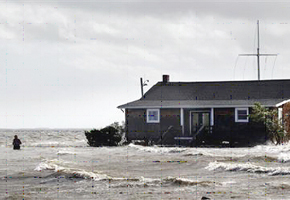
The storm interrupted the presidential campaign a week before Election Day — posing both risks and opportunities for President Barack Obama as he seeks a second term in a tight race — and closed US financial markets for a second day.
As a weakened but still massive storm system continued its trek inland, more than one million people in a dozen states were under orders to evacuate. Sandy left behind a trail of damage — homes underwater, trees toppled and power lines downed — caused by epic flooding and fierce winds all along the Atlantic coast.
In the storm’s wake, Obama issued federal emergency decrees for New York and New Jersey, declaring that “major disasters” existed in both states. One disaster-forecasting company predicted economic losses could ultimately reach $20 billion, only half insured.
“It’s total devastation down there, there are boats in the street five blocks from the ocean,” said evacuee Peter Sandomeno, one of the owners of the Broadway Court Motel in Point Pleasant Beach, New Jersey.
“That’s the worst storm I’ve ever seen, and I’ve been there for 11 years.”
Sandy, which was especially imposing because of its wide-ranging winds, brought a record storm surge of almost 4,2 metres to downtown Manhattan, well above the previous record of 3 metres during Hurricane Donna in 1960, the National Weather Service said.
Water poured into the subway system and tunnels that course under the city, raising concerns that the world’s financial capital could be hobbled for days.
“Hitting at high tide, the strongest surge and the strongest winds all hit at the worst possible time,” said Jeffrey Tongue, a meteorologist for the weather service in Brookhaven, New York.
Hurricane-force winds as high as 90 miles per hour were recorded, he said.
“Hopefully it’s a once-in-a-lifetime storm,” Tongue said.
As residents and business owners began the daunting clean-up effort, large sections of New York City remained without power, and transportation in the metropolitan area was at a standstill.
It was the worst disaster to strike the storied New York subway system in its 108-year history, and the Metropolitan Transportation Authority said it could take up to four days to get the water out of the flooded train tunnels.
The unprecedented flooding hampered efforts to fight a massive fire that destroyed more than 50 homes in Breezy Point, a private beach community on the Rockaway barrier island in the New York City borough of Queens.
New York University hospital was forced to evacuate more than 200 patients, among them babies on respirators in the neonatal intensive care unit, when the backup generator failed. Four of the newborns had to be carried down nine flights of stairs while nurses manually squeezed bags to deliver air to each of the baby’s lungs, CNN reported.
Two people in New York City reportedly died in the storm — a man in a house hit by a tree and a woman who stepped into an electrified puddle of water. Two other people were killed in suburban Westchester County, north of New York City, and two others were reported killed on suburban Long Island.
A motor vehicle death in Massachusetts was blamed in part on the bad weather. Two other people were killed in Maryland in storm-related incidents, state authorities said, and deaths also were reported in Connecticut, New Jersey, Pennsylvania and West Virginia, CNN said.
Toronto police also recorded one death — a woman hit by flying debris.
Sandy killed 66 people in the Caribbean last week before pounding US coastal areas.
More than 7 million people in several US states were without electricity due to the storm, which crashed ashore late on Monday near the gambling resort of Atlantic City, New Jersey.
With Obama and Republican presidential rival Mitt Romney keeping campaigning on hold for a second day instead of launching their final push for votes ahead of the 6 November election, the storm’s onslaught added a new level of uncertainty to an already tense, tight race for the White House.
Obama, who has made every effort to show himself staying on top of the storm situation, faces political danger if the federal government fails to respond well in the storm’s aftermath, as was the case with predecessor George W Bush’s botched handling of Hurricane Katrina in 2005.
But Obama also has a chance to look presidential in a national crisis.
With politics cast aside for the moment, New Jersey Governor Chris Christie, a Republican, heaped praise on the Democratic incumbent for the government’s initial storm response.
“The federal government response has been great,” Christie, a staunch Romney supporter, told NBC’s “Today” show. “I was on the phone at midnight again last night with the president personally … and the president has been outstanding in this.”
Federal government offices in Washington, which was spared the full force of the storm, were closed for a second day yesterday, and schools were shut up and down the East Coast.
The storm was ploughing westward over south-central Pennsylvania, still packing near hurricane-force winds as strong as 65 miles per hour (105 km per hour), the National Weather Service said.
Wind gusts, rain and flooding were likely to extend yesterday, but without the storm’s earlier devastating power, said AccuWeather meteorologist Jim Dickey. — Reuters


 derick.khumalo
 Online Reporter