Chronicle Editor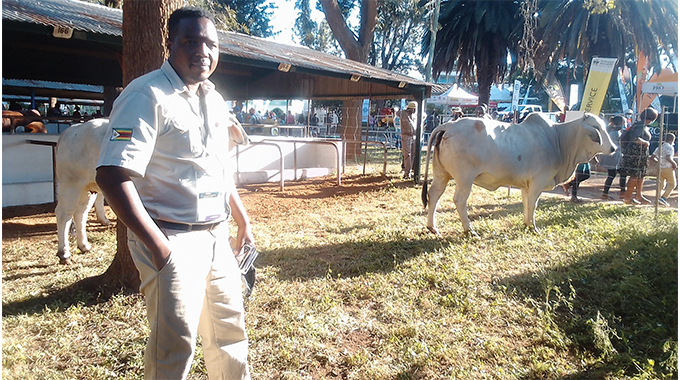
Sikhumbuzo Moyo, Senior Reporter
MR Douglas Nyathi (42) is a young commercial and livestock farmer who brought three of his finest studs for the Agricultural Show at the ZITF.
Mr Nyathi has 32 studs at a farm in Shangani and 78 commercial cattle at Malundi Farm along the Bulawayo-Kezi road.
Each stud is prized at a minimum of US$2 500.
Commercial herd farming normally focuses on breeding animals of good weight.
The ultimate goal is to have an animal with a good weight for eventual sale to the butcheries while stud cattle farming focuses on good genes.
As Mr Nyathi mentions the numbers, one naturally sees a completely content farmer until he explains why his commercial herd is now at 78, down from 185 in the early years when he started venturing into cattle farming 10 years ago.
Simply put, Mr Nyathi has no land.
“I trimmed my beasts by transferring them to another farm due to overgrazing where I was initially renting while I sold some to invest into stud breeding. I had to move some of the animals all because I don’t have a farm that I call my own, I am renting and it makes it so difficult to expand my project because the land I am in is not mine.
Expansion is determined by land, so is infrastructural improvement. You cannot drill boreholes for drinking water for the animals neither can you plant maize for silage all because that is not your land,” said Mr Nyathi.
He said even accessing loans from financial firms to capacitate his project was a non-starter because he does not have an offer letter that he can use as collateral when applying for a bank loan.
“I have not had any assistance as a young black farmer, I am doing all this alone but it has always been my intention to get a loan but it’s impossible to get it because I don’t have an offer letter. I am renting farms so when I talk of a project, I will only be referring to my cattle which, sadly, I cannot use at the bank as collateral.
You can assure them that you have cattle which can be viewed as proof but the bank will still ask you about the security of their money in the event that you fail to repay the loan, only to find that we don’t have an offer letter and that becomes the end of the story, so it’s a bit tricky for me to say I can get any financial aid from these banks as a result of what I said,” said Mr Nyathi.
To condition his studs for the agricultural show, Mr Nyathi received some assistance from Mzansi Express while Island Feeds provided two tonnes of stock feed to condition them for the show.
Just how did Mr Nyathi start his cattle farming business?
“I started this project 10 years back but my focus then was commercial animals and doing cross-breeding. I used to cross-breed Brahman and Beef Master so that is how I started on cross-breeding and growing my commercial head. I remember at one point around 2014, I had 185 animals in Malundi but we got into challenges due to grazing land so
I had to reduce my number as a result of overgrazing. It’s also a dry area that often experiences droughts. I found a farm to rent along Bulawayo-Plumtree road,” said Mr Nyathi.
He said commercial cattle are good breeders hence as the herd grew, he decided to venture into stud breeding last year in January that saw him forming a company called Malundi Brahman Stud.
“This kind of breeding is a sensitive one to things like genes,” he said.
Stud breeding involves animals that are traceable in terms of genes. Some farmers jokingly refer to them as cattle with birth certificates because the family tree is traceable.
“When you do stud breeding, you are simply documenting your herd in every aspect. You are even sensitive to the structure of the animal. I registered my project with Zimbabwe Herd Book (ZHB) as Malundi Brahman Stud. ZHB is responsible for all the database for the animals we breed. I am also a member of the Brahman Association and from last year I managed to secure 18 breeding animals, this is why I said at the moment I have 32 because some have already delivered calves,” said Mr Nyathi.
As a result of not having his own land, Mr Nyathi has been forced to sell some of his cattle even though his ambition is to have as many cattle as possible on his own farm.


 Online Reporter