Chronicle Editor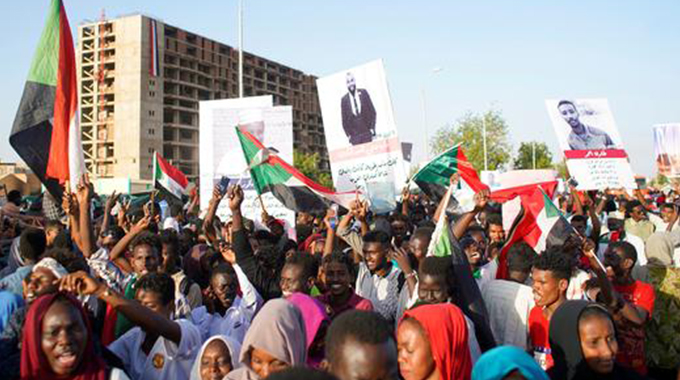
Sudan’s main protest group says an attempt is under way to break up a sit-in outside the defence ministry in the capital, Khartoum, as the country’s military rulers face increasing pressure to hand over power to a civilian government.
The Sudanese Professionals Association (SPA) called on people to respond by joining the sit-in to “protect your revolution”, according to a statement published on its social media pages.
The mass protest outside the ministry entered its 10th day yesterday.
Thousands remained camped outside the complex overnight after protest leaders issued demands to the military council set up after veteran president Omar al-Bashir was overthrown.
The organisation that spearheaded the four months of protests leading to al-Bashir’s fall, the SPA, urged the council “to immediately transfer power to a civilian government”.
Sudanese demonstrators displayed their national flag and the national flag of South Sudan, as they attended a sit-in protest outside the defence ministry in Khartoum.
It said the resulting transitional government and the armed forces must bring to justice both al-Bashir and officials from his feared National Intelligence and Security Service (NISS).
The United States, Norway and the United Kingdom urged the military council and other parties to hold talks over the country’s transition to civilian rule.
In a joint statement by their embassies on Sunday, they warned against any use of violence to break up the protests, and said the “legitimate change” the Sudanese people demanded had not taken place.
“It is time for the transitional military council and all other parties to enter into an inclusive dialogue to effect a transition to civilian rule,” they said.
“This must be done credibly and swiftly, with protest leaders, political opposition, civil society organisations, and all relevant elements of society, including women.”
Sudan’s military council yesterday said it was restructuring the council and appointed Colonel General Hashem Abdel Muttalib Ahmed Babakr as army chief of staff.
Colonel General Mohamed Othman al-Hussein was appointed as deputy chief of staff, the council said in a statement.
On Sunday, the council met political leaders and urged them to agree on an “independent figure” to be prime minister, an AFP news agency correspondent at the meeting said.
“We want to set up a civilian state based on freedom, justice and democracy,” a council member, Lieutenant General Yasser al-Ata, told members of several political parties.
A 10-member delegation representing the protesters delivered a list of demands during talks with the council late on Saturday, according to a statement by the Freedom and Change alliance.
But in a Press conference later, the council’s spokesperson did not respond to the protesters’ latest demands, although he did announce the appointment of a new intelligence chief of the NISS.
– Al Jazeera



 Online Reporter