admin
admin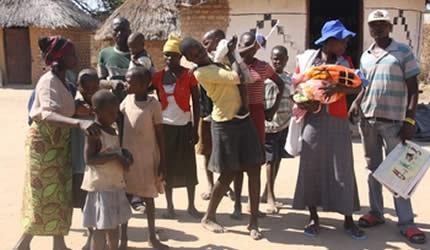
Known to many Zimbabweans as a super dad, polygamist Luka Ngwenya (53) of Chireya area under Chief Mukoka, who has sired over 40 children with his five wives, looks strong on the outside but he is a broken man who is finding it difficult to take care of his ever increasing number of children.
The latest addition, Mthandazo, from his third wife Hlekiwe Tititi Ngwenya (40) also known as MaMoyo brings the number of his living children to 27. He now says the children are enough.
While many may envy the super dad, for his siring prowess, his remaining two wives feel sorry for him as they watch the burden of taking care of his children take its toll on their husband.
The way the wives narrate their life and what meets the eye when one visits their homestead leaves many stunned.
“We were always pregnant and it felt abnormal not to be,” said MaMoyo.
A total of 11 children, out of the 16 who are still in school, were at home because of non-payment of fees when The Herald knocked on their doors last Thursday.
The children all aged between six and 14 were scattered on all corners of their yard.
A dark skinned lean woman holding a plate of golden brown homemade bread emerged from the kitchen hut and made her way to the car to see who the visitors were.
Her small eyes quickly scanned through the passengers to see if there were any familiar faces. She finally caught a glimpse of MaMoyo who was holding her baby and performed a small dance, ululated, welcoming both mother and child.
“My sister has come, she has brought our baby, our late sister-in-law,” she said.
All the children also tried to lay their hands first on the child.
The children were no match as they were outdone by the woman who took the baby from the warmth of its mother and performed another victory dance.
Like hyenas waiting for a lioness to finish her feast and take the leftovers, the 11 kids just watched from a distance.
For a moment, we had no doubt that the ululating woman was MaMoyo’s elder sister but lo and behold, she is 50-year-old Delia Maongera, her husband’s first wife.
We later gather they call each other sisters.
“We are so close that our babies would breastfeed from any available mom with ease as we would have children at almost the same time.
“We respect each other. I do not see her as my husband’s first wife but as my sister. We are one big family and I have never called her amaiguru (older wife) and neither has she called me mainini (younger wife). Our husband taught us to love each other in this marriage and this keeps us as a unit. We also do not go to our husband to say bad things about each other.
“In fact we gang up against him if we want anything. Saying bad things about another wife is what makes many polygamous unions fail. We are sisters first and wives last,” says MaMoyo.
It’s her first time to return home since she was discharged from Gweru Provincial Hospital a few days earlier and the family is excited.
The notable absentee is their husband who has gone to some gold claims 25 kilometres away to try to raise money for school fees.
There is no rest for the superdad as he has 41 hungry mouths to feed. This is a typical baby welcome for the Ngwenya family under Chief Chireya in Nembudziya, where love and respect knows no boundaries.
“Our husband does not know the total number of his kids and neither does he know their names.
He just calls them by any name and the closest to him answers,” says Maongera who was married in 1971.
She is the quieter of the two wives and has 13 children. She has had two miscarriages.
The children are Chiedza born in 1980, Esnath (1983); Chipo (now late but born in 1985); Sam (1987); Jabulani (born in 1989 but deceased); Jewel (1991); a miscarriage in 1992; Gabriel (1993); a child born in 1995 but died at one month; Samson (1997); Charity (2000), another miscarriage (2001); Simon (2004).
MaMoyo gave birth to 15 children and had three miscarriages.
The children are an unnamed one who died soon after birth in 1987; Innocent (1988); Nyasha (1990); Petros ( born in 1992 but died at six months); miscarried in 1992; another miscarriage 1994; Tatenda (1996); Ropafadzo (1998); Moses (2000); Billy (born in 2002 but now late); Barbra (2004); Martha(2006); Kuda (2008); Sibongile (2010) and Mthandazo (2013).
The late second wife Maria Mazivisa had four children, Job 1986; Joyce (1989); Zacharia (born in 1992 but now late); Tsungai (1996); twins Ruvarashe and Tinashe (1999) and Tsitsi and Munashe (2003). She had one miscarriage.
Two other wives who left Ngwenya are Fadzai Maongera who had one child and Tsitsi Washaya who also had a child. They were both Maongera and MaMoyo’s sisters respectively.
Ngwenya also takes care of his late brother’s two children Francis and Angela, both minors.
He has 10 grandchildren.
Born in the Johanne Marange Apostolic Church to a polygamous father, MaMoyo views polygamy as just a normal way of living.
“My father had three wives and many children. My husband could have outdone him had other children not died,” she said as she sat on a reed mat laid for her by her “sister” to protect her from the cold cracked floor.
Maongera’s kitchen is dark and run down but there are signs that she attempts to keep it intact.
A metal sheet is in place of a windowpane.
Floral metal plates are neatly arranged on shelves made of clay.
All the children kneel and take turns to greet MaMoyo as they try to take a quick look at the baby, still in the possession of Maongera.
All the children call her MaMoyo, while they call Maongera mum.
Even if they make a picture perfect family, the wives say their ever increasing number is likely to cause cracks to their union as hunger has found its home in their midst.
They said they could not say no when their husband wants more kids, for he is head of family.
“Our husband is overburdened by the large number of children though he pretends that all is well. Men are too proud to concede when they fail, but this is too much for him,” says MaMoyo who met Ngwenya in 1985.
At 16 she fell head over heels in love with him after he told her he only had one wife.
“He is very clever and said his first wife wanted a friend to play with and I complied. I only learnt that he had two wives when I married him. I did not have a problem with that since I came from a polygamous family.
“I just said to myself, ndajutwa nababa ava, ( I have been tricked by this man),” she said.
Back then they had a small family, owned two cows, several chickens and goats.
They lived in pole and dagga houses.
But today, they own only two chickens, no goats. They do not own any cattle and the four they had in their kraal belong to Ngwenya’s younger brother who is a businessman, according to the wives and all the children.
The cattle they owned died of hunger.
“Babamudiki is our umbrella who protects us from this harsh world. He helps us with food, payment of fees and other things. He is the one who paid for my medical bills when I was discharged from hospital since my husband had no money. He also bought a very nice coffin when our husband’s second wife died,” said MaMoyo.
The 16 children in primary and secondary school need a total of US$1 470 for fees which are in arrears. They do not know where the money will come from. Sometimes the children mould bricks to raise school fees, but customers are not always available.
Ngwenya buys pens, books, covers etc but they are never enough for all the kids.
“Mapositori just collect wives like trophies and fail to take care of them, it really hurts,” says MaMoyo.
Until recently, their children were not immunised against measles or any other child killer disease. They survived by the grace of God.
There is no toilet at the homestead as the walls of the one they had collapsed and no one bothered to have it repaired. They use the bush for all sanitary requirements.
A collapsed house, which belonged to Maria Mazivisa, the late second wife, is being renovated.
There are six other small houses at the homestead one used as a bedroom by one of the older boys Nyasha.
Nyasha’s room is the pride of the family as it contains most of what they count as their valuable wealth, besides the 25 acres of land they got under the land reform.
In the small bedroom is a small solar panel, DVD player, two speakers, a bed and an inverter.
The family insists that photographer Innocent Makawa should take pictures of this room for the world to see the achievements of this hardworking child they now look up to. He has become sort of father figure as he always tries to fill in the father’s gaps whenever Ngwenya goes gold panning.
Two other huts are used by another married son, Sam and his wife and child.
The other kitchen belongs to MaMoyo, and this is where all the female children sleep. The males sleep in the first wife’s kitchen hut. Ngwenya and his wives use a two-bedroomed house. Each wife has her own room.
The granary is almost empty and the family is afraid the maize will not last till the end of the year.
“We did not harvest much and need about four buckets of maize per month. We do not know how we will feed all these children if the maize runs out. We will bother our brother-in-law again,” she emphasized.
MaMoyo is HIV positive and now on ARVs.
She thanks her brother-in-law for advising her to leave the Johane
Marange Apostolic faith sect and seek medication.
“I could have been dead right now were it not for my brother-in-law. People would say all sorts of things when I was pregnant with this child because I became very sick at one point before I knew my HIV status.
Others said I would die but here I am today,” she said.
She added they now use condoms to prevent transmission.
Ngwenya admitted that he was facing serious challenges to feed and educate his children.
The money they get comes from cotton sales.
“Last season we got 17 bales but the money was not enough. We are contract farmers and had to repay loans. We also planted cotton this season and we are harvesting,” he said.
He, however, is not honest about his wealth.
“I own 11 cattle, my wives each have six chickens and we also have nine goats,” he boasts.
He thanked President Mugabe for the land reform saying it had empowered him when he was allocated 25 acres of land.
Village head Tafataona Gone said they had been assisting the family with food but it was never enough.
“BEAM has also been assisting them but the challenge is they have to give others a chance,” he said.
Feedback – [email protected]


 Online Reporter