admin
admin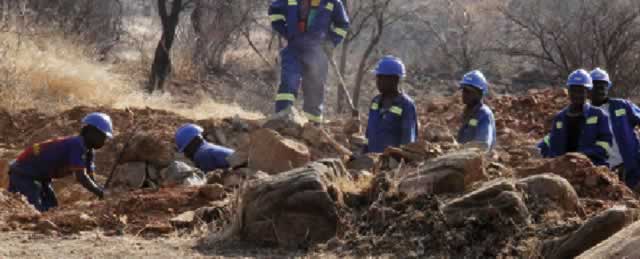
Factmore Dzobo
It’s a hazardous occupation which claims scores of lives every year. Last month, Enock Mbulayi watched as five of his colleagues were crushed to death when a disused mine shaft where they were illegally working in Kwekwe collapsed.
He lived to tell the tale only because other panners working in neaby shafts heard his cries for help.
In Umzingwane district, a gold miner suffocated in a shaft at Mclaren Mine after inhaling poisonous fumes from a fire that had been made to crack rock about 22 metres underground.
The country’s illegal miners and artisanal small scale miners are risking life and limb in their search for the precious metals in various mining communities across the country.
Incidents of illegal miners and panners killed or injured are viewed by some experts as emanating from the problem of unregulated mining activities in the informal mining sector.
Experts said most fatal incidents in the informal mining sector were as a result of government’s lack of proper regulation and policies to support and govern the operations of the informal mining sector activities.
Artisanal small scale miners are accused of causing extreme environmental degradation with severe social impacts while seldom contributing to government revenues.
Economist Enoch Mupera, who is also an artisanal small scale miner, said the artisanal small scale miners in their current form, cannot be regarded as contributing to sustainable livelihoods, but provided emergency poverty relief and daily sustenance.
“Unregulated artisanal small scale mining activities have often been viewed as the major cause of extreme environmental degradation with many reports of causing more detrimental social impacts and seldom contribute to government revenues. In their current form, they cannot be regarded as contributing to sustainable livelihoods, but they’re mainly associated with various health and safety risks,” said Mupera.
Mupera said as long as the sector continued to operate informally and unregulated with no proper government support in terms of finance and technology; it would remain a health and safety threat to the miners.
Zimbabwe Artisanal and Small-Scale for Sustainable Mining Council president Wellington Takavarasha said because of the unregulated nature of many artisanal small scale miners, labour exploitation and the use of simple tools were one of the major reasons for mishaps affecting the informal mining sector.
The use of rudimentary tools by most of the unregistered artisanal small scale miners were the major cause of deaths.
He said unregistered artisanal small scale miners were ignorant of health and safety measures associated with mining operations.
“Some small-scale miners use rudimentary equipment like chisels, picks, buckets and wheelbarrows when mining and very often they’ve to rely on man-made mining explosives which more often than not endanger their lives. There is also lack of geological information and technical know-how on health and safety measures among the illegal miners to the extent that some can risk their lives by entering into deep mineshafts with poor ventilation without taking into consideration the required safety tools and they ended up suffocating in the process,” said Takavarasha.
He said it was imperative that artisanal small scale miners be regularised for monitoring purposes and to ensure that the environment was kept safe from dangerous mining activities to avoid loss of lives.
“Most of the unregulated mining operations create negative impacts on the environment both during the mining operations and for years after the mine closed. It’s very important to regularise the sector and educate miners on the dangers of unsustainable mining activities on the environment,” he said.
Environmental Management Agency (EMA) said there is need to regularise and work closely with the artisanal small scale miners to monitor their operations.
EMA Planning and Monitoring Manager Allet Nyahuye said the agency had started pilot projects to encourage artisanal small scale miners to form syndicates for easy monitoring.
“Many unregulated artisanal small scale miners practice unfriendly mining activities, causing negative impact on the environment and to the society. We need them to form groups so that we can be able to monitor and support them to practice sustainable mining practices,” she said.
Recent calls by the government to have artisanal small-scale miners formalised have intensified following realisation that they can enhance revenue collection if the minerals they extracted were sold within proper channels.
The government has recently come up with a raft of legislative measures to repeal the bulk of provisions in the Mines and Minerals Act in a move set to align the law with latest development in the mining sector.
The new regulations under the auspices of Zimbabwe Mining Development Policy are already before Cabinet for consideration and the amendments are expected to address the shortcomings of the current Act in dealing with ownership and exploitation of the country’s rich mineral resources. The amendments will also incorporate some provisions for the artisanal small scale miners and indigenisation of the mining sector which were excluded in the old Act.
Mphoengs Miners’ Association leader Elliot Ndlovu commended the government’s effort to amend the archaic colonial Mines and Mineral Act saying the development will bring sanity for the artisanal and small scale miners and the mining sector at large.
“Amendments of the colonial Mines and Minerals Act would also address the issue of unregulated informal mining sector activities. Some of the amended laws would spearhead the decriminalisation of mining operations undertaken by gold panners and this will also allow the government to give them mining licences so that they can operate lawfully and able to get government support,” said Ndlovu.
Ndlovu highlighted the need for the government to put to an end some issues of double dealing in the offering of mining claims.
“The issue of decriminalising the illegal mining will mean that sanity will prevail as miners would get organised and able to register with the Ministry of Mines and Mining Development and benefit from a Gold Fund or loans that will also allow us to receive proper mining equipment and technical support while, in turn, selling our mineral to the state for national development,” he said.
Finance Minister Patrick Chinamasa revealed in his 2015 National Budget Statement that government was working on modalities to formalise activities of artisanal small-scale miners. He also revealed that Zimbabwe’s diverse mineral resources offered scope for significant contribution in supporting and stimulating the country’s economic blueprint Zim-Asset growth rate of over 6 percent on an annual basis if amendments are made to the ancient Mines and Minerals Act.
“Amendments to the Mines and Minerals Act should also result in a progressive and investor friendly mining title management system. This will enable the implementation of the beneficiation and value addition strategy while at the same time attracting local and foreign investment in the mining sector,” said Cde Chinamasa.
President Mugabe is also on record describing Zim-Asset as being “crafted to achieve sustainable development and social equity anchored on indigenisation, empowerment and employment creation which will be largely propelled by the judicious exploitation of the country’s abundant rich natural mineral resources.
Zim-Asset is expected to leverage on the country’s rich mineral resources, generating revenue to facilitate socio-economic transformation. It identifies mining sector as the major foreign currency earner with the potential to become the pillar for economic growth through value addition and beneficiation.


 Online Reporter