Online Reporter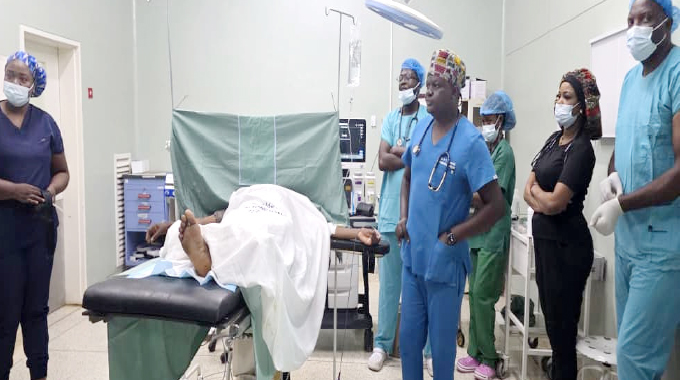
Rumbidzayi Zinyuke, [email protected]
A special orthopaedic surgical camp at Gweru Provincial Hospital is giving new hope to dozens of patients who have been waiting for treatment, as doctors work to reduce a growing backlog of trauma-related cases.
The week-long programme is already making a difference, with 18 operations successfully carried out by Thursday. The hospital aims to assist at least 30 patients by the end of the camp, most of whom suffered fractures and serious injuries from road accidents and mining incidents across Midlands Province.
Leading the effort is Head of Surgery, Dr Brian Paketh, who said the province continues to face high numbers of trauma cases because of its location and economic activities.
“Gweru Provincial Hospital is the referral centre in Midlands Province and we are inundated with trauma cases. We have major roadways passing through the province and these are sites of many road traffic accidents. We also have a lot of mining activities that result in trauma cases, which need to be managed here,” he said.
He said that delays in treating patients are often caused by limited operating space and shortages of essential orthopaedic materials such as implants. To tackle this, the hospital introduced the surgical camp, dedicating specific theatre time to patients who have been waiting for operations.
The focus is mainly on treating bone injuries, including fractures of the hip, knee and upper limbs — many of which, if left untreated, can leave patients permanently disabled.
Dr Paketh said the Ministry of Health and Child Care has played an important role by funding the purchase of implants, while private partners have also come in to support through public-private partnerships.
“Our concern is that trauma mainly affects the middle-aged working population who should otherwise be contributing to the country’s economy but are stuck at home because of injuries. We also have elderly patients with fractures who risk losing mobility if they stay too long without treatment,” he said.
Among those who have benefited from the programme is Rumbidzai Musekiwa, whose story is nothing short of remarkable. She survived a crocodile attack while crossing the Mbembeswane River in February.
“As we were crossing the river, I felt something grab my leg and I knew that it was a crocodile. As it was trying to pull me towards the deeper end of the river, I managed to hold on to a tree with one arm and continued to push at its jaw with another until my aunt and her son arrived to rescue me. We fought with the crocodile for more than 30 minutes until they managed to insert a stick inside its mouth while attacking it. That is when it let go of me,” she said.
After the attack, Musekiwa was first treated at Kwekwe Hospital, where she received blood before being transferred to Gweru.
“I stayed in hospital from then until I finally got my surgery yesterday. I am grateful that I did not lose my leg,” she said.
Another patient, Evans Dube, also shared his experience after undergoing surgery for a fractured thigh bone following an assault.
“When I came here, I received a donation for the implants used during my surgery so I did not pay anything,” he said.
Despite the success of the camp, hospital authorities say there are still challenges that need to be addressed.
Acting Medical Superintendent Dr Johannes Mukwembi said the hospital is under pressure, as it is operating beyond what its infrastructure was originally designed for.
“We are still very much a provincial hospital in terms of infrastructure, although we are operating at the level of a central hospital in terms of the services we are offering. With all these specialists on board and the old ward system that we have, we struggle to accommodate patients. We only have two functional theatres excluding maternity. So, dedicating one theatre to orthopaedics strains the system.”
Dr Mukwembi said there are plans to expand the hospital’s wards and operating theatres, but these will take time and require significant funding.
He also called on partners and well-wishers to continue supporting such initiatives, especially in providing implants and other medical supplies.
“These camps really benefit communities because most of the patients are breadwinners. If someone is hospitalised for months, they cannot fend for their families. Once operated on, they can return to their communities and resume productive lives,” he said.
With demand for such services continuing to grow, the hospital is already planning another orthopaedic camp in September, with hopes of making the programme a regular, quarterly initiative.
For many patients, the current camp has not just offered treatment, but a second chance at normal life.