admin
admin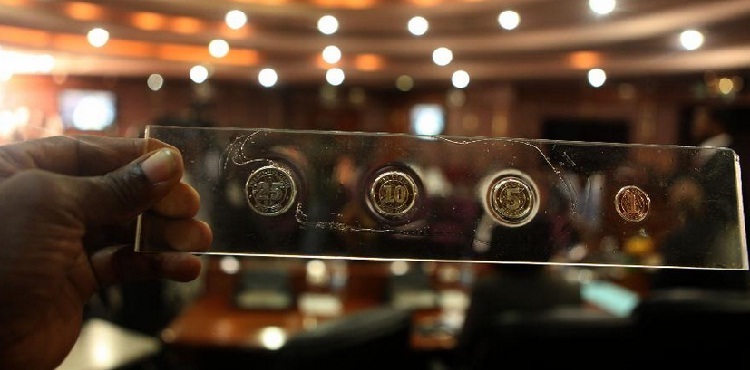
Persistence Gwanyanya —
THE market cannot simply ignore the general concerns over bond notes. Also, the behaviour of people who are already taking positions ahead of their rollout cannot equally be ignored.
No matter how misguided and irresponsible those that are betting on a parallel market rate for bond notes might be, it must be appreciated that they carry an important vote in the success or otherwise of bond notes.
Quite often, perceptions are self-fulfilling prophecies. What is perceived, especially on currency markets, usually comes to pass. This underscores the need to understand market concerns and adequately respond to them.
Necessary safeguards should be put in place to avoid a repeat of the 2008 era of arbitrage. What will be key is to ensure that bond notes trade at par with the US dollar during their life.
The debate on if bond notes will seamlessly work in place of the US dollar has been dominating social and economic discourse since the announcement of the policy early this year.
Some market watchers are putting out arguments on how pegging the exchange rate of the bond notes at par to the US dollar is unsustainable. In sum, the hypothesis is that bond notes will ultimately trade at a discount.
The premise of this argument is the assertion that the only time where economic fundamentals support two currencies remaining at the exchange of 1: 1 is in a common monetary area. Outside a CMA arrangement, two currencies cannot trade at a par if one of them is not fungible or tradable outside the country.
Since bond notes are only tradeable in Zimbabwe, an exchange rate of 1:1 with US dollar would be difficult to sustain, it is argued. The analysis points to the assertion that you can’t regulate financial markets without the preparedness to accommodate their judgement.
It is also believed that Gasham’s law, which postulates that bad money drives out good money, will apply in the determination of the exchange between bond notes and US dollars. The anlaysis further emphasises that preference for the US dollar will see it being wiped off the market by bond notes and kept as a store of value.
High demand for the US dollar, due to our huge dependence on imports, against dwindling supply of the same will, see them trading at a premium to bond notes on the informal sector, is the argument. Whilst all this may sound thoughtful, it is not exhaustive as it left out some of the key factors that guarantee maintenance of an exchange rate in both CMA and bond note scenarios.
The analysis limits factors guaranteeing an exchange rate of 1:1 in a CMA to the decisive influence that the issuing country wields over the monetary policies of the rest of CMA.
This is not the only factor needed to sustain a currency peg in a CMA.Maintaining an exchange rate peg in CMA largely depends on the ability by other members to maintain adequate reserves, which requires prudent fiscal policy.Under the South Africa-Lesotho-Namibia-Swaziland CMA, there is an agreement that countries can issue their own national currencies (loti, Namibian dollar and lilangeni) as long as they are supported with equivalent foreign reserves.
The biggest threat to the CMA is mounting fiscal pressure in non-issuing countries, which could lead to large losses of reserves and a break of the exchange rate peg.
At one point, low international reserves in Namibia and Swaziland undermined confidence in the CMA exchange rate arrangement, increasing vulnerability to external shocks.
Argentina in 2000 offers an interesting case. The country experienced a major crisis in 2001 to 2002, the currency board arrangement was abandoned, and the peso started floating.
An important factor behind the crisis was deterioration in the fiscal position. Thus, discrediting the proposed exchange rate peg of 1:1 between the bond notes and US dollar may not hold water.Like in the CMA arrangement, a currency peg will be sustained by the necessary safeguards to limit oversupply of domestic currency and minimise occurrence of a black market.
There is need to ensure that bond notes do not flood the market, which will lead to their discount.One of the reasons why the bond coins have so far maintained the rate of 1:1 to US dollar is that they remained in short supply.Only an amount of US$15 million, out of the US$50 million facility, are currently circulating in the economy.
Given a population of 13 million people in Zimbabwe, it means that the average exposure to the bond coin is less than US$3,85 per person, which is too insignificant to upset the exchange rate peg. By the end of the year, an estimated US$75 million in bond notes will be injected in the economy to take the total to US$125 million, which translates to an average exposure of US$9,62 per person, which is still very low.
Even after the bond notes are fully injected, the average exposure will be US$19,23 per person, which is still too insignificant to cause parallel market activities and disturb the exchange rate.
Like in the CMA, where fiscal discipline is key to sustaining an exchange rate of 1:1 between two currencies, RBZ should observe discipline by ensuring that it doesn’t print more that the US$200 million bond notes guaranteed by the Afreximbank facility.The fact that bond notes will be injected on a gradual basis lends credence to their success as it limits the amounts in circulation at any given time.
This is the biggest fear of ordinary citizens who have experienced financial turmoil caused by indiscipline before.There is need for transparency in handling bond notes, which RBZ advised will be achieved through formation of an independent board to oversee them.
Needless to say, the credibility of board members will be key to gaining market confidence.Unlike in the CMA arrangement, where the issuing country controls monetary policy and the amount of domestic currencies to be issued by the rest of CMA members – usually related to the level of foreign currency reserves – the formula used to arrive to the US$200 million bond note facility is unknown.
So, if the US$200 million is the appropriate amount to restore the exchange rate of 1:1 to the US dollar is something we cannot easily determine.
The RBZ’s arguments have largely been that the bond notes facility is less than four percent of total bank deposits.
However, if looked in terms of the average daily cash holdings of banks, which is around US$200 million, bond notes will be sufficient to replace all cash balances, hence it’s possible they can replace a significant amount of the foreign currency circulating locally. The best thing would be to use foreign currency to fund nostro accounts for foreign payments.
There is need to understand that in essence bond notes are a solution to cash challenges, which is only a symptom of the fundamental economic challenges confronting Zimbabwe today.It is a pity that the country spends six months debating bond notes when industry is reeling.
There is need for the country to start producing and exporting on a serious scale. This should complemented by a reduction in consumption and imports. This is the only way we can revive our economy. If this economic rebalance is achieved, we may not even worry about currency challenges.
Persistence Gwanyanya is an economist, banker, and member of the Zimbabwe Economics Society who writes in his personal capacity. Feedback: [email protected] and WhatsApp +263773030691



 Online Reporter