admin
admin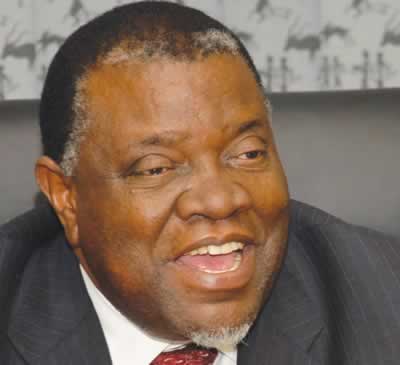
WINDHOEK. – Namibia’s ruling party South-West Africa People’s Organisation (Swapo) looked set for a sixth straight election victory yesterday, according to a second round of preliminary results.
With slightly more than half of votes counted, the Swapo party – in power since 1990 – was leading the polls with 77 percent.
The party’s candidate for president, Hage Geingob, received 86 percent of votes in a presidential election also held on Friday.
Geingob, who served twice as prime minister in the former German colony rich in diamonds and uranium, faced eight challengers.
On Saturday, the Electoral Commission of Namibia (ECN) had released a first round of preliminary data putting Swapo in the lead with slightly more than 66 percent of the vote.
About 1,2 million Namibians were eligible to vote in Friday’s first electronic polls in Africa.
The electoral commission pegs voter turnout at 69 percent. In addition to diamond and uranium extraction, Namibia is also a major travel destination, drawing tourists to the Namib Desert that runs along its coast.
The African Union election observer mission has said Friday’s elections were an expression of the will of Namibian voters.
“The elections were conducted in compliance with national laws of the country and in line with its international obligations. They were conducted in a manner that allowed Namibians to express their will freely and in a credible and transparent manner,” said Fatuma Ndangiza, the head of the 45-person AU election observation mission delegated to observe the elections.
Ndangiza also applauded Namibia for taking “an innovative and bold step” in adopting the use of the electronic voting machines (EVMs).
Namibia has made history by becoming the first African country to use EVMs.
Ndangiza, on behalf of the mission noted the Electoral Commission of Namibia (ECN) should in future elections ensure the training of staff on the use of technology in elections is continuous.
This, she said, would “improve their ability to operate the equipment”.
She added that in 15 percent of the observed polling stations visited by the AU election observer mission, voting stopped at least once because of technical issues with the use of the voter verification of the EVM system.
“These issues delayed counting in some stations by up to one hour, but in some cases were resolved quickly. In all cases, normal voting resumed after the issue was resolved,” she said.
Furthermore, Ndangiza said the ECN should consider simplifying polling station procedures, namely the voter identification process and recording of a voter’s presence to ensure all procedures be completed within the stipulated time frame for voting.
“Consider limiting the number of voters per polling station to reduce voters’ waiting times and overcrowding of some polling stations,” Ndangiza said.
Ndangiza noted the closing and counting process was observed at 13 voting stations and nine regions and 92 percent of observed polling stations closed late after 2100.
“Some polling stations only completed the counting process in the morning of November 29. The main reason for late closing was the long queues of voters still waiting to cast their ballot at closing time. All voters in the queue by closing time were allowed to vote,” Ndangiza noted.
She also advised that efficient measures be developed to improve the management of mobile polling stations to make them more effective.
“Consider including security personnel for advance voting to free some polling stations for regular voters and reduce crowding on election day,” she said.
She further encouraged the Namibian Government to ratify the African Charter on democracy and elections to further strengthen and entrench democratic governance in the country in line with international obligations.
Ndangiza also advised the country to amend its electoral law to regulate sources of party funding and to provide mandatory ceilings on campaign expenditure to ensure fair access to resources amongst all contesting political parties.
Meanwhile, members of the Namibian Economic Freedom Fighters (NEFF) did not take kindly to members of the SADC observer mission to Namibia after the observers described Friday’s elections as credible and fair.
Maite Nkoana-Mashabane, the head of the SADC observer mission to Namibia, who is also South Africa’s Minister of International Relations and Co-operation, said Namibia’s 2014 presidential and National Assembly elections “were peaceful, transparent, free, fair and credible reflecting the will of the people of the Republic of Namibia.”
However Nkoana-Mashabane’s statement did not go down well with some members of the NEFF who disrupted her while she spoke, disputing the elections were free and fair.
NEFF members were silenced by officials before they stormed out of the briefing packed with observers, journalists and diplomats among others.
“I just want to reiterate that there is nothing like a perfect election,” Nkoana-Mashabane said when a reporter commented her statement was not reflective of the fact that many people were unable to vote on Friday.
“Yes, the SADC observer mission observed that some people could not exercise their right to vote because of technical errors,” she admitted.
She, however, added that the Electoral Commission of Namibia (ECN) had by midday on Friday called a Press conference to address this challenge and they went into details as to “what was going wrong and what was going right”.
She also urged Namibians and political parties’ leaders to accept the outcome of the elections.
“Some of our observers also attended that Press briefing. But we will say at the end after having observed the elections that elections were generally peaceful, credible, free and fair because there was nobody who was chased away, apart from technical errors which the ECN admitted to by midday of the 28th (November). So there was no shenanigans of hiding anything. They came out and made a public statement,” she said to the applause of the SADC observer team.
Furthermore, Nkoana-Mashabane said the mission observed democratic practices and lessons learnt during Namibia’s 2014 elections. – New Era/Sapa/HR.


 Online Reporter