Online Reporter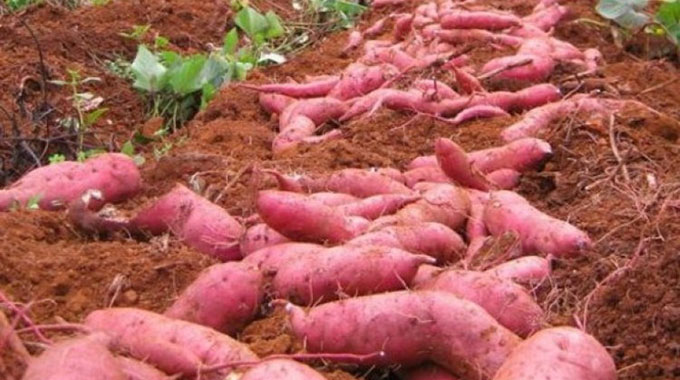
Word From The Market
Tina Nleya
CHILDREN who used to carry sweet potatoes to school instead of bread were often laughed at.
The tide has since changed.
We now envy those who eat sweet potatoes.
As demand for healthier, climate-resilient and value-rich crops continues to rise both locally and internationally, sweet potato (Ipomoea batatas) has emerged as a beacon of hope for Zimbabwean farmers.
Classified as a superfood for its rich nutritional profile, sweet potato presents an exciting economic opportunity with growing global demand, diverse value chain applications and increasing Government and private sector support.
Why sweet potato?
Sweet potatoes are loaded with essential vitamins, particularly pro-vitamin A, high-quality proteins, iron and fermentable fibre.
Their ability to grow in diverse agro-ecological zones, short maturity period (80-100 days) and tolerance to drought make them an ideal crop in the face of climate change.
Moreover, they require less capital investment and cold chain logistics compared to crops such as blueberries or avocados, making them suitable for smallholder and commercial farmers alike.
The Government of Zimbabwe, recognising the crop’s potential, has promoted its cultivation by distributing virus-free planting vines and supporting training initiatives through village business units (VBUs) and innovation hubs.
These initiatives are helping boost farmer incomes and food security while aligning with Vision 2030.
Value-addition potential
Sweet potatoes are incredibly versatile.
Beyond being consumed boiled or roasted, they serve as raw materials for a wide range of value-added products, including:
- Bread and flour: The University of Zimbabwe’s VN Agro (Pvt) Ltd is producing nutritious bread using sweet potato flour, reducing reliance on imported wheat
- Dried chips and crisps: These have high market appeal, especially in urban and export markets
- Juice and other beverages: Sweet potato juice and even vodka are gaining traction as unique, locally made products
- Noodles, candy, pectin, molasses, mock coconut and sugar: These products create avenues for agro-processing businesses
Sweet potatoes also integrate well into culinary dishes, including soups, salads, curries, flatbreads, brownies and more, offering chefs and households creative healthy options.
Zimbabwe’s production outlook
In Zimbabwe, sweet potato farming is gaining momentum across provinces, especially in Manicaland, Mashonaland East and West, and Masvingo.
The Ministry of Lands, Fisheries, Water and Rural Development, through Agritex, has rolled out extension services and demonstration plots in various VBUs.
With appropriate agronomic practices, yields can exceed 40 tonnes per hectare.
The University of Zimbabwe’s initiatives have further strengthened the value chain, enabling farmers to tap into institutional markets, including hospitals, schools and bakeries.
This institutional consumption has significantly widened the domestic market base.
The global market: An export goldmine
The global sweet potato market has experienced notable growth in recent years, with significant import activity across various countries.
According to the latest available data, the leading importers of sweet potatoes were:
- Netherlands: Importing approximately 191 983 tonnes, valued at US$159,8 million
- United Kingdom: Importing around 124 463 tonnes, with a total value of US$88,2 million
- Germany: Importing about 51 458.9 tonnes, valued at US$62,5 million.
- France: Importing approximately 65 327,4 tonnes, with a total value of US$59,6 million
- Belgium: Importing around 43 575,2 tonnes, valued at US$37,3 million.
- Spain: Importing about 11 085 tonnes, with a total value of US$11,2 million.
These figures highlight the robust demand for sweet potatoes in Europe, with the Netherlands and the UK leading both in volume and value of imports.
The Netherlands, in particular, plays a pivotal role as a re-export hub, distributing sweet potatoes to other European countries.
In the UK, the primary suppliers of sweet potatoes in 2024 were the United States (55 000 tonnes), Egypt (40 000 tonnes) and China (19 000 tonnes), collectively accounting for 83 percent of the UK’s total imports.
The average import price stood at US$718 per tonne, with variations depending on the country of origin.
Entry tickets to global markets
To access these lucrative markets, Zimbabwean producers must meet strict quality and safety standards.
These include:
- GLOBALG.A.P.: For good agricultural practices
- BRCGS/IFS: For food safety management during processing and packing
- Phytosanitary certification: Issued by Zimbabwe’s Plant Quarantine Services Institute
- MRLs compliance: Adhering to maximum residue levels for pesticides and heavy metals
Producers must also consider sustainability and ethical trade certifications, such as SMETA or GRASP.
Retailers like Tesco and Marks & Spencer often demand these add-ons for traceability and ethical assurance.
Furthermore, Zimbabwe enjoys trade agreements that provide duty-free and quota-free access to the European Union and UK markets under the ESA Economic Partnership Agreement.
New bilateral deals with China and the United Arab Emirates (UAE) further enhance the country’s export prospects.
Sweet potato is more than a food crop — it is a climate-resilient, health-promoting and wealth-creating opportunity.
For farmers, processors, exporters and investors, now is the time to tap into its potential.
With coordinated support and adherence to international standards, Zimbabwe has the potential to become a significant player in the global sweet potato industry.
Word from the Market is a column by the Agricultural Marketing Authority (AMA) aimed at promoting market-led farming. For feedback, contact [email protected]