admin
admin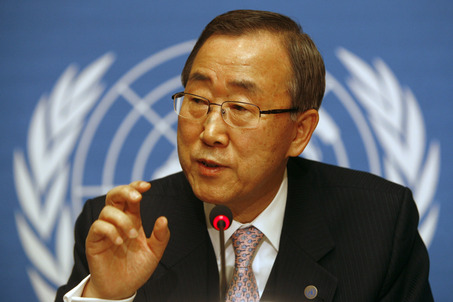
Syrian peace talks kicked off in Switzerland with little hope that it could override clashing stances between key players, the Syrian regime and the opposition, whose presence on the same table for the first time in almost three years resembles the highlight of the conference.Syrian Foreign Minister Walid Muallem, who heads President Bashar al-Assad’s delegation, and Ahmed Jabra, president of the opposition Syrian National Coalition exchanged accusations of treason and terrorism, each holding the other responsible for the violence that has killed more than 130,000 people and displaced millions more.
Muallem, who urged the international community to not interfere in internal affairs, said “whoever wants to speak for the Syrian people must not be a traitor,” referring to opposition groups that have been battling the regime in demand for more rights and freedoms.
“They claim to represent the Syrian people. If you want to speak in the name of the Syrian people, you should not be traitors to the Syrian people, agents in the pay of enemies of the Syrian people,” he said.
In response, Jabra said the opposition Syrian Free Army is “battling international mercenaries” brought in by Assad, naming Lebanese Hezbollah and al-Qaeda-linked Islamic State in Iraq and Levant.
“We are facing the terrorism of Assad who claims to be fighting terrorism,” Jabra said, accusing the regime of killing 10,000 children since the war broke out in 2011.
UN Secretary-General Ban Ki-moon inaugurated the conference by outlining the efforts made – since the first round of Geneva talks took place about 18 months ago – to bring the rival sides together. Last minute developments could have derailed the meeting aimed at ending the crisis that is about to hit its third anniversary.
“The challenges before all of us are formidable, but your presence here raises hope,” Ban said. “All Syrians are looking for a Syrian-led transition.”
The peace talks are set to be based on a communique reached at the end of Geneva 1 talks, entailing a political transition plan to end a crisis that has killed many.
“Syrians must talk to each other again,” Ban said, urging the international community to pressure both sides to reach agreements based on the Geneva 1 communique, and allow for the passage of humanitarian aid to harmed citizens.
While the establishment of humanitarian corridors is a mutual ground between the rival parts, a political transition plan is not. President Bashar al-Assad and his foreign minister Walid Muallem have shown no intention of giving up or sharing power.
US Secretary of State John Kerry, however, said there was “no way” Assad to be part of the transition plan, and he could not regain legitimacy to govern.
“The right to run a country does not come from bombs and missiles,” he told the participants in the Swiss town of Montreux. “The stubborn clinging to power of one man,” Kerry said, “is the only thing preventing the Geneva communique from creating peace”.
Russian Foreign Minister Sergei Lavrov, whose country is a staunch supporter of the Assad regime, called for international forces to stop meddling in the country’s affairs, saying that Syrians have the right to decide their own future.
“The negotiations will not be simple, they will not be quick,” Lavrov told the conference.
The conference is attended by delegations from 40 countries.
Meanwhile, the government of al-Assad has systematically killed and tortured about 11,000 people, according to a reports based on the evidence of a defector and produced by three former international prosecutors.
The report, commissioned by the government of Qatar and released on Tuesday, examined thousands of pictures said to have been smuggled out by a former military police photographer.
The report shows explicit evidence of starvation, strangulation and beatings, and features pictures of emaciated corpses with livid wounds.
The pictures show . . . the systematic murder of detainees by starvation, by torture . . . the mutilation of bodies. The release came a day before talks were due to begin in Switzerland aimed at negotiating an end to Syria’s bloody civil war.
The Syrian denies torturing detainees. The report was written by Desmond de Silva, the former chief prosecutor of the special court for Sierra Leone; Geoffrey Nice, the former lead prosecutor in the trial of former Yugoslavian President Slobodan Milosevic; and David Crane, who indicted the Liberian president, Charles Taylor.
It features evidence from a forensic pathologist, an anthropologist who investigated mass graves in Kosovo and an expert in digital images.
De Silva said the report was the “smoking gun” showing evidence of “industrial-scale” killing by the Syrian regime. The defector, identified only as “Caesar”, presented about 55,000 images of 11,000 dead prisoners since the start of the uprising in Syria in March 2011.
The evidence was viewed by forensic experts commissioned by a London legal firm representing Qatar. — AP


 Online Reporter