admin
admin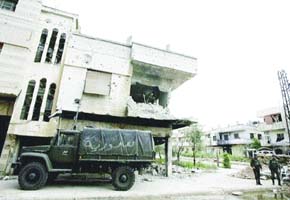
The assault on the country’s commercial capital came as Amnesty International raised concerns about the plight of civilians in the city and warned both sides they would be held accountable for any attacks on civilians.
“The assault has genuinely begun,” the security official in Damascus said.
“The army is advancing to cut (the southwestern rebel redoubt of) Salaheddin in two. It will not take long, even if there are still some pockets of resistance.”
On Sunday, an official had said the army had massed 20 000 troops for the assault to recover Aleppo, of which the rebels claim they hold half. He said the insurgents had 60 000 men.
Wassel Ayub, a commander of the rebel Free Syrian Army, said “regime forces advanced into AlMalaab Street (in Salaheddin) with tanks and armoured vehicles, and fierce fighting is now taking place in the area.”
A rebel commander said his men were being prevented from mounting a counterattack by snipers.
The army first shelled several districts of the northwestern city before dawn. Sixteen civilians were killed in Aleppo and in the rest of the same province, with six more elsewhere in the country, the Syrian Observatory for Human Rights said.
Among the dead were a woman and her two children, killed when a shell struck their house in AlMashatiyah neighbourhood, the Observatory said.
A total of 225 people mostly civilians died in Syria on Tuesday. That made it one of the worst days for casualties in the 17month uprising that the Observatory said last week had cost more than 21 000 lives.
The neighbourhoods of Qatarji, Tariq al-Bab and Shaar also came under heavy shelling.
The Syrian Revolution General Council, a network of activists on the ground, reported overnight shelling in the neighbourhoods of AlKalassa, Shaar, Sukari and Tariq alBab as well as heavy artillery fire aimed at the Bustan al-Qasr and Fardoss districts.
In Lebanon, a dozen shells from the Syrian side of the border struck overnight, causing no casualties, a security official in northern Lebanon said.
Amnesty International showed satellite images indicating an apparent increased use of heavy weapons in the area.
It warned forces loyal to President Bashar al-Assad that attacks on civilians would not go unpunished.
“Amnesty International is sending a clear message to both sides in the fighting: Any attacks against civilians will be clearly documented so that those responsible can be held accountable,” Amnesty’s Christoph Koettl said.
The London-based watchdog said images from Anadan, a small town near Aleppo, revealed more than 600 probable artillery impact craters from the fierce fighting over the city.
It said an image from 31 July showed what seemed to be artillery impact craters next to what appeared to be a residential housing complex in Anadan.
Amnesty said it was concerned the deployment of heavy weaponry in residential areas would lead to further human rights abuses and grave breaches of international law.
On Tuesday, Assad vowed to crush the rebellion that erupted in March 2011.
“The Syrian people and their government are determined to purge the country of terrorists and to fight the terrorists without respite,” he was quoted by state news agency SANA as telling a visiting Iranian envoy, using his regime’s terminology for rebel fighters.
Assad had earlier appeared on television for the first time in more than two weeks in a meeting with Saeed Jalili, a top aide to Iranian supreme leader Ayatollah Ali Khamenei.
Jalili offered Assad his country’s backing, saying Tehran would “never allow the resistance axis of which Syria is an essential pillar to break.
“What is happening in Syria is not an internal issue but a conflict between the axis of resistance on the one hand, and the regional and global enemies of this axis on the other,” he said.
On Wednesday, Iranian Foreign Minister Ali Akbar Salehi said retired members of the Revolutionary Guards and army were among the 48 Iranians taken hostage in Syria by rebels.
“A number of the (hostages) are retired members of the Guards and the army. Some others were from other ministries,” Salehi said as he flew back from Turkey, which he asked for help in freeing the Iranians.
It was the first time Tehran admitted any of those abducted had a connection to its military, having previously insisted the 48 Iranians were only pilgrims travelling to a Muslim holy site in Damascus.
Meanwhile, the Syrian army has regained control of a key district in Aleppo, private al-Ekhbaria TV reported yesterday.
The TV said the troops reached the main square of Salahuddien district after purging the entire sprawling district of armed insurgent groups.
The Salahuddien area was the first to fall in the hands of the rebels two weeks ago.
The district has also witnessed the lion share of the intense clashes that have spiraled in Aleppo over the past month. — AFP.


 Online Reporter