admin
adminthe crisis.
“Assad’s fall is inevitable,” Jim Carney, the White House spokesman, said on Monday.
“As governments make decisions about where they stand on this issue and what steps need to be taken with regards to brutality of Assad’s regime, it’s important to calculate into your consideration the fact that he will go. The regime has lost control of the country and he will eventually fall.”
But a senior Russian diplomat said yesterday that the push for adoption of a Western-Arab draft resolution was a “path to civil war”.
“The Western draft Security Council resolution on Syria will not lead to a search for compromise,” Interfax news agency quoted Deputy Foreign Minister Gennady Gatilov as saying. “Pushing it is a path to civil war.”
Damascus dismissed Western criticism and said it would defeat what it called foreign attempts to spread chaos.
“We are not surprised at the lack of wisdom or rationality of these statements and regret that they are still issued by countries that are used to making the Middle East an arena for their follies and failures,” the state news agency quoted a foreign ministry source as saying.
“Syria, which is defending itself today against terrorism and will continue to do so, will be the exception which . . . will foil the policies of chaos adopted by these countries,” it said.
Al Jazeera’s Anita McNaught, following events in Syria from neighbouring Turkey, said the crucial question is when Russia will feel pressured enough by the international community to stop voicing support for its ally.
“Syria doesn’t yet seem to feel that it’s sufficiently isolated, that it needs to change the course of action,” she said. “It certainly won’t feel that as long as Russia is telling it that it still backs it.”
The comments came as fighting seemed to escalate on the ground in Syria. Activists said battles resumed in Damascus suburbs yesterday, after members of the anti-Assad Free Syrian Army pulled back the previous night after deadly clashes.
About 100 people were reportedly killed across the country on Monday, as troops battled opposition fighters in the central city of Homs and in suburbs of the capital.
The Local Co-ordination Committees said the majority of the victims died in Homs province, many of them in the town of Rastan, where the army shelled residential buildings.
Meanwhile, Nabil Elaraby, the secretary-general of the Arab League, and Hamad bin Jassim Al Thani, the Qatari prime minister, held talks with diplomats in New York ahead of yesterday’s Security Council meeting on Syria.
A new draft resolution calls for a “political transition” in Syria. While it does not seek military action or UN sanctions against Syria, it does say that the Security Council could “adopt further measures” if Damascus does not comply with the terms of the resolution.
Russia, which along with China vetoed a previous draft in October, has not explicitly threatened to veto the resolution, but has said the draft is unacceptable in its present form.
Hillary Clinton, the US secretary of state, said she would travel to the UN for the meeting to “send a clear message of support to the Syrian people: We stand with you”.
France, the UK, and Portugal are sending their foreign ministers to take part in the meeting.
A vote on the resolution, drafted by European and Arab members of the council, could come before the end of the week, diplomats say.
Al Jazeera’s Kristen Saloomey, reporting from the United Nations in New York, said that French diplomats were claiming that the resolution now had a majority of votes in the Security Council.
“All diplomatic muscles are being flexed here in New York in an attempt to win support for a resolution that is put forward by Morocco in the Security Council . . . But it comes down to China and Russia who have both expressed concern over the resolution.”
As permanent members, both Russia and China have veto powers at the Security Council, so any binding resolution would require Moscow and Beijing to at least abstain from voting.
Earlier, Russia suggested to the government and the opposition that they should meet in the Russian capital for “informal contacts” without any preconditions.
Russia said Assad’s government had agreed to talks, but a major opposition body rejected the offer.
“The resignation of Assad is the condition for any negotiation on the transition to a democratic government in Syria,” Burhan Ghalioun, head of the opposition Syrian National Council, told AFP news agency. – Al Jazeera.


Online Reporter
- Chronicle
- July 31, 2026
- 2 views
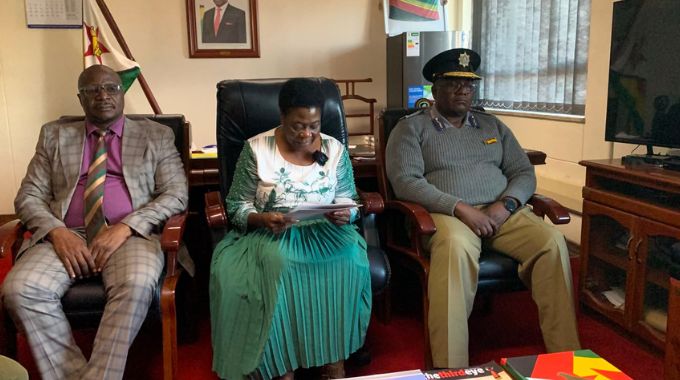
WATCH: Bulawayo urged to maintain peace, ignore unlawful stay-away calls
Peter Matika, [email protected] THE Minister of State for Provincial Affairs and Devolution for Bulawayo Metropolitan Province, Cde Judith Ncube, has appealed to residents, businesses, transport operators and the informal sector…