Chronicle Editor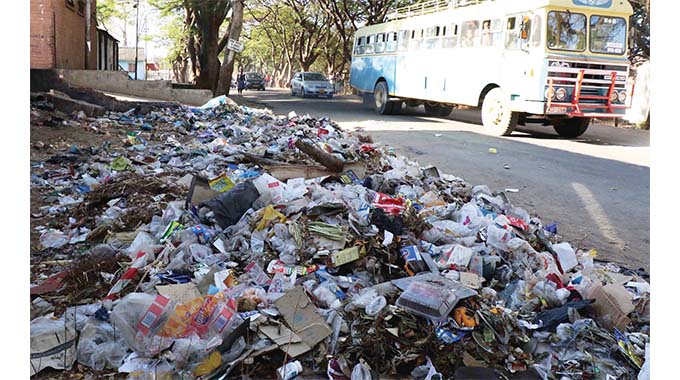
Judith Phiri, Features Reporter
The environment comprises all living and non-living components necessary for people’s survival and it is important to maintain the integrity of the surroundings to ensure that they can support and sustain current and future generations.
However, this has not been the case worldwide as the environment continues to deteriorate due to several triggers such as overpopulation, pollution, burning fossil fuels and deforestation, among other things.
Bulawayo Metropolitan Province has been found wanting in terms of the unsustainable accumulation of waste. The deplorable state of uncleanliness across the country, particularly in urban areas has been viewed to be a result of local authorities’ ineptitude and negligence in collecting and managing solid waste disposal.
The Government recently said it would promulgate a Statutory Instrument (SI) that will make the National Clean-Up Programme compulsory as one of the measures to curb the unsustainable accumulation of waste across the country.
Cabinet considered and adopted measures to address the solid waste management challenges across the country, especially in urban areas, as presented by the Minister of Environment, Climate and Wildlife, Dr Nqobizitha Mangaliso Ndlovu.
The measures include a statutory instrument that will be promulgated to make the National Clean-Up Programme compulsory for Government Ministries, Departments and Agencies, local authorities, the business sector, vendors, retailers and manufacturers.
Local authorities have been urged to localise the statutory instrument by promulgation of the relevant by-laws, funds collected by local authorities from residents for waste management will be ring-fenced in order to ensure that the authorities do not divert the funds to other uses, with the Environmental Management Agency (EMA) supervising the usage of the funds.
This is just the tip of the iceberg of the measures to address the solid waste management challenges, which will also include the deterrent fines for public littering that will be introduced and enforced, while repeat offenders will be charged with no option of a fine but given mandatory community service.
Presenting a paper on Environment Protection and Natural Resource Management at the review of the Bulawayo Provincial Economic Development Plan (PEDP), the thematic working group (TWG) chairperson, Mr Desmond Makosa who is also the Ministry of Tourism and Hospitality Industry Provincial tourism administrative officer, said a lot had to be done to address environmental issues in the city.
“Some of the challenges we are faced with is limited funding for environmental projects that are already in place and those that need to be done in the city. We have also witnessed a low uptake of the National Clean-Up programme mainly by residents and line ministries. The recurrence of illegal solid waste dumps especially in open spaces and sanitary lanes in Bulawayo continues to be on the rise. There is also continued sewer discharge into the environment and increase in sand poaching.
“Just like any other city, Bulawayo has witnessed resistance from the public in complying with environmental legislation and when the matters are taken further there are delays in the finalisation of court cases. These are some of the challenges that are affecting the city and derailing solving of environmental issues.”
He, however, said efforts were being made to ensure sanity is brought back to the city and environmental challenges are tackled. Mr Makosa said EMA was rolling out the Awareness on Solid Waste Management programme and their annual target was 24 campaigns while in 2021 they achieved 41,36 percent, in 2022 they achieved 45 percent and in 2023, 100 percent.
On the Clean-Up programmes, he said: “Their annual target is 600 clean-ups, in 2021, 84 were done and 148 tonnes of waste was cleared on 1 439 cubic metres (m3). In 2022 and 2023, 369 and 161 clean-ups were done respectively, while 1 893,2m3 of waste was removed from the environment in 2022 and 1 212,3m3 in 2023. This cumulated to a total of 614 clean-ups conducted with 4 545,5m3 of waste removed from the environment.”
Mr Makosa said 100 percent had been achieved on the Awareness on Land Degradation programme as the annual target was 24 campaigns while 29, 33 and 28 were done in 2021, 2022 and 2023 respectively.
He said the Awareness on Water Pollution programmes was also at 100 percent achievement after 2021, 2022 and 2023 saw 30, 27 and 25 campaigns being rolled out for the respective years against an annual target of 24.
Mr Makosa added: “On Solid Waste Management programme, the annual target for EMA was one project per year. In 2021 they completed one waste sorting cage at Magwegwe North shopping centre. In 2022 no projects were implemented while in 2023 there is the installation of one waste sorting cage at Hillside Dams Conservancy which is ongoing and at 75 percent complete.”
He said among other key programmes were Awareness on Veld Fire Management, Wetland Restoration, Wetland Management, Fire Management and Rehabilitation of Mines Areas.
In terms of environmental law enforcement, Mr Makosa said against an annual target of 1 200 inspections per year, EMA has done 1 137 in Bulawayo for 2021, 2 970 in 2022 and 1 239 in 2023 so far.
He said 83 tickets were issued in 2021, 86 in 2022 and 82 in 2023 to offenders by EMA as they roll out operations to protect the environment and public.
“One docket was opened in 2021 and there has been none in 2022 and 2023 in Bulawayo. In terms of compliance to environmental law enforcement, it was 90,85 percent in 2021 and 94,5 percent in 2022 while it is currently standing at 89,3 percent this year.”
The Government has been loud and clear on solid waste management in order to protect the environment. Massive awareness and education programmes are set to be undertaken, starting with a re-launch of the National Clean-Up Programme in order to embed a mind set against littering and general disorder.
In the medium-term, more efficient usage and disposal of plastic carrier bags and PET containers will be promoted in order to address the challenge of plastic waste. The long-term measures include increased waste recycling business and introduction of levies to deter the importation of materials such as plastics and disposable nappies whose management of post-consumer use is problematic.
The Government has said the education curriculum will also have deliberate learning programmes on cleanliness and management of waste from the lowest levels going up. Environmental Protection programmes and services are critical for reducing risks to the environment from contaminants such as hazardous materials and wastes, fuels, and oils.
International efforts are being made to protect and improve the environment. The main reasons for the protection are to counter ozone depletion, greenhouse effects and global warming, desertification, deforestation and loss of biodiversity among other things.
Globally, several treaties and conventions have been set up for the improvement and protection of the environment, with Zimbabwe being a signatory to a number of them.


 Online Reporter