

 admin
admin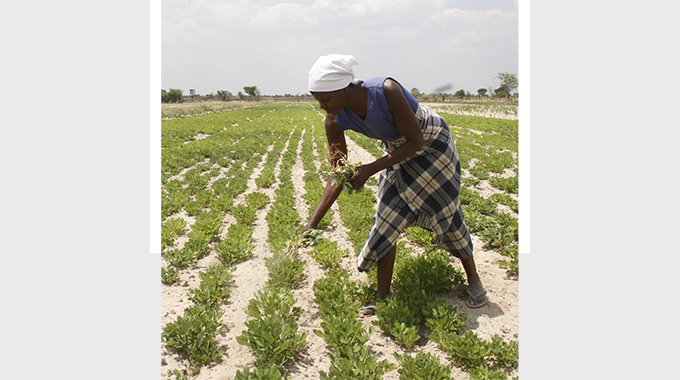
Elliot Ziwira Senior Writer
FIFTY-three-year-old Ms Conscencia Muvirimi from Murungweni Village, Chegutu District in Chief Ngezi’s domain of Mashonaland West Province has lived long enough in the area, which falls under natural region III, to know that rain-fed farming is as unprofitable as rains are unreliable and unpredictable.
She has not only tapped into the traditional ways known to her people to circumvent the heart-wrenching disasters occasioned by shifting rainfall patterns owing to climate change, among them vlei wheat, maize and groundnuts farming, but has also perfected them.
As nature, through its armoury trained to subdue, scathe and destroy, found new methods of shifting agro-economic zones through either holding onto heaven’s tears or releasing them in torrents, negatively impacting on rain-fed crop production, Ms Muvirimi, like most women in the Chegutu, Mhondoro and Chikomba districts of Zimbabwe, has equally risen to the occasion to call the rampaging seasons to order.
She is aware that nature has not always been mean to their region; for that reason, she vows to preserve it for future generations. From generation to generation, the people of Chegutu and Mhondoro districts, owing to their environment, have relied on dry season farming to sustain their families through nature’s largesse.
While others from far-flung provinces might separate seasons as rainy or dry, thus responding accordingly in terms of what agricultural activities to partake in, the enterprising woman, as is the norm in her village and its environs, always has crops in the ground throughout the year. The dry season is a natural choice for her since it is easier to tame.
“I was born here,” she puts it across straight away. “I know that the easiest way to get a heart attack is to rely on rain-fed farming because our fields lie largely in marshlands, and the soils become soggy at the slightest hint of a downpour.”
It is midday on a Friday as she braves the blistering late October sun, shielded by a wide-brimmed khaki sun hat under which a white doek shows, to tend a fruiting tomato crop in her three-hectare plot a stone’s throw to the west of her attention-grabbing homestead, with Neuso Primary School to the south-west.
She has a hectare under tomatoes, another one under sugar beans, and has just harvested wheat on the other.
Although the tomatoes are generally in good shape, the sugar bean crop looks stressed.
Both crops appear to have taken a thorough hiding from nature’s arsenal, though.
“On the sugar beans, I failed the moisture test since the area which I used here is a bit harder. It requires irrigation,” she opens up to The Herald without a tinge of despair. She has taken the lesson well, for it was an experimentation crop.
“I should stick to the February crop,” she reflects. “Last year I harvested three 50kg bags from a very small area, so I dreamt big.”
After a momentary pause, she says: “Farming here is a whole-year affair. So, we rotate our crops. Besides this patch here, there is another dry season field about 800 metres from here, which is even bigger. I have planted maize and groundnuts, which are at the flowering stage.”
Ms Muvirimi is keen to take us to this bigger field located at the north-western end of the village, so we oblige.
True to her word, in spite of the desperate situation surrounding it, characteristic of the dry season, the groundnut crop lushly takes root at pod and kernel development stage. She is expecting to harvest 20 bags of unshelled groundnuts.
Chegutu and Mhondoro districts are in natural region III, which is ideal for semi-intensive farming, as is the case with 19 percent of Zimbabwe.
Although rainfall is largely moderate, the region is prone to severe dry spells, which makes it problematic for enterprises that depend on rain-fed crop production alone.
However, due to climate change, as Brown et al, observe in their paper “Climate change impacts, vulnerability and adaptation in Zimbabwe” published in 2012, more areas have been turned arid, thus shifting the country’s main agro-ecological zones.
The researchers note: “Rainfall patterns and crop production progressively deteriorate from Region I to V. For example, Chinhoyi and Chibero and their surroundings have shifted from natural region II to natural region III while Kwekwe and its surroundings have shifted from natural region III to natural region IV.
“In addition, natural region I has reduced in size, natural region II has shifted further east and natural region III has shifted to the north. Overall, the climate in Zimbabwe is regionally differentiated, but is generally becoming warmer with more erratic rainfall patterns.”
The country is landlocked, and “lies in a semi-arid region with limited and unreliable rainfall patterns and temperature variations,” (ibid). Due to climate change, extreme weather events such as tropical cyclones and droughts increased in frequency and intensity too (Mutasa, 2008). Therein rests the challenge — receding agro-ecological precincts coupled with inconsistent rainfalls.
Since agriculture accounts for about 15-18 percent of Zimbabwe’s gross domestic product (GDP), an estimated 60 percent of the raw materials needed by the manufacturing industry, and 40 percent of total export earnings, any shift in rainfall patterns has a bearing on overall economic growth.
Therefore, reliance on rain-fed agriculture exposes the economy and the livelihoods of vulnerable communities to climate change (Brown et al, 2012).
However, climate change does not only negatively impact Zimbabwe, but also the entire African continent “due to widespread poverty, limited coping capacity and its highly variable climate” (Madzwamuse, 2010 cited in Brown et al, 2012).
Because women are the backbone of families and communities, their adaptation to the vagaries of nature is crucial.
“Farming runs in my blood because my father was a prominent dry season farmer, capitalising on the wetlands common in this region,” resumes Ms Muvirimi.
“As I said earlier on, most of our fields are wetlands. So, if we dither, waiting for the onset of the rainy season, we will harvest close to nothing. That is why we grow crops in the dry season using groundwater preserved in the soil. By the time the rains come we would have long harvested our crops.”
Indeed, nature’s womb is giving, although it takes effort on the part of those for whom it is intended.
“Preserving this moisture comes naturally for us,” the mother of four says. “After harvesting the dry season crops, we plough the fields, turning the husks and the sods upside-down. We then harrow the fields. That way the moisture is preserved. However, we need to be careful on our planting days. Timing is crucial, for a slight variation may lead to losses. Thereafter, there is no need for watering until harvest time.”
From her hectare of vlei wheat she harvested 600kg (12 bags), without irrigating it even for a single day, and with no weeding.
Now that’s bready news!
Ms Muvirimi is now preparing the field she used for wheat production to plant maize once the first rains hit the ground. Heaps of cattle manure on the hectare patch are evident to that.
Looking above, one wonders whether she will be able to beat the skies one more time should the hovering clouds gather enough weight to erupt any time soon!
With the assistance of her husband, Cuthbert Ndalakwa, Ms Muvirimi has sunk a solar-powered borehole on her three-hectare plot, although she is yet to use it, and bought a grinding mill to produce her own stock feeds for her poultry project.
“There is something big that I am saving for through mukando (savings group), which my husband does not yet know about, and I would not like to pre-empt it”, she intimates. “By the end of the year I would have had it.”
Councillor for Ward 2, under which Murungweni Village falls, Ms Idah Mbiriza, says vlei wheat has been grown for ages by members of her community with Chegutu District, inclusive of Wards 3, 4 and 5, having a capacity to put at least 400 hectares under the cereal, making it a key player in its production.
With Zimbabwe poised for flour self-sufficiency, Ms Muvirimi and her fellow farmers have ensured that the district contributes significantly to national historic production in the 2022 season by putting 200 hectares under non-irrigated wheat.
Although the farmers are assisted under the Presidential Input Scheme, Cllr Mbirimi bemoans lack of draught power due to the decimation of cattle by diseases such as theileriosis, commonly known as January disease, leaving most families to rely on donkeys. The crop is usually planted in March and late April or early May.
Speaking at a field day in Ward 2 in August, Seed Co provincial agronomist, Mr Mordcai Chinembiri, said vlei wheat farmers could increase output by increasing plant population to between 200 and 250 plants per square metre.
Fifty-three-year-old Ms Lillian Juma, whose patch, under a thriving maize crop, already tussling, lies a gaze to the south-west of Ms Muvirimi’s dry wetland plot, shares a similar story. “It comes with the terrain,” she says, smiling. “We understand the nature of our land. Like our forefathers before us, we work the land according to its strength — wetlands. If we misstep we will not be able to sufficiently provide for our families.”
Ms Ketty Musekwa (42), whose field, in front of her homestead, and about 300 metres as the crow flies, to the north-west of Ms Muvirimi’s, graces a plush maize crop at hip level, equally enthuses. “We are expecting to reap big,” she says. Her husband, Sabastian Murungweni, is the village head. In Shamhu Village, also in Ward 2, Ms Memory Musinha (42) shares an interesting story.
Unlike Ms Muvirimi, Ms Musekwa and Ms Juma, she goes beyond reliance on wetlands for moisture, to also tap into groundwater reservoirs using a solar-powered borehole.
“To me farming is passion. You need to love the soil enough to work on it,” she says. “I used to farm in Mazowe, Mashonaland Central Province, doing mainly potatoes, but I would lose a lot of my produce to thieves, so I decided to move here—our rural home. This is where my husband was born, and he has been supportive,” she says.
Ms Musinha reveals that Covid-19 has been a blessing to her.
With the searing heat refusing to relent, she is harvesting potatoes, assisted by part of her team, while others are preparing holes for the transplantation of the maize plants on a seedbed on the fenced two-acre plot a few paces north of her eye-catching homestead, which she uses for her horticultural enterprises.
“Had it not been for Covid-19, this project wouldn’t have kicked off,” she heartily divulges.
“When the new coronavirus struck Zimbabwe in 2020, I had put aside US$2 000 for my son’s school fees for the year. He was then doing Form Four at a boarding school and is now in Form Six. Since schools were subsequently closed to curb the spread of Covid-19, I decided to use the money to sink and install a solar-powered borehole.”
Thanks to the pandemic, two years to the mark now, she has been growing sugar beans, onions, potatoes and maize under irrigation.
“I had 25 lines of potatoes, and have so far harvested 100 pockets on slightly over half of the total area. I have also grown sugar beans and set up a seedbed for about 2 000 maize plants, which are ready for transplanting.”
She is also into poultry and has now raised capacity to 500 birds in varying batches, having started with 50 broilers.
“I use the droppings to make organic fertilisers for my crops. That is why my sugar bean crop is flourishing,” Ms Musinha says.
Besides buying a grinding mill to be stockfeed self-sufficient using proceeds from her poultry and horticultural projects, she is also setting up drip irrigation equipment on an 80m×70m area.
She also intends to construct a greenhouse before year-end.
She says her husband, Simon Mangachemwa, who mostly works outside the country, has been supportive of her projects from the word go.
“My husband bought me a car for easier movement, but I decided to sell it. I combined proceeds from my projects with what I got for the car, and bought 10 Brahman heifers which will be delivered soon,” says Ms Musinha.
The market for her horticultural projects and broilers is readily available in her community and surrounding areas.
“I cannot complain,” she says, adding, “The market has been encouraging.”
On seeding maize and transplanting it, she has this to say, “The advantage of transplanting maize is that I will be able to beat the early rains, since there will be enough time to harvest other crops, and prepare the land, while the corn will also be growing on the seedbed.
“Timing is of essence here because our fields are largely wetlands.”
She got the transplanting idea way back from her paternal grandmother in Chiweshe.
“When transplanting maize from a seedbed,” she says, “the first thing after carefully pulling the plant out is to prune the leaves so that it does not sag.”
But what do experts say about wetlands and their cultivation?
A paper published in 2003 by AREX in collaboration with the Natural Resources Institute, Silsoe Research Institute and the University of Zimbabwe titled, “A Guide for the Sustainable Cultivation of Vleis in Zimbabwe”, defines wetlands as “gently sloping areas with soils that usually hold a lot of moisture (saturated with surface or groundwater) for most of the rainy season.”
Wetlands, which are classified as dry or wet, include swamps, coastal lakes, fens, mires, moors, estuaries, marshes, mangroves, springs, vleis, seeps, wet meadows, floodplains, peatlakes, and bogs (Mayr, 1996; DWAF, 2005 in Swanepoel & Barnard, 2007).
The paper notes that there are 1 280 000 hectares (12 800 square kilometres) of wetlands (both dry and wet) in Zimbabwe out of a total land area of 390 757 square kilometres, which if used effectively could contribute significantly to food security at the household level and ensure incomes as they enable farmers to grow crops throughout the year.
The researchers point out that wetland fields “can be used to produce maize, rice, groundnuts and beans in summer months and wheat in the winter.”
Summer in Zimbabwe runs from October to April, which means Ms Muvirimi and her community are apt in insisting that they utilise the dry season, and capitalise on the groundwater accumulated in the rainy season.
Using South Africa as a case study, Swanepoel & Barnard (2007), affirm that wetlands are a crucial landscape that provides both environmental and cultural benefits. Like most countries in Africa, including Zimbabwe, South Africa receives average rainfalls; about 497mm annually compared to 860mm global average.
Because much of Africa lies within the arid and semi-arid climate, wetlands are vital for the provision of nutrients and grazing land.
With half the world’s wetlands having disappeared since 1900 (Swanepoel & Barnard) due mainly to agricultural practices, researchers agree that if used wisely, wetlands have the potential to sustain present and future generations as they have always done in the past.
“A Guide for the Sustainable Cultivation of Vleis in Zimbabwe ” (2003), highlights that rice should be planted in rows when it is intercropped with maize to allow for easier weeding.
When farmers consider wetland wheat farming, the authors advise, they should ensure that the land is dry enough “for planting in late April or early May”, after the harvesting of maize.
“Wheat grows on residual soil moisture and as the soil surface is dry there is little weed growth in the crop.”
However, wetland wheat can only be grown in fenced areas to guard against grazing by cattle in the dry season. Another disadvantage is that since wheat is harvested in late September and early October, early summer crops cannot be planted on the same field.
The paper reads: “The wheat will remove moisture from the soil to dry out the wetland field. The farmer will then need to wait until rains fall before the field can be ploughed and planted to maize and rice.
“The advantages of early planting will be lost and waterlogging is more likely to be a problem unless the rains are late.”
In the same district of Chegutu, Ward 20, approximately 140km from Ms Muvirimi’s village, and 35km to the north of the town of Chegutu, wheat is grown under irrigation at Dzingainhamo Cooperative, a scheme on a 333-hectare farm in the Musengezi resettlement area.
About 30 hectares of the farm are irrigable, sustaining livelihoods for the 55 members of the cooperative, 20 of whom are women.
Ms Annah Guhwa (63), a member since 1986, says she has been able to provide for her children through income-generating farming projects at Dzingainhamo after her husband’s death in 2008.
She is now looking after six grandchildren, the youngest of whom is three-years-old, left in her custody following the death of three of her seven children.
“We had 12 hectares under wheat, and harvested 20 tonnes which we delivered to the Grain Marketing Board. We could have produced more had it not been for erratic power supplies, which affected our irrigation system,” Ms Guhwa says.
She says when the money comes, they will split it equally after acquiring inputs, to augment those provided through the Presidential Inputs Scheme.
Irrigation water for the scheme, which benefits 76 households, is drawn from Dongaronga Dam, and another one upstream, on Dongaronga River. The dam has been a source of livelihood for many families at Dzingainhamo and the adjacent 60-member Rudaviro Scheme, to which Ms Chiedza Kent (28) belongs.
A committee member, Ms Fungisai Gotore (54), also a widow, says besides wheat, sugar beans and maize farming as a group, members of the co-operative engage in individual enterprises like livestock rearing and growing crops in nutritional gardens dotted on the banks of Dongaronga River.
Ms Gotore appeals for assistance to value-add their produce, particularly perishables like tomatoes to guard against losses when markets are flooded.
Dzingainhamo Co-operative chairperson, and Musengezi District Co-operative Union chair, Mr Clevermore Kent, says women should go beyond delivering their families’ bread through income-generating projects, like gardening and wheat farming, to also play a leading role in value addition and preservation of water sources.
“Zimbabwe is blessed with vast arable land and more than 10 000 water sources, which if used wisely will go a long way in mitigating the impacts of climate change. The challenge is that most rivers and dams in the country are silting. There is a need to desilt our water sources, not only for us, but for posterity.
“In addition to beneficiation of their produce, women should play a leading role in the desilting of rivers and dams since they are key players in agricultural enterprises,” implores Mr Kent, who is also Cuf-Two Sub-Catchment area councillor and vice chairperson, under Sanyati Catchment.
About 120km away in Village 9, Ward 15, Chikomba West constituency in Mashonaland East Province, the wetlands tale reels out, with slight variations.
Besides being a resettlement area, with plot sizes marginally bigger than those in Chegutu and Mhondoro districts, which in this instance are communal lands, farmers in Village 9 share the same sentiment regarding the nature of their land. They, therefore, use the same methods to utilise groundwater in the dry season, before the onset of the rainy season.
Thirty-two-year-old Ms Rejoice Sithole’s day begins at 5am and sometimes goes beyond 6pm. It is way past 6pm as she takes The Herald on her farming expedition.
“We appreciate nature and what it has in store for us underground,” she begins.
Her husband’s family was allocated 20 hectares under the land reform programme.
Ms Sithole and her husband, Leonard Chijoko, utilises most of the land.
“We plant maize, rice, groundnuts, okra, sugar beans and butternuts throughout the year,” she adds. “We plough and harrow our fields just after the rainy season; and on August 15 we plant our maize. We used to vary planting days, but we realised that the 15th of August is ideal if we are to beat the rains.”
There are four pole and grass gardens within the 20-hectare farm, much of which is already ploughed and harrowed awaiting dry planting, and on maize and other crops.
“We use those four gardens as water sources since the areas are wet vleis, providing the wells for the larger field. We inter-crop maize, rice, sugar beans, butternuts, okra and other crops to effectively use the land,” Ms Sithole says.
Unable to readily quantify her produce in terms of tonnage, she says last year she harvested about 21 scotch cart-loads of maize cobs, and 25 buckets of brown rice.
The challenge has been roaming cattle during the dry season, but the family has been able to secure the fields by fencing them using proceeds from their produce.
With neither pumps nor a borehole to irrigate her crops, using cans has been burdensome for Ms Sithole.
“We do not have a pump, so we irrigate this whole area using cans if the crops show signs of moisture stress. Since my husband is usually away at work, my 14-year-old daughter and 8-year-old son assist me in irrigating the crops. We also use our harvests to secure labour from ploughing, planting, weeding, watering to harvesting,” she says.
She has another child, a girl aged four.
Although the market for her produce has not been a challenge, irrigating the huge space that she put under crops in the dry season has been tasking.
“If we get irrigation equipment, we will do miracles here. We used to work on the land with my father-in-law and mother-in-law, but the former is late now, and age has taken a toll on the latter. My husband’s siblings are not keen workers of the land,” she says as she casts a glance at her husband.
He nods.
Acknowledging the Government’s support through provision of land and inputs, Ms Sithole says if she were to get resources to sink a borehole and install irrigation equipment, she will “touch the skies”, and “work wonders on the land.”
This story was funded by the Women in News SIRI Real Grant Project



 Online Reporter