Vusumuzi Dube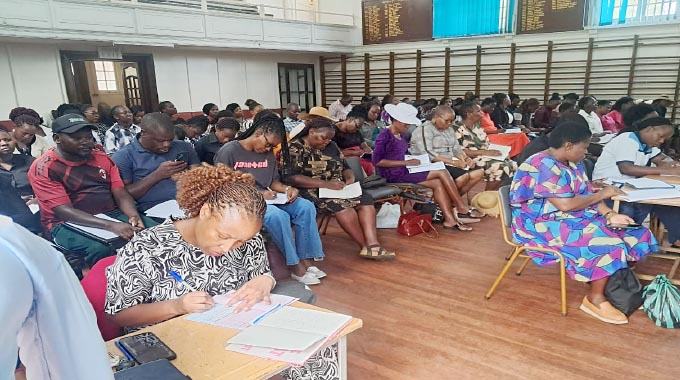
Mbulelo Mpofu, [email protected]
EVELINE High School last week became a hive of imagination and reinvention as more than 130 IsiNdebele language teachers temporarily traded chalk for creative pens, stepping into the demanding but rewarding world of storytelling.
Drawn from Matabeleland North, Matabeleland South, Bulawayo Metropolitan and Midlands provinces, the educators gathered for a two-day Creative Writing Workshop held from February 12 to 13, an initiative designed to align classroom practice with the ambitious goals of the Heritage-Based Curriculum (HBC).
Under the guidance of celebrated educator and playwright Thabani Hilary Moyo, the teachers were challenged to become writers first before expecting the same of their learners. The HBC (2024–2030), championed by the Ministry of Primary and Secondary Education, places significant emphasis on indigenous languages and cultural expression. A key requirement is that learners produce original short stories and plays in languages such as IsiNdebele, work deemed potentially publishable.
However, a pressing concern lingered among educators: how could they effectively guide learners through creative production if they themselves had never undergone such training?
Enter the Centre for Talent Development (CTD), Eveline High School’s pioneering Non-Formal Education initiative. Determined to bridge the capacity gap, CTD curated what many participants described as a transformative experience.
Far removed from a conventional lecture-driven seminar, the programme immersed teachers in the architecture of storytelling. Moyo, marking 30 years of shaping young minds and artistic talent, alongside facilitators Alexious Mangoro, Chelesani Sibanda and Nomfundo (uMaNdiweni), dissected the anatomy of compelling narratives.
Participants explored character development, plot construction and emotional depth in short stories, while also unpacking the unique demands of playwriting, from crafting purposeful dialogue and stage directions to building dramatic conflict.
“The new syllabus demands learners produce publishable work, but how do I teach that if I’ve never done it?” voiced one teacher.
“Ordinary is the last word anyone would use to describe what unfolded,” remarked one observer, capturing the mood of the workshop.
CTD’s approach was simple yet radical: transform teachers into practising writers. The results were immediate. A teacher who travelled from Victoria Falls reflected, “I am going back a better teacher. The long journey was worth it.”
Another from Insiza District added, “CTD must continue its good work. This was a powerful workshop, and we are waiting for the next one.”
Beyond the technical training, organisers were intentional about creating an atmosphere of respect and professionalism. From quality meals to dynamic facilitation methods that replaced monotonous PowerPoint sessions, the workshop modelled the very creativity it sought to inspire.
“This aligns perfectly with our philosophy. Written texts are plain words. When brought to life with movement and emotion, elements often missing in class, theatre becomes a powerful educational tool.
We recognised a gap in teaching methods and created platforms like this to enhance education,” Moyo said.
His career reflects that philosophy. Through CTD, he has brought Shakespearean works and local texts such as Makhalisa’s Umhlaba lo! to life, while producing historical epics including King Lobengula and Ihloka, aimed at reclaiming and celebrating Ndebele narratives. – Follow on X @MbuleloMpofu



 Online Reporter