Chronicle Editor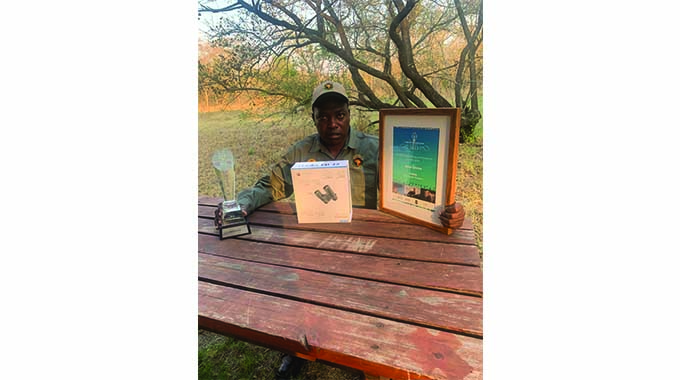
Leonard Ncube, [email protected]
ARMED not with traditional weapons but with a mobile device and a network of community informers, Amos Gwema ventures into the heart of the wilderness of the Hwange National Park with a singular mission – to apprehend poachers. For nearly two decades, he has dedicated his life to this cause, successfully thwarting illegal hunters and significantly reducing poaching incidents in one of Africa’s most treasured wildlife sanctuaries.
Gwema, the Principal Investigation and Security Officer at the Zimbabwe Parks and Wildlife Management Authority (Zimparks), recently clinched the prestigious title of Best Game Ranger at the 2023 African Conservation Awards, hosted by the Game Rangers’ Association of Africa (GRAA). This well-deserved recognition was sponsored by CNEI and bestowed upon him at the Southern African Wildlife College in Greater Kruger, South Africa.
The awards sought to honour exceptional conservationists whose unwavering dedication has played a pivotal role in safeguarding Africa’s natural heritage.
Gwema’s journey in conservation began in 2007 when he joined Zimparks as an investigation officer, bringing with him 12 years of experience from the police Criminal Investigations Department (CID), where he had served eight years. For him, the most potent weapons are information and technology, which have consistently propelled him to receive several prestigious conservation accolades.
“This is a promotion of Zimbabwean conservation and I think the awards and recognition internationally will assist our country,” said Gwema.
This is not the first time Gwema’s notable contributions have been acknowledged. He previously claimed the title of the 2020 Tusk African Ranger of the Year, the 2019 Winner of the African Rhino Conservation Awards, and the first runner-up in the African Rhino Conservation Award.
Behind these accolades lies a methodical and effective approach. Gwema operates in Hwange National Park, Zambezi National Park, and Matopos National Park, relying heavily on intelligence gathered through close collaboration with community informers. Over the years, this approach has yielded impressive results, with poaching cases in Hwange National Park plummeting from approximately 200 in 2013, during the height of cyanide poisoning, to zero in the past year
“I started working as a Parks Investigation Officer in 2007 and worked at Hwange Investigations office for 13 years. Previously I had worked as a police officer for 12 years of which eight years were in CID. One of the challenging times in my career was 2013 when elephants were poisoned but with my fellow investigators Raphael Mudzingwa and Peter Chiza we managed to account for all the poachers behind the poisoning.
“Elephant poisoning has drastically gone down and the results are still felt today as elephant poaching is down in Hwange. My strength is working with the community to find out why poachers come from a community that also consumes illegal wildlife products, said Gwema.
He relocated to the regional Bulawayo Zimparks office, where he has maintained his stellar reputation as a ranger. Ambushing and intercepting poachers, stealing cyanide from gangs, and orchestrating more than 130 arrests since 2013 – the bulk of which resulted in convictions – have been hallmarks of his career.
Working with the locals, Gwema gathers information on the whereabouts of poachers and purchasers. When offenders are located, he dispatches his team of plain-clothes investigators for an ambush. Some of the events are really risky since some poachers carry weapons. Gwema claims that the work is not for the timid. His story is one of integrity, devotion, and brave duty performance while safeguarding wildlife.
The awards’ organisers acknowledged that Gwema has had a big influence, particularly on the rates of poaching of elephants and rhinos and on the impressive 95 percent conviction record in Hwange and Bulawayo. He is an essential part of the ranger training program for law enforcement and intelligence methods related to wildlife.
Beyond his formal responsibilities, Gwema participates in community programs in schools to promote the humane capture and release of wild animals, promote harmony among local residents and the environment, and lessen conflict between people and wildlife.
First runner up was Petronella Chigumbura, a female ranger from Zimbabwe who serves as the deputy ranger supervisor at Akashinga, while second place went to Orlat Ndlovu, the chief of ranger services at South Africa’s Timbavati Private Nature Reserve.
The Best Field Ranger award went to Nkateko Letti Mzimba, a female ranger from Olifants West Nature Reserve in South Africa’s Black Mambas Unit. The first runner up was Reginah Smith, a female from the Rhino Protection Unit at the Pilanesberg Game Reserve in South Africa, who was followed by Givemore Bako, a senior ranger and head rhino monitor from the Save Valley Conservancy in Zimbabwe.
The 2023 awards attracted nominations from 11 countries.
Wildlife Action Group, Thuma Forest Reserve and the Dedza Salima Escarpment Forest Reserve, Malawi were the Best Conservation Team. The first and second runner up were Majete Wildlife Reserve of Malawi Zinave National Park of Mozambique respectively.
Speaking at the awards ceremony, Dr Larry Hansen, the founder of the African Conservation Awards hailed individuals and organisations that are fighting for the protection of wildlife.
“Every organisation and individual nominated for these awards has demonstrated exceptional determination to overcome formidable challenges. Often faced with daunting odds, they have showcased an unwavering commitment to their conservation missions.”
The African Conservation awards are hosted annually by the Game Rangers’ Association of Africa (GRAA) and are made possible with the generous support of sponsors Chinese New Enterprise Investment (CNEI) and are endorsed by the Department of Forestry, Fisheries and Environment. His Serene Highness Prince Albert II of Monaco.
The Game Rangers’ Association of Africa (GRAA) is a non-profit organisation, founded in 1970 to provide support, networks and representation for rangers across Africa. – @ncubeleon


 Online Reporter