

 admin
admin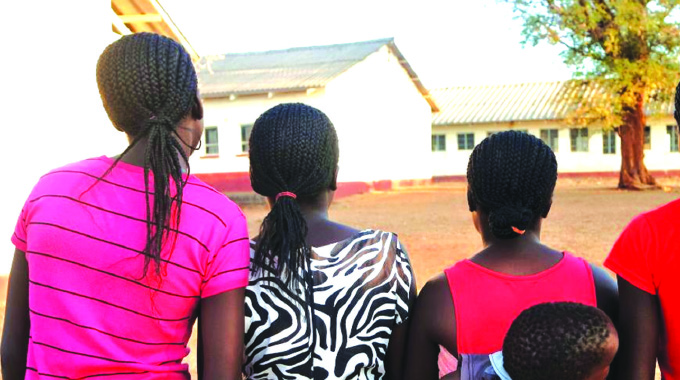
Muchaneta Chimuka
Herald Correspondent
At 13, Theresa (not her real name) is already a mother and is expected to do all the house chores such as dish washing, cleaning the house, looking after her baby girl and fending for herself after her aspiring husband Trynos (18) not his real name deserted her on realising that she was pregnant.
Theresa is now bed ridden in hospital after her caesarean operation raptured while at home doing household chores.
She stays with her grandmother who is also finding it difficult to fend for herself due to old age.
This reporter caught up with her at a local hospital and she narrated her ordeal.
“I used to stay with my parents in Harare but they chased me away after realising that I was pregnant. I came here in Chitungwiza to stay with my grandmother who accepted me.
“I was not raped, I consented to have sex with my 18-year-old but he dumped me after I fell pregnant. My parents once sued him but he was later released, I do not know what happened to the matter since I was hospitalised thereafter,” she said.
Theresa gave birth to a bouncing baby girl at Chitungwiza Central Hospital through caesarean section after the doctors recognised that she was young and unfit to deliver normally.
“After delivering, I stayed in hospital for four days and was discharged. I went home and my grandmother was assisting me in nursing the child but I had complications and had to go back to the hospital.
“I have spent two weeks in hospital and am not aware when I will be discharged.
“I had a torrid time breastfeeding the child and at the same time nursing my wound,” she said.
The young mother is also appealing for financial assistance from well-wishers.
“I do not have sanitary ware, baby clothes, food and most of the medications that doctors prescribed for me. I do not have any means to look after myself and the child,” she said.
Theresa has hopes of going back to school but said chances were slim since her family was poor. She said most of her family members had deserted her for rushing to have a baby.
The teenager is now a laughing stock of the society at a time when she needs the utmost support. “My peers laugh at me. I blame myself for this and If I had a way I would have changed the situation. All I need is support so I can look after my baby — I love her. My baby is innocent and I am the one to blame.
Theresa is not alone in this dilemma, teen pregnancy has been high in Africa and globally resulting in high school drop outs, illegal abortions, suicidal cases and maternal mortality.
On Theresa’s bed side, was another girl aged 12 from the apostolic sect, clad in her white garments waiting to deliver her baby — it was a sorry state. The girl moaned in pain and was heard uttering all sorts of prayers to the Almighty to save her from the cramping pain.
Chitungwiza Central Hospital spokesperson Mrs Audrey Tasaranarwo said teen pregnancies are rife and they had witnessed many cases at the institution.
“We are receiving many cases of teen pregnancies. Some experience difficulties in delivering babies as their bodies are not yet mature for that.
“Most of them deliver through caesarean section like the 13-year-old girl that we are talking about. She did not have a birth certificate because her parents separated way back and the doctors had to do tooth counting to establish her age. She is admitted here after her operation raptured. Theresa is young and cannot take care of herself and the baby,” she said.
Mrs Tasaranarwo is appealing for a helping hand from well-wishers to assist the girl in needy.
In Zimbabwe there is a growing population of teen mothers especially in Mbire, Mashonaland Central according to the United Nations Population Fund (UNFPA) latest statistics.
Most children in Mbire are dropping out of school before completing their primary education to get married with some ending up being employed as house maids after being deserted by the so called “husbands”.
The husbands run away from parental responsibilities and to evade arrest knowing that it is a crime to marry underage girls.
Poverty, unemployment, lack of parental guidance and support to child — child education have been attributed to the increase in teen pregnancies especially in remote areas.
Women’s Action Group director, Mrs Edinah Masiyiwa said many girls end up having unsafe abortions to avoid stigma and shame.
“Due to lack of accessible contraceptives during Covid-19, about 5 000 girls were reported to have fallen pregnant in January 2021 alone, and sadly, the abandonment of unwanted babies is one of the outcomes.
“Unsafe abortions are another. The reality is, this could just be a tip of the iceberg of what is happening to women and girls as a result of their inability to access contraceptives. We are pushing Government to legalise abortion in Zimbabwe. Research has shown that maternal mortality is very low in countries where abortion is legalised and done under the care of experienced medical practitioners.
She said the outbreak of Covid-19 has crippled the health delivery systems across the world resulting in the increase in maternal mortality cases.
Failure to access contraceptives is a confirmation of the concern raised by UNFPA when they predicted that about 47 million women in low and middle-income countries are likely to be deprived of contraceptives as a result of the Covid-19 pandemic.
The Covid-19 pandemic has resulted in vertical programming which is not in line with the Primary Health Care approach (PHC).
Zimbabwe, just like any other country now, is feeling the pressure of Covid-19 and other health issues have suffered in the process particularly Sexual and Reproductive HealthSRHS.
According to a study by Guttmacher Institute, 40 percent of pregnancies in Zimbabwe were unintended, and one-quarter of all unintended pregnancies ended in abortion. The study highlights that nearly all these abortions were performed in an unsafe manner.
The same study revealed the challenges related to post abortion care which include the shortages of medicines such as misoprostol and antibiotics. “The situation we are in requires that policy makers consider reviewing some of the laws and policies in place to make savings in service provision of SRHS. One such law that needs to be reviewed is the Termination of Pregnancy Act. There is a need to broaden circumstances where abortion can be allowed,” Mrs Masiyiwa said.
Dr Ruth Labode, a member of the Parliamentary Portfolio on Health said Zimbabwe should consider the economic implications of unsafe abortions on the country’s economy.
“Almost every day, a child is picked from the bin or a bush or at the gates of some orphanage. So what can we do to save the children and to fix the problem once and for all.
“Government should review the restrictive law on abortion, facilitate access to safe abortion care for everyone who needs abortion, and make contraception more accessible so that unwanted pregnancies can be prevented in the first place.
We need youth friendly Sexual and Reproductive Health Corners where young people can freely go and collect their contraceptives. For how long shall we continue preaching the gospel of abstinence yet these young ones are way above us due to high penetration of information technology,” she said.
Tradition is also believed to be one of the major reasons fuelling early child marriages despite numerous Government efforts to stamp out the practice through legislation such as the Sexual Offences Act to curb the practice.
Different religious groups, mainly the apostolic sects, have also been accused of fuelling the practice by marrying off young girls to ageing congregates of the church.
The practice within the apostolic sect, contributes a huge percentage to early child marriages. While several studies acknowledge that accurate data on the true extent of child marriages is difficult to get because some unions go unregistered and the girl’s actual age may be falsified, the United Nations Population Fund (UNFPA) 2012 report says at least 31 percent of girls are married before the age of 18 years in Zimbabwe, with 15 percent of them getting married by the age of 15.
The issue of teen marriages is not confined to Zimbabwe, but is widespread across the globe.
A report by the World Bank reveals that early marriage is closely linked to poverty and girl’s educational opportunities. Across 18 of the 20 countries with the highest prevalence of child marriage, with no education are up to six times more likely to marry than girls with a secondary education.
Girls living in poorer households are almost twice as likely to marry before the age of 18, compared with girls in higher income households
The present situation allows child offenders to violate children and then hide behind this banner of “consent”.
Sections 64 (1) of the Criminal Law (Codification and Reform) Act, Chapter 9:23, reads: “A person accused of engaging in sexual intercourse, anal sexual conduct with a young person above the age of twelve years but of or below the age of fourteen shall be charged with rape, aggravated indecent assault or indecent assault, as the case may be, and not with the sexual intercourse or performing an indecent act with a young person or sodomy, unless there is evidence that the young person was capable of giving consent to the sexual intercourse or other sexual conduct.”
Such an act spells disaster for young girls at the moment because the law does not give them sufficient protection when they find themselves in the hands of the merciless sexual predators.
“The age of consent in Zimbabwe is 16 years. However, that age was not always 16 years as once upon a time, Zimbabwe’s age of consent was 12 years. The age was raised from 12 to 16 years through an amendment to the Page 9 2 Criminal Law (Codification and Reform) Act (Chapter 9:23).
The sentences they are giving are generally lenient, forcing some parents of sexual victims to opt for negotiations with the perpetrators outside the confines of the judiciary system. The age of consent to sex should tally with the legal age of the majority 18 year of age where one can marry. How can one consent to sex if he or she cannot marry, what are promoting?, asked Dr Labode.
Should that continue to happen, hundreds of victims of sexual abuse are less likely to report for fear of being let down by the judiciary system.
The Government is making strides to make sure that every child go to school and it has introduced an educational policy that ensures that all learners that dropped off from school due to pregnancy continue with education without discrimination (Section 75 of the Education Amendment Act of 2019).
The act speak to the provision of basic state funded education to enable the enrolment of children especially in grade ones and form ones.
Some organisations such as Tag A Life International (TALI), intervention of Campaign for Female Education, (Camfed) are complimenting government efforts by ensuring that girls receive their education.
Camfed, has been promoting education by providing uniforms and books to girls from disadvantaged families, finds itself in a dire situation.
Unicef says covid-19 has affected 4,6 million boys and girls in Zimbabwe which prompted them to introduce the learning passport to ensure that every learner can cover the entire primary and secondary curriculum as part of their child protection initiatives.



 Online Reporter