Chronicle Editor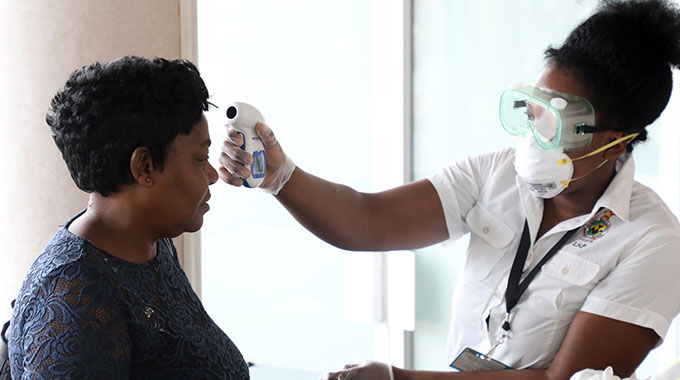
Andile Tshuma recently in South Africa
Just as flight number FN8664 landed at 10:30PM on a Friday night from South Africa, one could feel that this time things were different at Joshua Mqabuko Nkomo Airport.
As people disembarked the FAST Jet Embraer RJ145 jet, the air was thick with uncertainty at the Bulawayo airport. This was the first flight for most people, since South Africa had issued a statement confirming its third case of the Covid-19.
There are no confirmed cases in Zimbabwe but worldwide, so far more than 95 000 have been diagnosed with the Covid-19 and more 3 800 people have died, surpassing the number of people who died from the SARS outbreak in 2002.
As expected, there were many stories of what was to be encountered upon landing in Bulawayo.
The usual quick port health screening that had been on for weeks, was this time a step up as Port health officials tested every arriving passenger not once but twice for the virus.
All arrivals from South Africa had to fill in lengthy forms, with their details on contacts, addresses in the country and in South Africa.

Travellers had to disclose information on their brief medical history for the past month. Body temperature was taken, twice, on arrival and just before proceeding to the immigration officials.
There was a bit of chaos in the form filling process with people scrambling for the limited desk space to fill in the forms.
Perhaps if a few of the benches from the departure lounge are temporarily moved to the arrivals port health centre, the process could be a bit orderly.
There are senior citizens who need all the comfort they can get and standing around proved taxing. Also, this would minimise the unnecessary body contact that occurs as people jostle for space at the desks.
Among the requirements is for one to divulge if she/he may have been in the company of an infected person, or had been with someone who had travelled to a virus hotspot.
It is worrying that there is potential for one to make a false declaration.
There was general fear when health officials started checking body temperature.
That fear could actually raise one’s body temperature by a degree or two which meant trouble. In the event one’s body temperature was higher than the normal 37 degrees Celsius then it meant further tests and possibly quarantine.
Entering South Africa last week had been no hassle, considering also that the first case had not yet been confirmed, so the port health checks were rather still lax. It was the same routine as in Zimbabwe before the confirmed cases.
On return to Bulawayo, the mood at the OR Tambo had switched. It was tense. I noticed that people were not very keen to stand near any Chinese nationals or other Asian travellers. Nearly one in three people had a surgical mask covering their mouth.
It was however hilarious to note that more people had the surgical masks hanging on their necks than the number that wore them, especially among the airport staff. This probably could have been due to the discomfort of wearing the mask all day.
Airport shops were busy, people were buying hand sanitisers and disinfectants.

The 90-minute flight to Bulawayo was longer than usual. Being crammed up in the small aircraft space at 35 000 feet above sea level could trigger a panic attack if one started imagining that one of the passengers on board had the virus.
The best feeling however was finally going through immigration in Zimbabwe and proceeding to baggage collection, going through customs, and going home.
Being a journalist, I have the privilege of being able to sift through information and dismiss fake news and pay attention to legit information. However, thousands of travellers were on panic mode because of the fake news peddlers who were on overdrive, misinforming the public just to increase website traffic and make money.
Authentic information remains scarce while rumours explode.
It is therefore imperative to have a reliable media to give timely and detailed updates in such circumstances. When there is no official communication, the public will just believe whatever is said by whoever.
South Africa now has three confirmed cases, all linked to the same tour group that returned from Italy on March 1. A school in Sandton has since closed as a teacher was placed in quarantine.
A teacher at Grayston Preparatory School in Sandton, who had contact with the group of 10 who recently returned from Italy, is reportedly in isolation.
The third person to test positive was the wife of the first person to test positive in South Africa and all three were part of the same tour group that returned from Italy on March 1.
As the novel coronavirus continues to spread around the globe, so does misinformation, fear, fake cures and malicious hoaxes.
And to make things worse, people are readily sharing false information without first fact-checking. South African insurance companies are taking the chance, and have started offering Covid-19-specific cover, and some are actively advertising this as a benefit to those who have international travel plans.



 Online Reporter