Chronicle Editor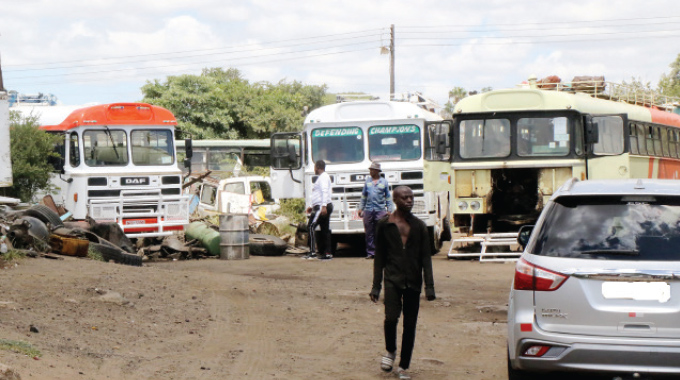
Raymond Jaravaza, [email protected]
FOR over 20 years, bus driver Mlungisi Mathe criss-crossed the vast Nkayi district in his beloved Gatsheni Express owned AVM bus that made daily trips from Bulawayo and he got to know almost all his passengers on a first-name basis.
Rusty and old, but packed with a powerful engine that withstood the demanding workload of carrying over 60 passengers, luggage ranging from door frames, wardrobes, beds, groceries, ploughs and the occasional scotch cart on a single trip, Mathe described his beloved AVM as a resilient machine that served the Nkayi community with pride.
Like any other machine, the advancement in technology and the entry of new types of buses in the market and eventually increasing competition on the Bulawayo-Nkayi route got the better of the AVM bus and the familiar faces Mathe was used to ferrying opted for other modern buses, one by one.
Today, you find the former bus driver in the Kelvin industrial area, assisting bus mechanics fix the few AVM buses still on the road and despite not be being a mechanic himself, Mathe says he knows the old AVM engine like the back of his hand.
“You can’t spend 20 years driving AVM buses and not know how the engine works or where to look when the engine starts giving you problems. I retired from driving long distance buses a few years ago, but I come to assist mechanics fixing AVM engines here in Kelvin.
“These buses were known for their power and endurance, especially on dusty roads in areas such as Nkayi, Tsholotsho, Kezi and parts of Plumtree where we carried passengers going to remote areas. I worked for Gatsheni Express Bus Company for years plying the Bulawayo/Nkayi route in an AVM and got to know nearly all the passengers by name.
“Unfortunately the old AVM buses can’t compete with the new models of buses manufactured nowadays and are slowly being pushed out of the road,” said Mathe.
During the Covid-19 pandemic years, the Government tried to bring sanity in the public transport sector by capacitating the Zimbabwe United Passenger Company (Zupco), which in turn also called on privately-owned buses to join the parastatal as private players.

Many AVM buses that had fallen out of favour with passengers and were deemed too old to ply long distances or simply broke down on a regular basis, found currency under the Zupco stable.
Some of the AVM buses were clearly very old. Take for instance, the popular Pelandaba Bus Services, a company established in 1958 by the late Mtshumayeli Joseph Ngwenya in Bulawayo, but still boasting of AVM buses more than 50 years later.
Ngwenya is said to have borrowed money from his father to buy a sewing machine as he was a gifted tailor and also dabbled in the business of selling roosters before eventually buying his first bus in 1958.
Today, his grandson Bukhosi, now the Pelandaba Bus Services manager, runs a fleet of 24 buses, both AVMs and modern buses.
When Zupco announced that the company would not be renewing contracts with private players, AVM buses again found themselves on the sidelines of the transport business.
“Competing against kombis and pirate vehicles such as Honda Fits has pushed us out of business. The prices we charged under Zupco attracted passengers to our old AVM buses and now that we have to go it alone, we stand no chance. Two of my AVMS are parked in an old garage in Kelvin, there is no business for the buses now,” said Sabelo Mdlongwa, a bus operator.
However, not all hope is lost for AVM Africa (Pvt) Ltd, the company that manufactures the buses, as it is making a return into the industry after developing a prototype 120-seater bus to provide the most cost-effective solutions.
The new AVMs can carry 120 passengers at once, — 100 seated and 20 standing with two exits, at the front and back. There are plenty of bus hangers for standing passengers, and there is ample room for those seated.

The company aims to be an exemplary leader in cutting the country’s import bill by assembling the buses domestically.
AVM managing director, Jacob Zvainairo Kupa, said the new design will create more employment and also ferry more people than other buses. The cost per customer was reduced since the 120 passengers will all use just one engine and drive train.
“This creates employment on the manufacturing side and the supply side. These buses will help in terms of transporting people, especially during peak hours, as they will carry 120 people at once,” he said.
Kupa said it takes 22 days to produce one bus.
“In terms of production, it will take us 22 days to produce one bus and we are looking forward to producing more this year alone. Currently we are waiting for the launching of this bus then after that production of more buses will start.”


 Online Reporter