Online Reporter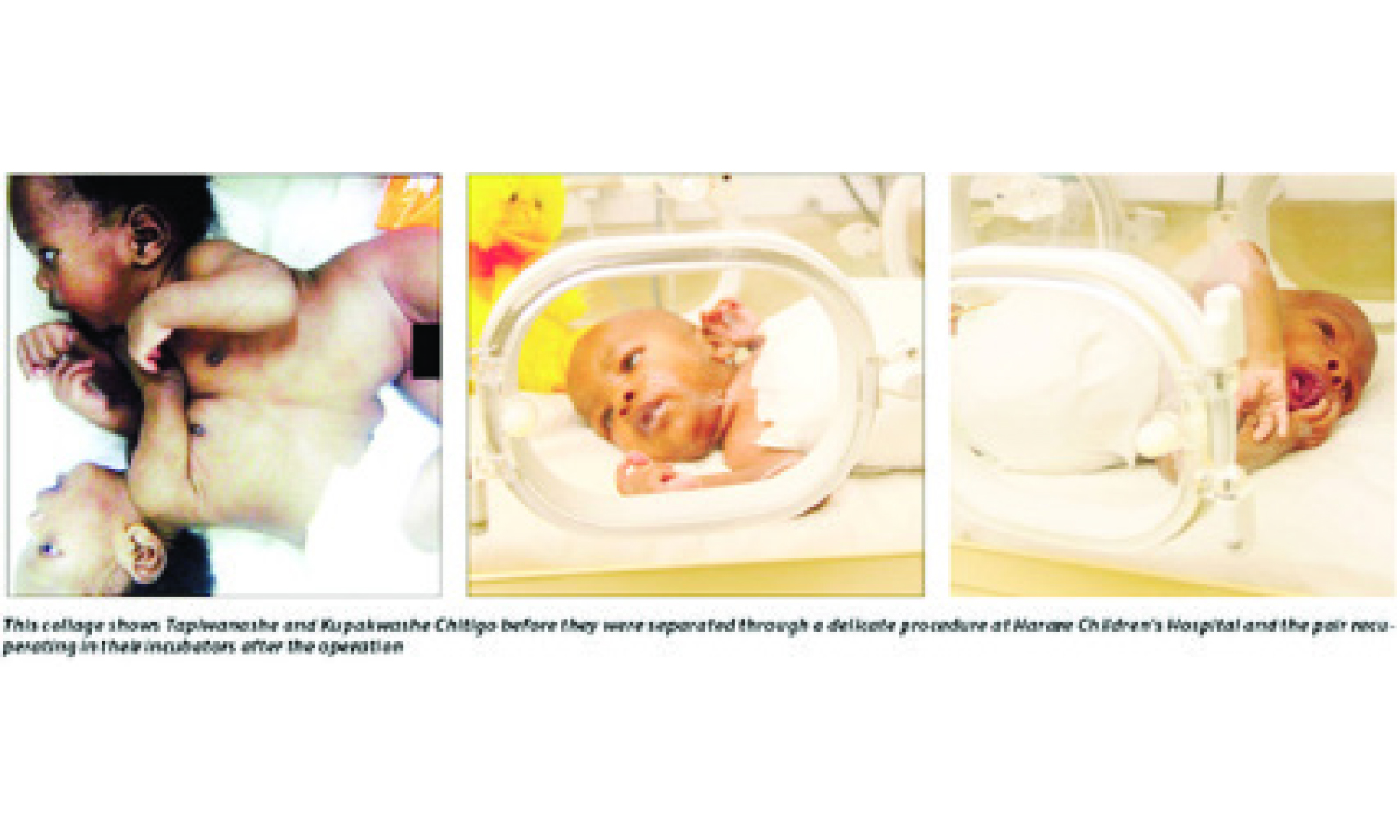
Paidamoyo Chipunza and Susan Mabunze
ZIMBABWE broke new ground in its medical history by successfully performing the first major operation on Siamese twins born in April, 2014, with a team of 50 having worked on the eight-hour delicate procedure at Harare Children’s Hospital.
Born on April 22, 2014, to a Murehwa couple, the twin boys − Kupakwashe and Tapiwanashe − were joined from the lower chest to the upper abdomen and shared a liver.
The most delicate part of the operation was on the liver, which had to be cut into two to ensure that both boys were left with something, although a liver can grow back if a part of it is removed.
Zimbabwe health sector was affected by brain-drain and funding constraints over the past 14 years as the West’s illegal economic sanctions regime constrained Government’s capacity to fund the sector.
One of the paediatric surgeons who took part in the critical surgical separation, Dr Bothwell Mbuvayesango, attributed the success of the procedure to teamwork.
“We needed everybody for us to be able to separate the babies properly,” he said.
“We also needed a lot of planning because it is not an everyday occurrence, there are very few incidents in the world where siamese twins are separated.
“This was an all inclusive Zimbabwean team of doctors. We did not get any help from any other doctors from outside the country and the success is because we managed to plan and work together.
“They are doing very well, they are feeding, they are breathing on their own, they are happy and they look strong.
“We still have them in the hospital for a little while just waiting for their wounds to heal.”
The twin’s father Mr Moses Chitigo, a fruit and vegetable vendor in Murehwa, said the success of the procedure was a relief to his family.
He said although his wife was going for antenatal care during pregnancy, no one had been open to them about the condition of the babies.
“The scan results read that there were separate heart beats, but there was no visible dividing membrane,” he said.
“Although I was a bit suspicious about the part which talked of a ‘dividing membrane’, I did not discuss it with my wife because she is hypertensive and no one else really told us what it meant.”
Siamese twins result from either fission, in which the fertilised egg splits partially; or fusion, in which a fertilised egg completely separates but stem cells search for similar cells on the other embryo and fuse the twins.
So rare are conjoined twins that their occurrence is estimated to range from 1 in 50 000 births to 1 in 200 000 births in the world. The overall survival rate for conjoined twins is approximately one in four. They are known as “Siamese twins” after the famous pair of Chang and Eng Bunker from Siam, now Thailand.
The only known local operation on Siamese twins was a “very minor” one successfully done at the same hospital in the 80s. − The Herald