

 admin
admin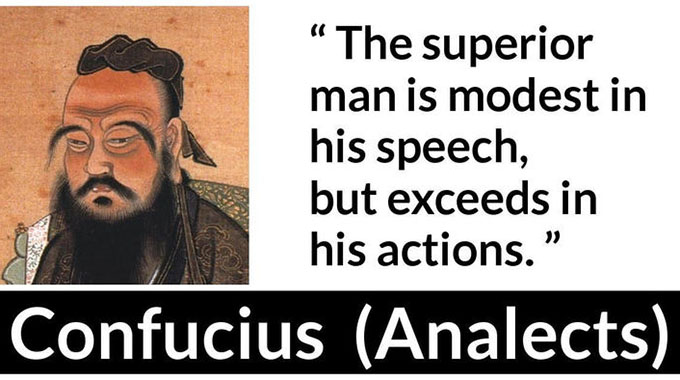
Ms G
While Zimbabwe is the first African country where I have lived, I did have the opportunity a few years ago to visit some of the other countries on the continent.
One of the things that struck me most during my previous trips and here in Zimbabwe is the eloquence of the speakers I came across.
Sitting and standing before a crowd, they are always confident and composed, taking their time to express ideas in plain language and capture the audience with the colour and rhythm of their expression and a little bit of fine personal touch.
Granted there is the advantage of speaking in the mother tongue, I find such good public speaking skills are not as common among the Chinese.
Some of my foreign friends also shared with me this impression of the Chinese generally being “not talkative”. Back in college, my foreign professors struggled a lot with the silence in class.
Why are the Chinese not interested in expressing themselves?
The cultural reasons are profound. The teachings of Confucius and Lao Tzu, the two greatest Chinese philosophers in ancient times, can shed much light on this question.
Confucius and Lao Tze represent two distinct schools of thought which dominate the Chinese culture.
Despite quite different worldviews, they converge on one point—to be restrained in words.
Confucius famously said, “A virtuous man is modest in his speech, but quick in his actions.”
At one point, he even defined Ren, or goodness, the foundational concept of his philosophy, as being quiet.
One day, Confucius said to his student, “I will stop talking from now on.” But how does a master teach without speaking?
He explained, “The heavens never speak; and yet the four seasons follow one another in good order, without chaos or mishaps.”
Lao Tze believes the greatest eloquence lies in quietness.
“Talking in excess creates difficulties; it is not as good as being reserved.” Both Confucius and Lao Tze disapprove clever talking, seeing it as harmful to a person’s trustworthiness.
Quietness is also regarded as a good way of learning. Confucius said, “To learn, one must watch and hear first, keep the questions to himself, and only speak about what he is certain of.” Zigong and Yanhui were two of his students. Zigong was articulate while Yanhui was very thoughtful. Confucius thought Yanhui was a much better learner, “Yanhui can make inference on ten things after learning about one; but Zigong can only make it two.” Lao Tze also regards silence as an indication of wisdom, “The wise do not talk, while those who talk are not wise.” “Let the ordinary men be clever, I would rather appear slow.”
What the two sages championed was not complete silence, but discretion in speaking.
According to Confucius, one must check his timing and the receptiveness of his audience before making comments and be right-on-spot with how much he speaks. Too much or too little are both imprudent.
There is an interesting story as well. Confucius had a student named Yan Rong who quite liked a poem from ancient China and recited it from time to time.
It reads, “Impurities in jade can be polished away; but mistakes made with words can never be undone.” For this reason, Confucius thought very high of this young man and married his own niece to him.
So the next time when you find your Chinese friend shy, just give him or her more time and patience. We are just brought up this way.
We do not speak too much because we would like to be sure about what we say and we want to hear you out first.



 Online Reporter