admin
admin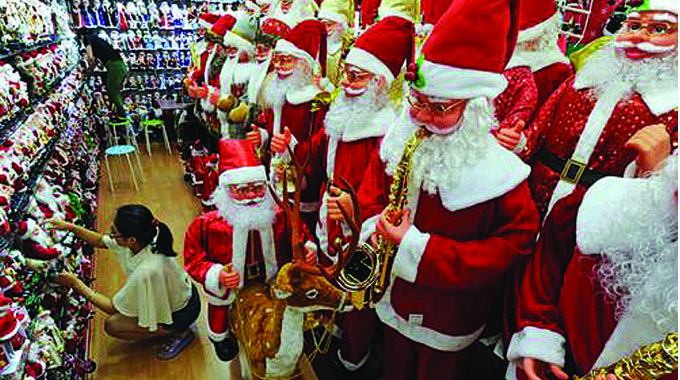
Dear friends, I hope you all had a wonderful Christmas and New Year. Was it enough fun or did you secretly wish the festive mood could last a bit longer?
If you are not yet ready to let go of the festive ambience, come to the town Yiwu in China and your dream will come true. There, the Christmas mode is always on, 365 days a year.
The International Trade Market of Yiwu, about 300 kilometres south of Shanghai, meets 60 percent of the global demand for Christmas decorations — the trees, bells, wreaths, baubles — everything you could think of for the festive season.
Some say nine out of the ten Santa hats you find on dropped on Times Square after Christmas celebrations come from the Chinese town. With more than 70 000 stores, the mall is 26 times the size of the Macy’s in New York. Even if you spend five minutes in each store, it will take you three years to visit all of them.
A BBC reporter who went there to do a story said he was lost in the “labyrinth of corridors and stores” and, after more than two hours wandering in the huge space, spent 45 minutes trying to find the exit, albeit without success.
Besides the marketplace, Yiwu is also home to more than 500 dealers and 600 manufacturers of Christmas decorations. At least three billion USD worth of products are made here on an annual basis, starting from January or February and lasting all year round until Christmas. Clients from faraway countries load their goods during summer; those from neighbouring countries can wait a bit longer to fill their containers in the latter half of the year.
But Yiwu is not repeating itself year in year out. The smart business people there never stop innovating. They created electric Santas that can play saxophone and dance a bit to the music; their Santas are dressed in patented outfits; they replace plastics with more environment-friendly materials, such as wood, fabric, and acrylic. And they customise their products to the clients.
“In Europe, they like it simple and elegant. So we give them a cedar pine with some artificial snow and gold and silver bells on it. The South Americans like it flashy. We put red, blue, and purple lighting on the tree together with some flower-shaped bulbs,” said a supplier who has been making Christmas trees for 15 years.
Wholesaling Christmas decorations is only a small part of the hive of business activities taking place in Yiwu. The town is the Mecca for traders from around the world looking for all kinds of products.
In 1982, Yiwu saw its first stalls in open-air markets. The business savvy took advantage of China’s reform and opening-up policy and made their first fortune by tapping into the potential of China’s huge market.
Since then, the town has always been at the forefront of China’s reform. Businesses are given enough leeway to experiment and innovate; the government does not interfere but makes sure policy support is forthcoming for the brave market players.
Yiwu attracted hardworking, smart business people from across the country. The town is nicknamed “the hometown of bosses” statistics show that, with 734 000 businesses in the town, every three out of ten persons in Yiwu are business owners.
They have several common traits, most are from poor families and started their business from scratch; they value even the smallest profit margins; they seek win-win growth with their clients, oftentimes splitting profits by 40:60.
When e-commerce surged in China like wild fires in recent years, Yiwu was quick to catch up. In 2007 the town opened its first online store; six years later 2 000 more appeared.
Sales revenue reached two billion RMB (more than 300 million USD). In a small village two kilometres away from the centre of the town, a common sight in the evening anchors promoting products to tens of thousands of customers online through a camera.
Dubbed “China’s No. 1 livestreaming village”, it has 1 200 online stores, employing more than 20 000 workers, 5 000 of which are influencers. Yiwu has developed a cluster of 169 villages like this in its surrounding areas.
In 2020, Yiwu’s e-commerce transactions reached 312,5 billion RMB (about 49 billion USD). Sales from livestreaming sessions topped 20,7 billion (about 3.2 billion USD). The town has also built specialised colleges to teach people how to do businesses online.
Today, Yiwu is reaching out to other parts of China to source products for export. Many small and micro businesses that find it difficult to access global market can connect themselves to the Yiwu Business Circle and find their way to foreign customers.
This business circle now involves over two million small and micro companies around China, especially those in the poor regions. Yiwu works with them under the processing on order model and provides skills training.
Yiwu’s story is one about hard work, honest trade, and innovation. Next time when you admire a Christmas trinket, remember its story and tell yourself, “Even the most trivial job in the world can be unimaginably rewarding when you put your heart into it.”


 Online Reporter