Online Reporter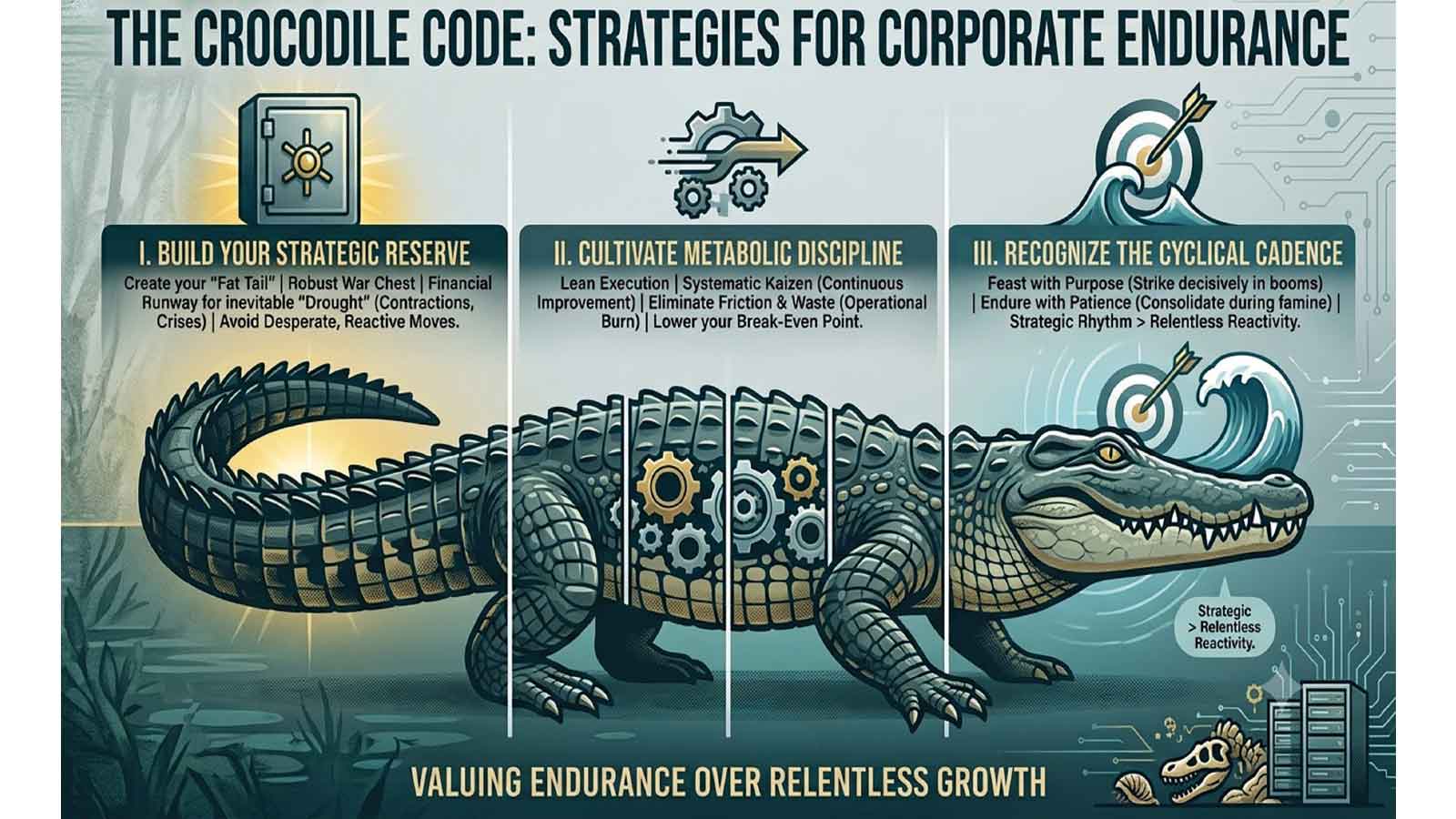
Arthur Marara
Point Blank
In the still, murky waterways where time moves to the rhythm of the seasons, an apex predator from the age of dinosaurs glides with primordial patience.
The crocodile has witnessed continents shift and ice ages come and go, not through relentless hustle, but through a masterful, patient efficiency. It does not fight the wetland’s harsh cycles of feast and famine; it is engineered by evolution to thrive within them. In an era where business headlines scream of disruption, burnout, and relentless growth, this ancient reptile offers a startlingly relevant blueprint. Its success is not a product of speed, but of resilience—a three-part strategy built on strategic reserves, metabolic discipline, and a cyclical cadence.
For the modern leader, adopting this “Crocodile Code” may be the key to building an enterprise that endures for decades, not just quarters.
- The Strategic Reserve: Build Your “Fat Tail”
Beneath the crocodile’s armoured plates lies its biological masterstroke: dense, specialised fatty deposits stored in the massive base of its tail. This is not fuel for daily activity; it is a strategic energy reserve, a dedicated cache for the inevitable drought. It transforms the animal from a creature of chance into one of strategic patience, allowing it to wait out periods of scarcity that would eliminate less-prepared competitors.
The business parallel is unequivocal: your financial runway is your “fat tail.” In a world obsessed with top-line growth and aggressive reinvestment, the discipline of maintaining a robust war chest is often undervalued. This reserve is not idle cash; it is active resilience capital. It is what allows a company to endure a sudden market contraction, navigate a supply chain crisis, or invest in a transformative opportunity when competitors are paralyzed.
Consider the Great Recession. Companies that entered 2008 with strong balance sheets didn’t just survive; they gained ground.
They could acquire distressed assets, invest in R&D while others cut back, and retain key talent. Their “fat tail” provided the ultimate strategic advantage: the power of optionality. While others were forced into desperate, reactive moves, they could choose their moment with calm precision. Building this reserve requires a cultural shift—from worshipping utilization at all costs to valuing strategic liquidity. It means sometimes forgoing a flashy expansion to solidify the foundation, understanding that the drought always comes.
- Metabolic Discipline: The Art of Lean Existence
The crocodile’s second pillar of resilience is its exceptionally low metabolic rate. It is a study in energy conservation, expending the bare minimum required for core functions.
Every movement is deliberate; no calorie is wasted on non-essential exertion. This low “operational burn” ensures its strategic reserves last exponentially longer.
In business, this translates to operational excellence and lean execution. A “Crocodile Company” cultivates a culture of intentionality where waste—whether of time, capital, or human potential—is systematically hunted and eliminated. This goes beyond traditional cost-cutting. It’s about streamlining processes, empowering agile decision-making, and ensuring every resource allocation drives toward core strategic objectives.
This metabolic discipline is what allows companies like Toyota to maintain legendary profitability through decades of cyclical downturns. Their foundational Kaizen philosophy—continuous, incremental improvement—is a form of corporate metabolic tuning. It’s not about austerity, but about strategic conservation of energy. By reducing friction and inefficiency, a company lowers its break-even point. This creates a wider margin of safety, making it more resilient to demand shocks and price wars. When the market turns cold, the efficient organisation doesn’t just shiver; it thrives, using its conserved energy to outmanoeuvre bloated competitors.
III. The Cyclical Cadence: Feast with Purpose, Endure with Patience
Finally, the crocodile embodies a powerful, rhythmic intelligence. It is the ultimate opportunist, capable of a explosive, full-force strike, consuming a massive meal. Yet, this “feast” is followed not by frantic activity, but by a state of prolonged, patient digestion and conservation. It does not chase every minnow; it waits, perfectly positioned, for the right moment when the return on energy invested is immense.
The business application is strategic rhythm over relentless reactivity. Markets, like ecosystems, move in cycles: periods of abundant capital and growth (“feast”) are followed by contractions and scarcity (“famine”). The Crocodile Company recognizes this rhythm and builds its behaviour around it.
During the “feast”—a market boom, a technological shift, a period of low interest rates—the resilient company strikes with decisive force. It raises capital, scales efficiently, and captures market share. But crucially, it does so not for vanity, but to build its reserves for the lean times. Then, as conditions inevitably tighten, it has the discipline to shift modes. It conserves, refines its offerings, strengthens customer relationships, and prepares. It understands that not every quarter is for explosive growth; some are for consolidation, learning, and strategic positioning.
This cadence is evident in the world’s most enduring investors. Warren Buffett is famous for his “patient capital,” accumulating cash during bull markets and deploying it with overwhelming force during crises.
He doesn’t attempt to eat every day; he waits for the right prey. Companies like Apple exhibit this same rhythm, using periods of immense profitability to build a fortress balance sheet, which then allows them to innovate through industry downturns and seize strategic opportunities.
The Long View
The crocodile’s tenure on Earth is a testament to a simple truth: resilience trumps temporary frenzy. In business, the “Crocodile Company” is rarely the flashiest headline-grabber during a boom. It is the steady, formidable entity that still stands, stronger than ever, when the climate changes. It has built its vital reserves, tuned its operations for efficiency, and mastered the patient rhythm of its market.
Adopting this ancient code requires a fundamental reorientation—from a mindset of infinite growth to one of infinite endurance. It asks leaders to value strategic patience over impulsive action, resilience over mere speed, and longevity over short-term spectacle. It is about architecting an organisation not just for the next earnings call, but for the next economic cycle, the next technological disruption, and the next century.
In the end, the silent predator in the wetland teaches us that the most powerful force in business, as in nature, is not the ability to always move fast, but the profound strength to wait, to conserve, and to strike with decisive purpose when the moment is right. That is the path to becoming not just a competitor, but a legacy.
Arthur Marara is a corporate law attorney, keynote speaker, peak performance and corporate strategy speaker. With his delightful humour, raw energy, and wealth of life experiences, he captivates audiences and inspires them to unlock their full potential. He is also a leadership expert with extensive experience in leadership development and coaching. He is passionate about developing effective leaders and empowering individuals and organisations to achieve their full potential. Through his engaging talks and workshops, he imparts invaluable insights and practical strategies that empower individuals to lead with confidence and make a lasting impact. Arthur is the author of “Toys for Adults” a thought-provoking book on entrepreneurship, and “No One is Coming” a book that seeks to equip leaders to take charge. Send your feedback to bookings@arthurmararaattorneys.
com visit his website www.arthurmarara.com or contact him at +263772467255.