Online Reporter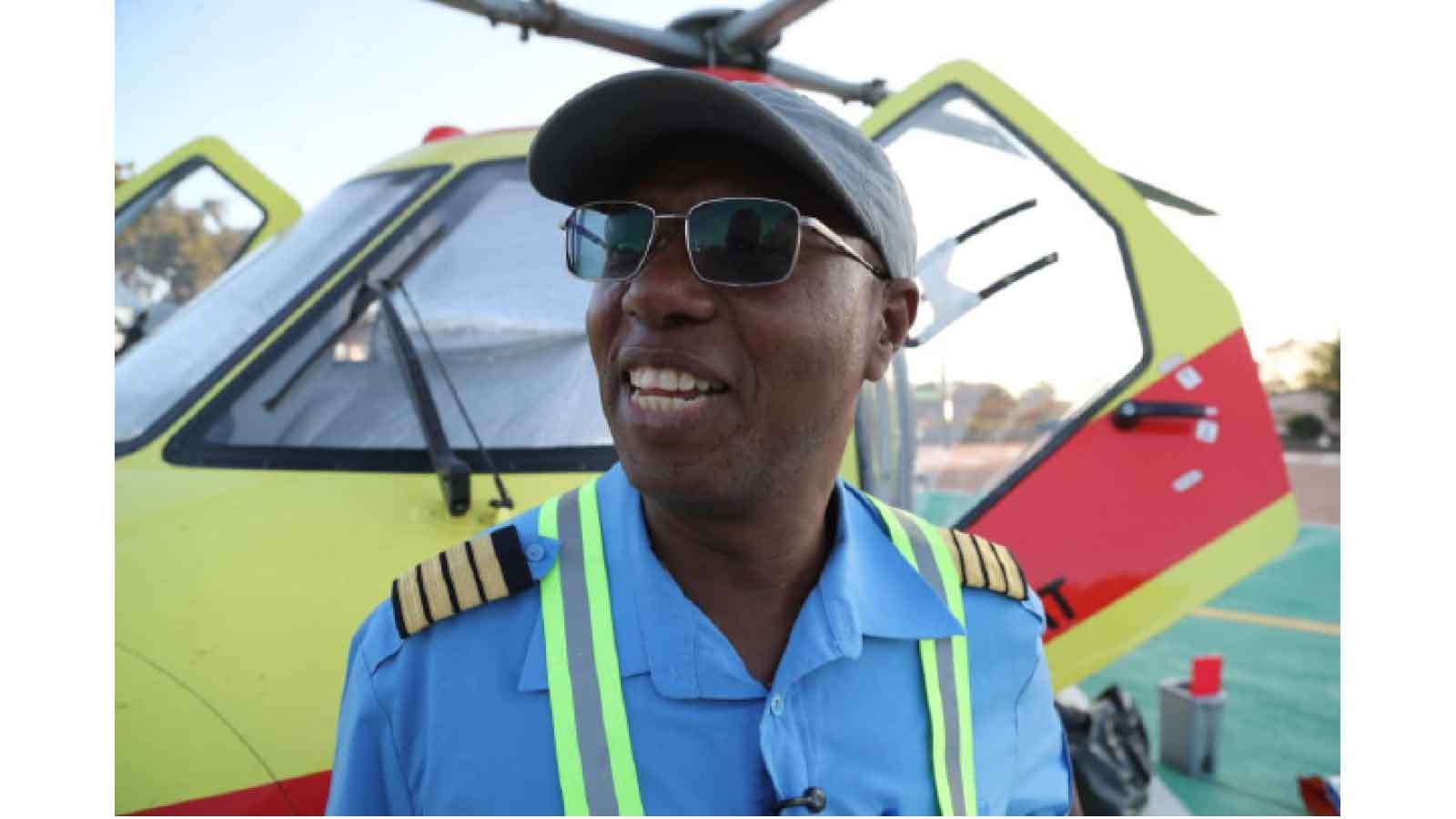
Theseus Mauruki Shambare in VICTORIA FALLS
THE helicopter appears before it is seen.
First comes the sound — a violent chopping of air above Victoria Falls District Hospital that sends nurses rushing toward the helipad and security guards lifting their heads toward the pale afternoon sky.
Tourists standing near the hospital perimeter instinctively look up.
In Victoria Falls, helicopters usually mean sightseeing. A slow flight above the waterfall.
A luxury aerial view of the Zambezi River.
Another adventure added to somebody’s holiday album. But not this one.
As the aircraft descends sharply onto the newly refurbished helipad, no cameras are pointing upward, no excited passengers waiting to disembark.
Inside, a patient lies sedated beside humming medical equipment.
Sometimes it is a child struggling to breathe, or a road accident victim, or even a mother losing blood faster than doctors can replace it.
Here, the helicopter does not carry tourists.
It carries time itself.
And in some cases, the difference between life and death is measured by how quickly its rotor blades begin turning again.
At the controls is 53-year-old Lasley Makoni, a former Air Force of Zimbabwe pilot who once flew military missions during Zimbabwe’s involvement in the Democratic Republic of Congo conflict.
Today, his war is against distance.
Born in Rusape, Makoni says becoming a pilot was never accidental.
“It has always been my dream,” he said moments after stepping out of the aircraft from Bulawayo. “It was my first job.”
He became a pilot in 1993 and spent a decade in the Air Force before eventually joining HeliDrive Zimbabwe National Air Ambulance Service — the country’s government-subsidised emergency aeromedical evacuation programme now expanding its footprint across Zimbabwe.
The opening of the Victoria Falls operational base follows similar emergency air ambulance service launches in Harare and Bulawayo.
But here in Zimbabwe’s tourism capital, the significance feels different.
Victoria Falls is internationally known for adrenaline, luxury tourism and one of the Seven Natural Wonders of the World.
Now it is quietly becoming something else too — a frontline centre for emergency medicine in the sky.
“When we receive a flight request for a critically ill patient, sense of duty calls,” said Makoni.
“There is excitement because you know you are going to help someone reach the next best medical facility in the shortest possible time.”
The missions are not always easy.
Thunderstorms build suddenly during the rainy season.
Strong headwinds increase fuel consumption. Remote locations often test visibility and endurance. But Makoni said the emotional burden of the work weighs more heavily than the weather.
“There have been many memorable missions,” he said slowly in an interview moments after stepping out of the aircraft from Bulawayo.
“But one I will never forget involved a mother and her baby after a Caesarean section. Both were in critical condition.”
For much of the journey, uncertainty sat heavily inside the aircraft.
“We were worried whether they would still be alive by the time we reached the hospital,” he recalls.
“But they made it alive and received the medical attention they needed.”
For Makoni, every landing represents another race against time.
“Sense of duty calls. You know that somebody’s life depends on how quickly you can get them to the next medical facility.”
That single flight captures a growing reality in Zimbabwe’s healthcare system: for many critically ill patients, survival depends not only on medicine, but on geography.
And geography can be cruel.
Across remote parts of Matabeleland North Province, patients requiring specialised intensive care often face journeys stretching hundreds of kilometres to Bulawayo or Harare.
By road, those journeys can consume half a day or more.
For patients in respiratory failure, severe trauma or postpartum haemorrhage, time becomes a luxury the body cannot afford.
Young general practitioner Dr Tapiwa Kandemiiri sees this reality almost daily.
The 32-year-old doctor from Hwedza works with the Helidrive Zimbabwe National Air Ambulance Service stationed at Victoria Falls District Hospital.
Soft-spoken but confident, he has been practising medicine since 2019 and believes the air ambulance system is transforming emergency outcomes in remote communities.
“By road, some patients would take almost 12 hours to reach Bulawayo because of the distance and road conditions,” he said. “In critical emergencies, that is simply too long.”
He remembers a recent maternity emergency that still lingers vividly in his mind.
“There was a patient who developed postpartum haemorrhage after complications in theatre,” he explained.
“She went into disseminated intravascular coagulation and urgently needed blood transfusion and ICU care.”
The nearest intensive care facilities were in Bulawayo. Without rapid evacuation, the odds would have narrowed dangerously.
“Because of the air service, we managed to quickly evacuate the patient,” said Dr Kandemiiri.
“The helicopter itself functions like a flying ICU. There was a ventilator on board and the patient remained sedated throughout the journey.”
The patient survived.
“As we speak right now, she is getting better,” he said.
For Dr Kandemiiri, the emotional reward of emergency medicine comes not from heroism, but from witnessing life continue.
“It is satisfying when things go well because not all situations end positively,” he said.
“But when someone survives because of your intervention, you feel you have done something meaningful.”
That meaning now stretches far beyond medicine. The arrival of the HeliDrive base in Victoria Falls represents a quiet but important shift in how tourism destinations increasingly intersect with public health systems.
Traditionally, emergency healthcare infrastructure in many tourism centres across Africa has focused largely on visitors.
But Victoria Falls is evolving into something broader — a system where tourism investment and local healthcare survival are beginning to reinforce each other.
The regional air ambulance base includes three operational helipads, dispatch infrastructure and maintenance facilities capable of handling rapid emergency deployments.
The helicopters themselves operate as flying intensive care units equipped to stabilise critically ill patients during transfer.
For tourists engaging in high-risk adventure activities such as white-water rafting, bungee jumping and helicopter excursions above the Falls, rapid trauma response can become lifesaving.
Yet perhaps the most remarkable aspect of the service is that the same aircraft reassuring international tourists is also rescuing ordinary Zimbabweans from some of the country’s most isolated communities.
The helicopter carrying a tourist injured during an adventure activity may later transport a rural mother suffering childbirth complications. Inside the aircraft, economic status disappears. What remains is urgency.
Helidrive Zimbabwe chief medical officer Dr Freddy Mhondiwa said the Victoria Falls operational base significantly strengthens emergency response capacity in the region.
“As Helidrive Zimbabwe National Air Ambulance Service, we are proud to mark the opening of our new operational base in Victoria Falls,” he said.
“This positions us to deliver timely, high-quality aeromedical services to both tourists visiting one of Africa’s premier destinations and surrounding local communities requiring urgent access to advanced medical care.”
Statistics released by Helidrive Zimbabwe reveal the growing national dependence on emergency air evacuation services.
Since the launch of operations in August 2024 up to May 19 this year, the service has handled 1 462 emergency cases across its Harare, Bulawayo and Victoria Falls bases.
The Harare base accounted for the highest number with 944 evacuations, while Bulawayo handled 504 cases.
Although still in its infancy, the newly established Victoria Falls base has already responded to 14 emergencies.
The figures also reveal the quiet human complexity behind the flights.
Nationally, adults aged 13 years and above accounted for 710 evacuations, while 473 children between zero and 12 years required emergency transfers. Of those children, 271 were infants under the age of one.
In Victoria Falls alone, six children have already required emergency evacuation, including five infants. Behind every statistic is a family waiting beside a hospital bed. A mother. A child. A survivor.
With Victoria Falls preparing to host upcoming international Cricket World Cup events, emergency preparedness is expected to become even more critical.
Thousands of athletes, officials and visitors are anticipated to descend on the resort city.
“Our teams are fully prepared and operational,” said Dr Mhondiwa.
“We are strengthening rapid response systems, trauma care and critical care transfers across the region.”
Tourism stakeholders have welcomed the expansion, describing it as a major confidence boost for destination safety and emergency readiness.
Globally, tourism destinations are increasingly judged not only by the quality of hotels and attractions, but by the strength of their emergency response systems.
In many ways, Victoria Falls is now attempting to redefine itself through both hospitality and healthcare resilience. But perhaps the deepest transformation happening here is less visible. For decades, distance has silently shaped survival in Zimbabwe.
Distance between rural clinics and urban hospitals; between emergencies and intensive care units; between life and specialised treatment.
Now aviation is beginning to compress that distance. A journey once measured in exhausting road hours can now take less than two hours by air.
For many families in Matabeleland North, that difference has begun to reshape how communities think about survival itself.
“Before this helicopter service, when someone became critically ill, families here would first pray for the road,” said Clemence Mudimba, a Victoria Falls resident who has witnessed emergency evacuations from the district hospital.
“Now, at least, we know the sky can also bring help.”
It is a simple observation, but one that captures the quiet transformation unfolding in Victoria Falls — a tourism destination increasingly becoming a lifeline for both visitors and ordinary Zimbabweans living far from specialist medical care.
And for critically ill patients, those saved hours can become saved lives.
As evening settles over Victoria Falls, sunset helicopters continue carrying tourists above the mist rising from the Zambezi gorge.
From the air, the city still looks like a postcard destination.
But on another section of the tarmac, a different helicopter waits silently on standby.
Its next mission is unknown. Perhaps another infant struggling for oxygen, or a road accident victim.
Makoni walks slowly across the helipad as fading sunlight reflects against the aircraft behind him. Three decades after first entering a cockpit, he still flies missions shaped by urgency. Only now, the enemy is no longer war.
It is time itself. And in a country where geography has too often determined who lives and who dies, the last road between life and death is increasingly becoming the sky.