


 Chronicle Editor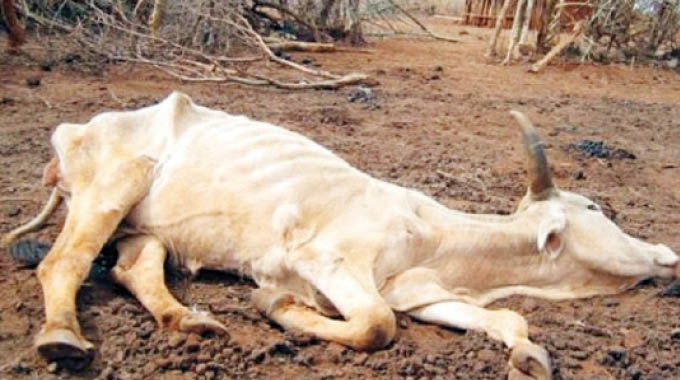
A devastating drought of the magnitude of the one experienced in 1992 is now fully loaded and already firing.
Very few places have received rainfall amounts worthy writing home about. In most cases it rained once and even the streams could not flow. We are drifting towards the end of December and it is becoming even less promising in terms of receiving any precipitation.
January has its traditional two week dry spell and this year the dry spell will be even more damaging because it will be coming against an already dry background. In simple language there shall be gnashing of teeth for livestock farmers.
Picture it this way, it did not rain enough to generate vegetative growth for the grazing land. In fact the grasses barely established because the amount of rains received were not enough.
The crop fields will be a total failure with not even any stover to stockpile for livestock feeding.
The water bodies did not collect enough water for the animals to drink, ground water table did not recharge enough and as such the few boreholes used to provide drinking water for both humans and livestock will dry out somewhere around February!

I paint this graphic horrific picture so that farmers can start planning and making very critical decisions and the powers that be can also start putting in place mitigation measures to alleviate the crisis.
In that regard we need to learn from the previous efforts that were done by the then Cold Storage Commission (CSC) to deal with droughts of similar magnitude with primary aim of saving the national herd.
The giant beef company had ranching across the country which some farmers used as relief grazing zones until the next season when proper rains were received. The same model could be used not specifically for CSC ranches but other similar rangelands including Forestry Commission forests.
Some livestock farmers with large ranches can also lease out some of their ranches to the needy livestock farmers. Admittedly there is not that man farmers with excess ranches but with the land should certainly help fellow livestock farmers.
The other vital approach would be utilise tonnes of cereal stover that is produced by irrigation schemes. It is very common to find irrigation schemes burning stover as a pest and disease control mechanism.
However, that stover can be given or even sold to livestock farmers within the vicinity of the scheme or to those with means of ferrying it to their places.
There are big irrigation schemes that produce wheat straw as well as maize stover in large quantities and that can be utilised to save livestock.
Actually, some irrigation schemes like Silalatshani in Filabusi District have feedlot pens within the scheme, which were meant to feed animals before marketing during drought periods.
The rational being that water and stover will be available within the scheme. This model can be revived and refined to cater for those farmers who want to condition their animals for the market.
It is not a stretch of the situation to warn that we may experience a severe shortage of meat from March going forward as animals will be too thin to even take to the market.
Only those with means to fatten will be able to sell. It is going to be a very rough ride for livestock farmers and mitigatory actions needs to be planned for and taken now.
Needless to say those that have animals that are in a fair condition such that they can be taken to the market, now is the right time to do it.
It is my submission that this drought be declared a national disaster and appropriate support and resources be availed now to save the situation from deteriorating into a calamity of epidermic proportions.
Let’s engage into our disaster mode gears now and be ahead of the situation as opposed to convening endless conferences to discuss farmer losses latter.
Let’s prevent the losses by acting now. Followers of this column will be advised to bear with me as this topic is going to occupy this space for some time because of the magnitude of the problem ahead of us.
It is difficult to write about anything else at the moment. Uyabonga umntaka MaKhumalo.
Mhlupheki Dube is a livestock farmer. He writes in his own capacity. Feedback [email protected] cell 0772851275


 Online Reporter