

 admin
admin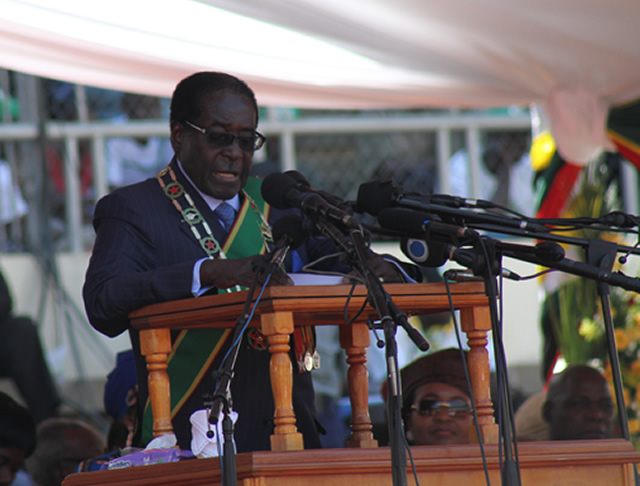
Reason Wafawarova On Thursday
But Nigerians and all of us must not fool each other into believing that in democracy lies the answer to all our woes and troubles. The concept of democracy is a flawed one, and it is some of these flaws that I seek to interrogate this week.
From 1960 to 1999 Nigeria was ruled by successive military leaders who took turns on the throne by the barrel of the gun and, as a result, there are people who were born in Nigeria at independence and grew to the age of 40 with no idea of what an election looks like in practical terms.
When the country tried its first election in 1993, General Ibrahim Babangida simply disallowed the announcement of the election result in which Moshood Abiola was leading by a wide margin.
That was end of story, and Nigerian life continued.
Last week, Nigeria was inaugurating its fourth President since Olusegun Obasanjo first came to office through a democratic election in 1999, and it was at that event that some blatantly ignorant dullards masquerading as journalists decided to confront President Mugabe, asking, among other harebrained questions, “When is democracy coming to Zimbabwe?”
No doubt the sponsored goons who have been described by others as “political activists” had among them members who are convinced that the inauguration of President Muhammadu Buhari was in itself the epitome of democracy, and to them anything different from what Nigeria is currently experiencing needs a visitation by this glorious godly animal called democracy.
This is quite understandable for citizens of a nation that was for so many years deprived of the entertainment of elections.
It is really good that Nigerians now know what voting means, a good five plus decades after the dawn of independence; thanks to many earlier examples of multi-party democracies across the continent, among them Zimbabwe, a country that has religiously held elections every five years since independence in 1980. It is good that Nigerian youths now know what an inauguration means, and that is excellent for democracy.
But Nigerians and all of us must not fool each other into believing that in democracy lies the answer to all our woes and troubles. The concept of democracy is a flawed one, and it is some of these flaws that I seek to interrogate this week.
Democracy essentially assumes that participants know what is best for them, and that there are no stupid people like the goons that were at Buhari’s inauguration.
Because rationality is not a commonly and evenly given reality among people, the vote has been used to suppress the voter in many instances.
People are quite simplistic most of the time. They want jobs, money, and comfortable lives. If a government tells people that it intends to slash salaries, or reduce the size of its workforce because the country is getting broke, people will simply vote for a government that says it will not be doing so.
Winston Churchill is famed for telling us “democracy is the worst political system — except for all others.” So here we are as post-independent Africa, with euphoric little girls so intoxicated with the preached wonders of democracy that they can even confront a founding father of African independence asking the question; “When is democracy coming to your country?”
Well, people are not perfect, governments are not perfect, and it is reasonably advisable to be sceptical, even of democracy. Even the revered Thomas Jefferson was wary of the “tyranny of the masses.”
Democracy is premised on this idea of aprioristic equality, assuming that all voters are equal, that all opinions are worthy the same, placing the same value on the opinion of the educated and that of the ignorant, even that of the law abiding citizens and that of crooks. One needs to exceed Abraham’s faith to comprehend such a world.
Of course we all tell each other that as humans we are created equal, itself a debatable assertion, but it is obvious that we grow in different environments, and that way our characters differ. There is a vacuous assumption in democracy that we are all able to reach rational and informed decisions after exploring all pros and cons.
It is the cultural and political environment in Nigeria that made the country go for 40 years without entertaining the idea of multi-party democracy, and for that period there were some other forms of rationality and reasoning that informed the political landscape of that country. Perhaps Nigerians did not exactly miss much during that time.
Instead of rationality, democracy often devolves into a popularity contest between political candidates. Polls do not decide who is right. In an election, the one who is right is determined by who is most willing to say what people like to hear. One needs to read the ZANU-PF election manifesto of 2013 to understand how to win elections by saying what people are waiting to hear. The ANC does an excellent job of this in South Africa too.
It is common that candidates will resort to populism once political competition begins to hot up. They begin to pursue policies that focus on the immediate satisfaction of the whims of the people, like saying “we have friendly countries waiting to give us billions of dollars once you make me win.”
With populism emotion comes before reason, and common sense is elevated above wisdom. This is the political rally behaviour where hundreds of thousands of people gather specifically to be entertained by vociferous sloganeering. We are talking here of the typical song and dance politics of the African motherland.
Populism breeds the toxic reality where bad ideas are defended with unabated stubbornness. Supporters of populist leaders are convinced that, like God in Heaven, their iconic heroes cannot sin. Youths fight to bloody noses over the moral shortcomings of their political leaders, and that is a sad indictment of democracy.
Democracy is a very dangerous phenomenon in communities where tribal mentality guides the thinking of people.
Mankind has not evolved much since the Stone Age, much as this Internet business is such a wonder in civilisation, and much as humanity has made many other phenomenal discoveries. Our human nature has hardly changed, and many of us still think in tribal terms.
We have class struggles, xenophobia, racism, and even nationalism — all emanating from the concept of us identifying with one group or the other.
Every group we may choose to identify with has alliances and enmities, and we blindly assume them.
Tribal mentality in a democracy will make you vote for your team, the way Temba Mliswa wants Zimbabweans to be choosing their presidents. After voting for your team, you essentially have not necessarily voted for your own interests, and the team has neither obligation nor business looking after your interests, so often they proceed to deal with their own interests once your vote is secured.
When this happens we often end up with unfair legislation targeted at oppressing minority groups, or laws that create privilege entitlement for minorities in power.
Democracy breeds clientelism or machine politics. This is when the man on the machine in a political organisation will doll out rewards in exchange for the vote.
Vote-buying in Africa is not only rampant, but has in many cases been elevated to the political norm.
When a state dolls out freebies to poor people in order to win their support what often happens is that the electorate develops not only a sense of dependency, but also of entitlement. We have seen people developing a sense of entitlement to farm inputs, food, T-shirts, beer and other commodities used to secure votes, and this is not good for long-term development.
Democracy has been criticised as a concept that promotes mob rule where the majority simply uses its numbers to decide over the minority.
We know that the smallest minority is the individual, and democracy in essence entails that the individual will have to depend on his agreement with the majority, purely on the assumption that it is impossible for the majority to be wrong.
True, we try to promote individual rights and liberties to militate against the tyranny of the majority, but there are always limitations in attaining those rights and liberties.
When a leader banks on the majority support he commands from the public to victimise the minority with the tacit approval of the supporting majority, it becomes so hard to hold the perpetrators of humanitarian crimes to account.
It is easier to identify and bring to book the culprits when it’s a dictatorship or a monarchy, but when the majority is in approval the suffering of the minority might be hard to atone for.
We are told democracy is such a wonderful political system that brings happiness, and yet we live in these times where nation states are increasing the number of skeletons in their power corridor cupboards.
Eavesdropping, spying and all other forms of intelligence gathering are inherently undemocratic, but we are told that state secrets are part of democracy, from America to Africa.
While the gathered intelligence is plausible in busting organised crime, or in fighting terrorism, we have seen many cases where such intelligence has been used to further the personal interests of those in power, and even to target political competitors with malice.
Democracy is far more complex than carrying out an election and changing heads of state.
It is a political system with many pros and cons, with flaws and strengths, and I hope the concept of democracy will develop for the betterment of Nigeria, and indeed for the rest of Africa.
It is far from a perfect political system.
Africa we are one and together we will overcome. It is homeland or death!
REASON WAFAWAROVA is a political writer based in SYDNEY, Australia.



 Online Reporter