Chronicle Editor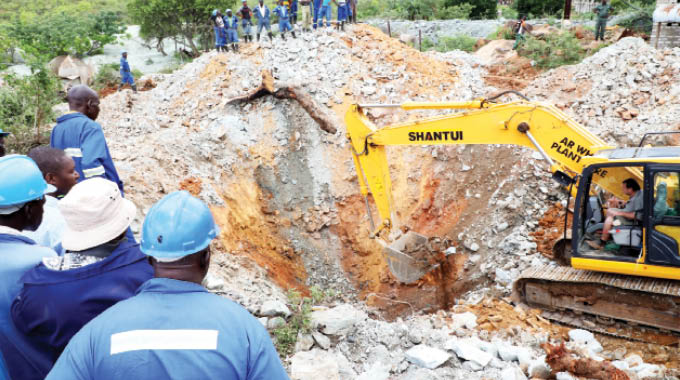
Obey Sibanda, Features Reporter
A FEW metres from the disused Nugget Mine in Matobo, whose gold-rich shafts have collapsed and trapped scores of male artisanal miners underground, are sobbing women cupping their chins with their palms in apparent sorrow.
These women cast a lone figure from the crowded scene. They are convinced their husbands are either among those trapped underground or are deceased after positively identifying their tools of trade and clothing belonging to their husbands.
Police officers, soldiers and the Matabeleland Civil Protection Unit (CPU) are working with practised precision to rescue gold panners who are suspected to be trapped underground.
For years, hundreds of male miners have died due to collapsing mine shafts, gas explosions and turf wars among the criminal syndicates that have seized control of the illegal industry.
As a result, widows have been left behind to fend for themselves and their children in a country where the economic situation is not so rosy and unprecedented unemployment rates.
In essence, these widowed women have replaced their husbands becoming the sole breadwinners.
Faced by the fact that they must work to provide for their families, many return to the mines where they, like their husbands, are at risk of being maimed or killed while foraging for their families.
For these women, it is even more difficult to find work in formal mines because those who do are often assigned different tasks than men. Most widows are “unskilled workers” who are assigned simple tasks such as picking up, loading and crushing stones. In many cases, they are paid less than men.
Driven by need, tens of thousands of these women are breaking barriers by venturing into the Artisanal and Small-Scale Mining (ASM) sector to scrape a living, risking death, disease and sexual violence.
To some miners, the participation of these women is driven by the allure of riches, however, for many widows, artisanal mining with its related hazards, signifies an opportunity to relieve the strains of poverty.
Women comprise 11 to 15 percent of the estimated 50 000 small-scale miners in the country.
For the past few years, the informal sector has been dictating the pace and level of national output after scores of large-scale producers collapsed. According to Fidelity Printers and Refiners, the ASM sector in 2018 produced 22 tonnes out of the total 34 tonnes produced, representing a 65 percent contribution.

The Zimbabwe Miners’ Federation (ZMF) affirmed that the ASM Mining Sector’s gold output has improved to 65 percent, a development that will bolster the country’s capability to earn the much needed foreign currency.
Widows in ASM have demonstrated enormous potential to achieve substantial financial gains and manage successful mining businesses. They rely on the income from this informal mining economy to support their households and dependants.
Reports show that women’s ASM activities are crucial sources of revenue for themselves and their families, allowing for basic survival, health and education, as well as accumulation activities that improve the status of women and their dependants.
The majority of these widows in the gold sector are financially responsible for generating their own and their families’ income. In climbing out of the poverty category, these golden girls have overcome traditional notions of gender by becoming breadwinners in their homes and providing primary financial support for their families.
Ms Monalisa Moyo is one of a growing number of widows driven into this dangerous world, earning less than what she expected but enough for her necessities from her claim in Inyathi Village.
For Ms Moyo mining is not just a job. It is her second home.
“When I leave home, I always say to my children it’s time for me to leave you to go to my second husband, which is the mines. Even though this work is very hard, it’s a good job,” says Ms Moyo, showing her calloused palms.
There is a large number of women who are not in constant contact with the yellow metal and make their money by participating on the peripherals.
Ms Ntandoyenkosi Dlodlo of Zimbili in Mbembesi and her daughter Nomasiko wake up every morning collecting empty cement bags from construction sites and sell them to the artisanal miners who use these empty bags to remove the gold ore from their pits.
A 7-tonne truck load is filled with empty cement bags which and can be reused once.
“I get most of these bags for free from builders and sell a bag R5 each,” says Ms Dlodlo with a bright smile on her face.
Although these widows seem to be settling well in the mining industry, they still have to endure inhospitable conditions in the male dominated panning field. They are experiencing a myriad of problems such as lack of skills and equipment, victimisation, violent disposition by intruders on their claims combined to a larger extent with various gender-based violence issues.
Three years ago, Bubi illegal settlers invaded a widow’s mine, Ms Silethemba Dube, and built homesteads. The illegal settlers claimed they were allocated the stands by the Agritex Officer.
“I engaged the councillor, lands office, Bubi RDC and traditional leaders and now it’s almost three years now without any solution. As a widow, I feel I’m being taken advantage of,” she said.
Last year, Peace Mine artisanal miners in Silobela were violently ejected from their mine by a rival armed gang. The community-owned mine that was mainly dominated by widows, single mothers, and orphans was led by the widow of the late Arthur Nkiwane who founded it in 2015 and passed on in 2017.
Recently, a group of about 10 machete-wielding men attacked a female miners’ worker, killing one before disappearing with about 180 bags of gold ore in Coleen Bawn, Gwanda. The other four workers sustained varying injuries and they were rushed to Gwanda Provincial Hospital.
Sexual violence is also common in ASM. Reports on the death and rape of a female mine worker placed a spotlight on the plight of the female mine workers and also recognised the importance of implementing measures to enhance the safety of women in mining.
Home Affairs and Cultural Heritage Deputy Minister Michael Madiro said at least 35 people were killed while 15 women were raped in the last 13 months by infamous machete-wielding gangs commonly known as MaShurugwi.
“A total of 35 murders, 225 robberies, 382 assaults and 15 rape cases were committed by machete-wielding gangsters. However, there are numerous ongoing measures in all the provinces aimed at containing violent crimes perpetrated by artisanal miners,” he said.
Many other challenges faced by women in the mines are due to ergonomic problems and working conditions. Working conditions for women involve more musculoskeletal risk factors due to the type of area in which work is done. Machinery, tools, etc are designed for men and the physical attributes of men.
“When women work under the same conditions with the same tools, it can cause musculoskeletal disorders as some conditions have a greater effect on them than on men, because women generally have less muscular power than men,” highlighted Mr Tichaona Mugodhi, a physiotherapist.
Poor working conditions do not affect Zimbabwean artisanal miners only but indications are that women mining in Southern Africa have to contend with inhospitable conditions.
In South Africa, ASM is not yet accommodating women. Only recently women have been seen participating in the diamond sector. South African mining company, Ingeli Minerals chairman Mr Pumezo Mqingwana pointed out that the gold sector is not regularised and it is still considered illegal for miners to go underground and scrape minerals.
“Our gold is found kilometres underground so you will not find women in that environment to scrape the ore in the dangerous Zamazama sector. In Zimbabwe, you talk about machete gangs, in South Africa people group themselves in kingships and there is tense rivalry that sometimes erupts,” he said.
Despite the numerous challenges highlighted above, women in ASM have demonstrated enormous potential to achieve substantial financial gains and manage successful mining businesses.
Widows in mining feel that there is need to support women for development in our country. Through educational programmes, business and leadership training workshops, financial support and exchange programmes to raise a generation of women with a difference are key.
Promoting gender equality in the sector will benefit not only women but it will also have a positive impact on their families and on society at large.
“Women are responsible and disciplined businesspeople. If a woman is financially free, she raises a community, then a community a nation,” said Ms Moyo.


 Online Reporter