Chronicle Editor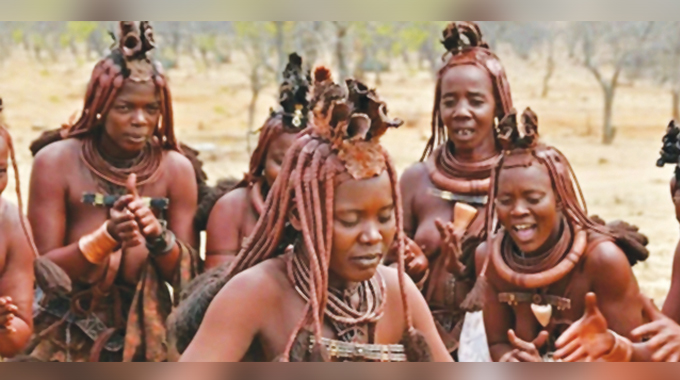
Simbarashe Murima, People and Places
NAMIBIA, ”The Land of the Brave”, has a population of over 2,6 million people, demarcated into 14 regions and 30 languages spoken in the entire republic. With a small population slightly below Botswana, Namibia is culturally affluent with a mosaic of a diverse and quaintly ethnic groups of which one is the bravura Himba tribe.
History and population of the Himba
In the Kunene region (formerly Kaokoland), a desert eco-region with untouched landscapes, we witness the OvaHimba (or Himba) tribe who inhabited this northern part of Namibia in the middle of the 16th century.
The OvaHimba are an indigenous people with an estimated populace of about 50 000.
The Himba are a primordial semi-nomadic people, meaning they live by travelling from place to place, hence they moved seasonally to find greener pastures for their livestock and settled in remote areas.
OvaHimba means ”people who beg”. This caricature became eternal due to displacement attack by the Nama cattle raiders and hunger driven in the mid-1800s of which many Himba fled to Angola, where they were called ”beggars” in Otjiherero language.
In fact, this was because they would ask other fellow tribes for assistance in their search for cattle and crops.
According to historical sources, the OvaHimba are ancestors and posterities of the Herero, a Bantu ethnic group.
Nevertheless, the OvaHimba and Herero speak the same Herero language (Otjiherero) and share a similar dogmata.
Although they split around 150 years ago as the Herero adjusted and settled in towns and villages, the Himba remained nomadic.
Mythology of the Himba tribe
OvaHimba are animists who believe and worship their supreme God called Mukuru and each homestead has one ancestral shrine for worshipping.
They gather round the ”okuruo” or holy fire in the evenings and this fire is continuously kept lit by the sacred glow both day and night.
Likewise, this fire is the connection between the living and the dead, thus it is their way of communicating with Mukuru whereby the village chief establishes contact with the descendants through the fire.
”The Red People of Namibia”
When I write about the exceptionality of the OvaHimba tribe, the attention is more on the women than men.
The most significant symbolism of this tribe is the red paste that is used and mostly applied by the women to which the OvaHimbas are also known as “The Red People of Namibia”.
Red is opulent in the representation of the Himba, it embodies the earth’s red sand colour and blood which is the essence of life.
The red paste or cream is called ”otjize” which is a mixture of butterfat, ochre pigment and scented resins extracted from the Commiphora wildii or ”Namibian Myrrh” known as ”Omazumba” in local Herero language.
The cream is usually smeared on the hair and body to give a terracotta-like reddish shade. It protects them from dirt and the scorching sun.
Interesting facts about the OvaHimba people
The Himba never bath, except at birth and at death. Instead, women use smoke bath in order to maintain personal hygiene.
They burn aromatic scented herbs with charcoal and wait for the smoke to ascend up to their pudenda to perspire and purify.
The Himba knock out their four front teeth to enhance uniqueness in their tone and accent when communicating with other coteries.
The Himba marry their cousins. Aunts will marry their nephews as this is a way keeping and guarding their wealth and close kin.
Innately, OvaHimba are polygamous, the men can marry two to 10 wives provided they have the cattle to upkeep them.
A woman can also have many husbands, if they agree to the open marriage.
The extramarital affairs were usually initiated when husbands were away with the livestock and the women would have “affairs” with other males.
OvaHimba attire and accessories
The traditional outfit for the Himba women is unequivocally revealing. They simple wear a goat hide skirt, leaving their breasts bare.
Everything that OvaHimba women wear or do with their hair communicates their status in society and womanhood.
Ostensibly, it expresses whether they have had their first period or whether their periods are now regular. Or it states if they have had one child or two or more children.
All Himba women wear hoi polloi of jewellery particularly married ones who wear a large white shell beaded necklace known as ”ohumba”, which is passed from mother to daughter.
Single women wear heavy metal rings around their ankles and those that are married wear a small headpiece made of soft skin on their heads.
Similarly, single men wear an ondatu braid on the back of their head while married men cover their hair with turbans for the rest of their natural life, but can remove it when having a hair-cut and during funerals.
The OvaHimba are still perceived as secluded from the contemporary world, but in reality, many Himba people are now moving or rather have moved towards modernity. Quite a handful have settled in Windhoek, the capital city to sell their traditional and cultural products to tourists.
Okuhepa means thank you in Himba.
l Simbarashe Murima (PhDc) writes in his own capacity as an Education, Tourism and Hospitality expert in Namibia and Zimbabwe.
Feedback: [email protected] 0781480742 .



 Online Reporter