admin
admin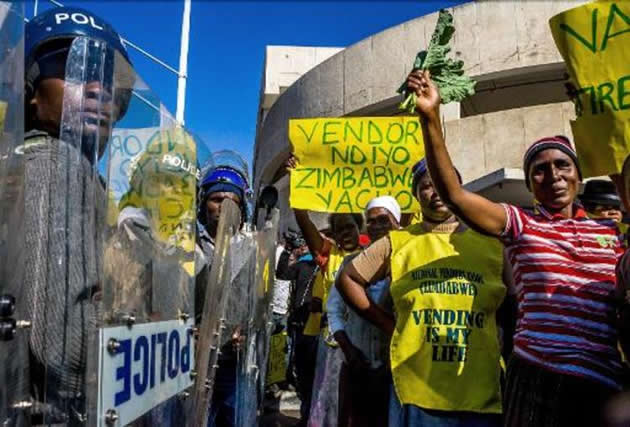
Tichaona Zindoga
Yesterday marked the expiry of the ultimatum given to illegal vendors to vacate the central business district of Harare and go to designated sites. By day-end yesterday, it did not seem like the vendors were going away and an uneasy lull hung over the city regarding the fate of the city – and its “sunshine status”. To make matters worse, there are strong political undercurrents in the whole fiasco. Our Political Editor Tichaona Zindoga (TZ) spoke to planning expert and international consultant Mr Percy Toriro (PT) to get his views on the matter.
TZ: Today (yesterday) was supposed to be the deadline for vendors to vacate the CBD and relocate to designated points but it’s business as usual. What is your comment and can you just explain how we have ended up in this crisis of illegal vendors?
PT: I think, firstly, we need to acknowledge the fact that vending as an issue is universal. You find it everywhere even in the developed cities, if you go to Barcelona (Spain) you will see vending; you go to here in Africa, cities that are considered to be doing well in terms of cleanliness and development like Kigali in Rwanda, there are elements of vending, the same if you go to Cape Town (South Africa).
Maybe the difference becomes the scale at which it is happening and the way it appears certainly it has to be regulated. You have to manage the statistics and the functionality of it. I mean, imagine a situation where on pavements that are designed for the movement of people those people actually find themselves unable to reach the product that they want to buy because the vendors themselves have literally blocked all passage and access to their products. So, certainly there has to be a limit to it. They are also other considerations such as sanitation and order. We have to give due regard to those because clearly you don’t want to be solving one challenge that you have and creating a lot more others. Public health is always a responsibility of public authorities such as Government and municipalities. If they don’t take that responsibility and when there is an epidemic, we will naturally go back to them and consider them as having been irresponsible. So I think everyone will accept that the situation of vending today in Harare or any other city in Zimbabwe at the moment has reached crisis proportions.
Many have given the view that we should look aside because the economy is not performing but clearly that is an irresponsible point of view. We have to manage this phenomenon. There is a carrying capacity for anything. In Harare we cannot we have as many vendors as the people that are supposed to buy from them. In fact, if that situation is allowed (to continue) we are also making even that vending business unviable because a vendor then finds themselves spending the day everyday with tomatoes that they are throwing away after three days because no one has bought them. So, really we need to be responsible whether we are thinking as vendors or we are thinking as regulatory authorities. And clearly if anyone who does business or has been exposed to Harare today is going to give an honest opinion is going to tell you that there has to be a point at which things have to be manageable.
TZ: But, of course, it’s an emotional issue at the moment, how do we handle the emotional aspects because it’s a livelihood issue and the practical, management issues?
PT: I think there has to be genuine engagement, and genuine engagement implies that both the people that are vending and the authorities would want to see the issue resolved. Unfortunately, what we also tend to see that vendors have become pawns of certain opportunists because we now see vendors who have assumed a certain level of militancy that you are not too sure that they really would want the issue of vending resolved or there is something that we do not clearly understand. But for me speaking as a planning professional, I think this issue really requires that we engage each other genuinely and honestly.
So, we need to regulate the numbers and the movements are inevitable, yes some people may remain in the street in the places that would have been designated as suitable for vending but certainly the manner in which it is today is certainly not acceptable from any point of view.
TZ: But there have been some stakeholder engagements over the last couple of weeks. So would you say generally that these negotiations or engagements have come to naught because on the deadline day we are not seeing any significant movement or anything to point to success in the relocation of vendors?
PT: Well, certainly, we have heard about engagements taking place unfortunately we are not privy to the details of the engagements but we can only encourage the parties to engage because there is no other way. I think we also need to assist both parties by saying we support as professionals and the public order in the city. From that perspective we then want to say everyone should be seen working towards attaining that order.
TZ: Speaking about relocation, the one thread that’s been running around arguments against relocation is that the new sites are away from the market. What is your comment and how do you think aspects of order and market can be balanced?
PT: Certainly, I would encourage that when authorities decide on the sites which are supposed to be vending sites they should not only consider the volume of traffic that goes in there but they should also consider sanitation point of view. But we also must accept the point that a market can be created: Mupedzanhamo, for example, as a market was not always there when it was put up people then learned that there was a market there then it became what it is today. So I think we also want to assist the vendors understand that if I get to know that there is a very good market for vegetables at Showgrounds, I will go there.
The people that go to Mbare Musika are not just passing there, they are people who are driving from Budiriro, Kuwadzana or even from Borrowdale to go and buy vegetables. So, a market can also be created, established and marketed and become vibrant. I think it’s a delicate balance… but let’s also be very clear that a market can be created.
TZ: Obviously, the major gripe here becomes that there will be short-term disruption of business…
PT: It’s really to do with an entrepreneurial thinking because I think the vendors are just about today but everyone knows that if someone has the right entrepreneurial skills, they will know that when you start a business you start by investing in marketing and inputs just to make sure that everything else works out. So, this in the short term will disrupt a number of vendors from what they were getting today but over time people will begin to know that this is where you go to get that and it will become equally viable even better than it is now.
More importantly, they will have security of tenure wherever they are. At the moment we must accept that most of them are in illegal places. So, really, that is in everyone’s interest that the vendors operate their business where they can invest and reinvest knowing fully well that there is security of tenure. At the moment some organisations are not assisting them because they also know that they are illegal but the moment they move to places where they are legal and properly settled they will get assistance.
The Ministry of SMEs has a fund to support these these enterprises but I’m just thinking, would they support a vendor who is at the corner of Julius Nyerere Way and Samora Machel Avenue? I don’t think they would because they are not sure if tomorrow they will be there or they would have been chased away.
It is in the vendors’ interest to be in places which are proper and are secure.
TZ: There have been suggestions that certain streets and thoroughfares in the city should be closed for markets and this could even be a tourist attraction. What are your thoughts on that?
PT: Certainly that makes sense from a planning point of view and from a business point of view and it’s something that we have seen in many areas and it has worked so it’s really about how it is organised and the logistics of it but as an idea the city should also consider. In the past, the streets such as George Silunduka Avenue were earmarked for “pedestrianisation” which would then incorporate elements of trade and all that. Maybe this is time for the city to go back to the drawing board and consider that.
TZ: Lastly, where do you see Harare and other urban centres with this pressure between people seeking livelihood and planning authorities and city authorities and trying to maintain sanity?
PT: I think there are a few things that we need to look at. Firstly, we really need to be realistic and say what constitutes an African city. When we talk about a world class city in the African context what are the elements of that city? Those people that have travelled to Lusaka and see how vending has been reorganised particularly around the city centre bus terminus will also realise that you will see something different that is acceptable. I think that we need to consider that. Secondly, I think we need to be realistic about this and not being too emotional about it because if all parties become emotional surely we will get nowhere.
We want to be sober and practical about and it recognise the importance of livelihoods and also recognise the importance of proper planning. I think if we can achieve that balance then we can come up with a city that we can still be happy that we belong to it and it includes me as well but it’s also a city I can be proud to show someone that this is where I live and do my business.



 Online Reporter