The last laugh…sculptor living large after being dismissed as dull by friends

Nqobile Bhebhe, Senior Business Reporter

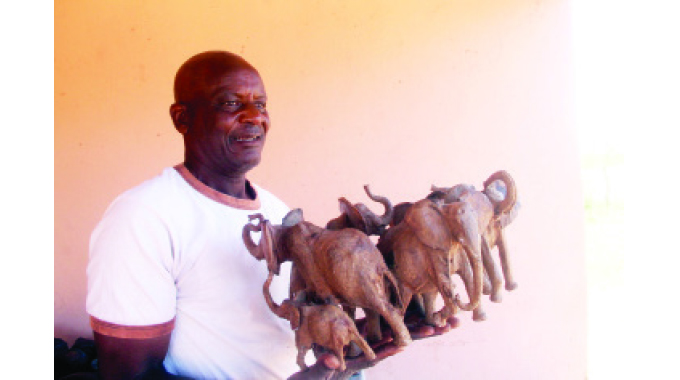
TUCKED in the bushes of Ward 19 under Chief Deli in Nyamandlovu is the home of a 62-year-old brilliant craftsman named Jabulani “Zulu” Mlangeni who has been a sculptor for close to 40 years.

Mlangeni’s home is a workshop for the self-taught sculptor who has never ventured into any other job, except part-time farming.

Last Friday, the Saturday Chronicle visited Zulu at his homestead and discovered that almost every inch of his veranda was covered with finished pieces of the big five.

From the onset, Mlangeni spells out two distinct features of what he terms a modern sculpture.
Modern art must have a purpose: “All my pieces tell a story. For art to have a purpose you must be well-read and familiar with characteristics of wildlife,” he says.

For Mlangeni, being well-read does not necessarily mean having a university education and being fluent in English.
“I didn’t go to school to be a sculptor, it’s an inborn talent that I only perfected by attending a few courses at Mzilikazi Arts and Craft Centre.

“It’s important to know the characteristics of most animals. Watching wildlife documentaries and reading books on animals is an added advantage. Also, an understanding of wood technology is important” he explains.

“I don’t need to be fluent in English to be a sculptor. My work speaks on my behalf. I have sold countless pieces in Victoria Falls and South Africa to European hunters who don’t even speak or understand English.”
Mlangeni, who is well known as Zulu among his contemporaries, traces the genesis of his trade to the time he was three years old.

Whenever his late mother went to the market, she would tell him to go out to play with other kids. However, Zulu would quickly sneak back to the homestead and start drawing.
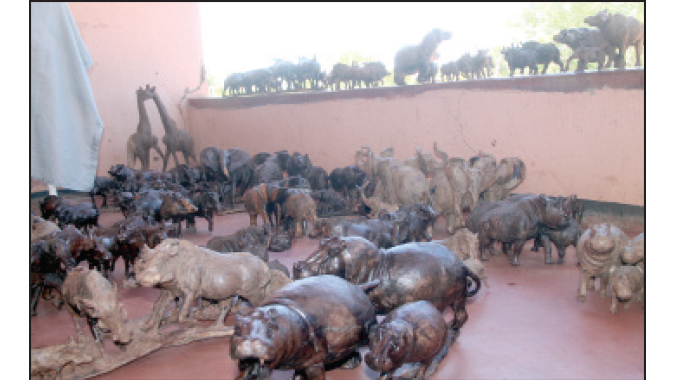
Jabulani Zulu shows some of his works. Inset: Some of Zulu’s other works

“Initially, my mother could not understand my love for drawing. None of my relatives was into arts. But to her credit, she never scolded or beat me. Then years later when I took art seriously, she encouraged me not to be deterred by obstacles that I would encounter.”

Those obstacles soon came in the form of his childhood peers who laughed at him for choosing a career path that was associated with not-so-intelligent people.

“During my days, any art was considered to be for people who are dull and outcasts in society. Armed with my mother’s prior advice and my determination to make a living out of it, I persevered.

“A renowned art collector, Burzel Stain who used to operate Sondela Curios in Bulawayo scouted me and took me on board. I received invaluable training from him, especially on ivory sculpture.”

Later on, Zulu relocated to South Africa for about six years and continued his trade. It was in South Africa that he broadened his craft.

“There are no shortcuts in this trade. A white man I worked for became greedy and paid less attention to the quality of products made.

“So, there was a time when he instructed his manager to fire anyone whom he deemed to be a troublemaker. In no time, all experienced sculptors were fired including me and replaced by trainees.

“That was in the middle of a massive order from America. Shipment was made to America and in no time the recipients quickly noted a huge gulf in the quality of artefacts delivered when compared to the previous one. They sent it back and that was the end of my former boss,” he recalls.

covid-19

When Covid-19 happened in 2019, Zulu returned to Zimbabwe. He found out that the terrain had changed. Before the Covid-19 pandemic set in, there was a ready market mainly from tourists. That stream dried up, forcing him to relocate from Bulawayo to Nyamandlovu.

He says he was struggling to pay rent for his workshop and it was economic for him to be closer to source areas for raw materials. He sources hardwood in Nyamandlovu.

However, apart from relying on tourists, he is into exports with South Africa being the major source market.
“For the greater part of my career, I have been selling to South Africa. In the old days, there used to be what we called collectors. They would round up artefacts and pay us handsomely.

“The system was not 100 percent perfect. The collectors took advantage of us and offered far less money. For instance, I could peg my sculpture at R2 000 but end up being paid R400. The trade has been invaded by dishonest people bent on exploiting artists,” he said.

ZimTrade

With the proceeds from his craft, Zulu has been able to sustain his family.
“I have installed a 5 KVA solar system with eight panels at a cost of about R40 000. This is the greatest investment I have made from curios. I can pump water from the borehole I drilled. So, sculpting has been good for me,”

Zulu is not thinking of ending his career anytime soon. He wants to supply lodges within Matabeleland North and penetrate the Asian market.

“I read several reports that tourism is recovering from Covid-19 effects and that it is an opportunity to clinch deals and supply lodges.

“Also, I desire to work with ZimTrade to get more exposure in the international market, especially in Asia.”

The last laugh…sculptor living large after being dismissed as dull by friends

Nqobile Bhebhe, Senior Business Reporter

TUCKED in the bushes of Ward 19 under Chief Deli in Nyamandlovu is the home of a 62-year-old brilliant craftsman named Jabulani “Zulu” Mlangeni who has been a sculptor for close to 40 years.

Mlangeni’s home is a workshop for the self-taught sculptor who has never ventured into any other job, except part-time farming.

Last Friday, the Saturday Chronicle visited Zulu at his homestead and discovered that almost every inch of his veranda was covered with finished pieces of the big five.

From the onset, Mlangeni spells out two distinct features of what he terms a modern sculpture.
Modern art must have a purpose: “All my pieces tell a story. For art to have a purpose you must be well-read and familiar with characteristics of wildlife,” he says.

For Mlangeni, being well-read does not necessarily mean having a university education and being fluent in English.
“I didn’t go to school to be a sculptor, it’s an inborn talent that I only perfected by attending a few courses at Mzilikazi Arts and Craft Centre.

“It’s important to know the characteristics of most animals. Watching wildlife documentaries and reading books on animals is an added advantage. Also, an understanding of wood technology is important” he explains.

“I don’t need to be fluent in English to be a sculptor. My work speaks on my behalf. I have sold countless pieces in Victoria Falls and South Africa to European hunters who don’t even speak or understand English.”
Mlangeni, who is well known as Zulu among his contemporaries, traces the genesis of his trade to the time he was three years old.

Whenever his late mother went to the market, she would tell him to go out to play with other kids. However, Zulu would quickly sneak back to the homestead and start drawing.

Jabulani Zulu shows some of his works. Inset: Some of Zulu’s other works

“Initially, my mother could not understand my love for drawing. None of my relatives was into arts. But to her credit, she never scolded or beat me. Then years later when I took art seriously, she encouraged me not to be deterred by obstacles that I would encounter.”

Those obstacles soon came in the form of his childhood peers who laughed at him for choosing a career path that was associated with not-so-intelligent people.

“During my days, any art was considered to be for people who are dull and outcasts in society. Armed with my mother’s prior advice and my determination to make a living out of it, I persevered.

“A renowned art collector, Burzel Stain who used to operate Sondela Curios in Bulawayo scouted me and took me on board. I received invaluable training from him, especially on ivory sculpture.”

Later on, Zulu relocated to South Africa for about six years and continued his trade. It was in South Africa that he broadened his craft.

“There are no shortcuts in this trade. A white man I worked for became greedy and paid less attention to the quality of products made.

“So, there was a time when he instructed his manager to fire anyone whom he deemed to be a troublemaker. In no time, all experienced sculptors were fired including me and replaced by trainees.

“That was in the middle of a massive order from America. Shipment was made to America and in no time the recipients quickly noted a huge gulf in the quality of artefacts delivered when compared to the previous one. They sent it back and that was the end of my former boss,” he recalls.

covid-19

When Covid-19 happened in 2019, Zulu returned to Zimbabwe. He found out that the terrain had changed. Before the Covid-19 pandemic set in, there was a ready market mainly from tourists. That stream dried up, forcing him to relocate from Bulawayo to Nyamandlovu.

He says he was struggling to pay rent for his workshop and it was economic for him to be closer to source areas for raw materials. He sources hardwood in Nyamandlovu.

However, apart from relying on tourists, he is into exports with South Africa being the major source market.
“For the greater part of my career, I have been selling to South Africa. In the old days, there used to be what we called collectors. They would round up artefacts and pay us handsomely.

“The system was not 100 percent perfect. The collectors took advantage of us and offered far less money. For instance, I could peg my sculpture at R2 000 but end up being paid R400. The trade has been invaded by dishonest people bent on exploiting artists,” he said.

ZimTrade

With the proceeds from his craft, Zulu has been able to sustain his family.
“I have installed a 5 KVA solar system with eight panels at a cost of about R40 000. This is the greatest investment I have made from curios. I can pump water from the borehole I drilled. So, sculpting has been good for me,”

Zulu is not thinking of ending his career anytime soon. He wants to supply lodges within Matabeleland North and penetrate the Asian market.

“I read several reports that tourism is recovering from Covid-19 effects and that it is an opportunity to clinch deals and supply lodges.

“Also, I desire to work with ZimTrade to get more exposure in the international market, especially in Asia.”

Related Posts

Returnees recount SA horror tales

Thupeyo Muleya Beitbridge Bureau FOR days, the Mossel Bay Municipality Hall in South Africa became an unlikely refuge for dozens of Zimbabwean families fleeing violence. Inside the crowded facility, mothers…

Officials get chance to upgrade

Innocent Kurira [email protected] AS the National Athletics Association of Zimbabwe (NAAZ) intensifies efforts to build a strong technical base for the sport, Bulawayo will host Level One and Two officiating…

Leave a Reply

Your email address will not be published. Required fields are marked *

×
×