Online Reporter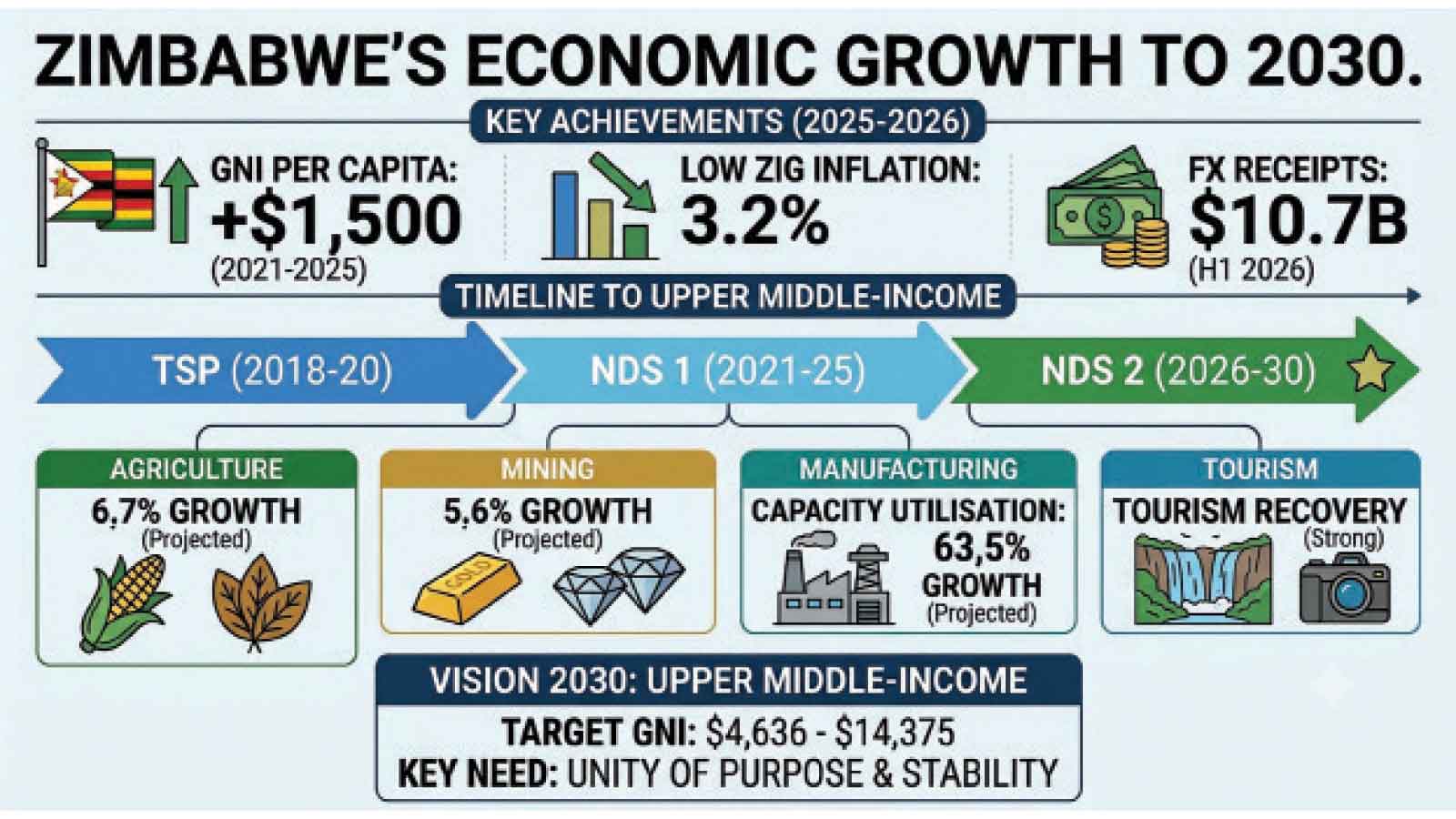
Innocent Madonko-Deputy Editor
ZIMBABWE stands on the threshold of achieving its much vaunted Vision 2030 strategic masterplan – thanks to the remarkable foresight of the Second Republic which crafted the National Development Strategy 1 and its successor pillar economic blueprint – NDS2.
We are literally on the last mile to Vision 2030 and given the strong macro-economic fundamentals, nothing stands in the way of Zimbabwe attaining an upper middle-income status.
From now until 2030, only a collapse of monumental proportions would stop us from collectively lifting our people from poverty to prosperity with average per capita incomes ranging between US$4 636 and US$14 375.
The Transitional Stabilisation Programme (2018-2020) laid the ground work for NDS1 by restoring financial health and stabilising the local currency. It also ensured the transition to a private-sector-led economy while addressing critical gaps.
NDS 1 (2021-2025) built on the foundations laid by the TSP through focusing on boosting productivity and macro-economic stability. During this period, Gross National Income per capita increased from about US$1 700 in 2021 to around US$3 200 in 2025.
It also took care of infrastructure gaps by refurbishing roads such as the Beitbridge-Harare, Victoria Falls-Bulawayo and other trunk roads around the country. The flagship Trabablas Interchange in Harare is another milestone while other interchanges are in the process of being constructed.
Dams were built in provinces around the country, while boreholes, solar farms and other amenities were installed to boost agricultural productivity. NDS 1 also looked into enhancing food security, public health (refurbishment of major hospitals) and human capital development.
We are now firmly within NDS 2, the last journey to 2030 where the nation is building on the successes of NDS1 and prioritising economic growth, food security, value addition and infrastructure development.
Economic overview
Based on the latest report by the International Monetary Fund (IMF), Zimbabwe’s economy has remained resilient, underpinned by strong agricultural recovery, increased mining production, and prudent macroeconomic policies.
The country’s economic growth rate reached an estimated 8,3 percent in 2025, driven largely by improved agricultural output after the previous drought and continued expansion in the mining sector.
The fund notes that inflation has remained relatively low due to tight monetary policy, controlled reserve money growth, and improved exchange rate stability. Zimbabwe’s external position has also strengthened, with a projected current account surplus supported by robust mineral exports and resilient remittance inflows.
The multilateral financial institution has commended the Government’s commitment to fiscal discipline, emphasizing the importance of avoiding monetary financing, strengthening public financial management, and improving transparency and governance.
In his Mid-Term Budget Review last Thursday, the Minister of Finance, Economic Development and Investment Promotion, Professor Mthuli Ncube, said Zimbabwe’s economy posted a strong 6,8 percent growth during the first quarter of 2026, up from 4 percent in the same period last year.
“The economy performed impressively at 6,8 percent during the first quarter of 2026,” he said. “This is much higher compared to about 4 percent during the same period in 2025.
“If we continue on this trajectory, it is possible to meet or surpass the 8,3 percent recorded in 2025 for the full year of 2026.”
Economic milestones include the annual ZiG inflation dropping to 3,2 percent in July 2026 — the lowest level recorded in decades.
Additionally, foreign currency receipts surged by 47,8 percent during the first half of the year, reaching US$10,7 billion compared to US$7,3 billion recorded over the same period in 2025.
Month-on-month inflation remained firmly anchored below the 5 percent target despite global oil price shocks, while the first-quarter current account surplus reached US$606,3 million.
On sectoral performance, agriculture expanded by 27,9 percent in 2025 and is projected to grow by an additional 6,9 percent in 2026, with grain output expected to hit 2,4 million tonnes.
The mining sector grew by 10,4 percent in 2025 and is set to expand by 5,6 percent in 2026, driven by a projected gold output of 55,6 tonnes.
Lithium exports increased by 229,8 percent during the first half of 2026 to US$782,2 million from US$237,2 million in the first half of 2025.
Manufacturing is projected to grow by 5,2 percent in 2026, supported by improved capacity utilisation, which rose to 61,2 percent in 2025 and is expected to reach 63,5 percent this year.
Inflation
Zimbabwe’s inflation continues to trend downward, with annual ZiG inflation easing to 3,2 percent in July 2026 from 4,7 percent in June, while month-on-month inflation slowed to 0,1 percent, reflecting sustained price stability.
The Reserve Bank of Zimbabwe’s prudent monetary policy, anchored by disciplined liquidity management and exchange rate stability, has helped contain inflationary pressures despite global shocks.
Following this improvement, the Apex Bank recently reduced the policy rate from 35 percent to 30 percent – and the move has been described as a recalibration to reflect structurally lower inflation rather than a relaxation of monetary policy.
Overall, current inflation trends indicate that monetary policy measures have been effective in supporting macroeconomic stability and preserving confidence in the ZiG.
Manufacturing sector
Zimbabwe’s manufacturing capacity utilisation has risen to 61.2 percent, driven by macroeconomic stability, local value addition, and increased production. Key metrics show growth from 36.4 percent in 2019, 57 percent in early 2026 with projections aiming for 63.5 percent by year end.
The country’s manufacturing sector continues to show signs of recovery, buoyed by improved macroeconomic stability, lower inflation and stronger business confidence.
The 2025 Confederation of Zimbabwe Industries (CZI) survey also reported a 13 percent increase in manufacturing output, a 9 percent rise in installed production capacity, and capacity utilisation of 55.9 percent, driven by factory modernisation, expansion of production lines and increased investment.
Mining
Mining is a key driver of Zimbabwe’s economic growth and foreign currency earnings. Treasury projects the mining sector to grow by 5,6 percent in 2026, following 10,4 percent growth in 2025, underpinned by a projected gold output of 55,6 tonnes. Lithium continues to be a major growth area, with exports increasing by 229,8 percent to US$782.2 million during the first half of 2026 from US$237,2 million in the corresponding period of 2025.
Platinum Group Metals (PGMs) remain Zimbabwe’s leading mineral export, accounting for 33,93 percent of total mineral export earnings, while PGM concentrates contributed a further 13,73 percent.
Together with spodumene concentrates, these minerals generated over 74 percent of Zimbabwe’s mineral export revenue, helping mineral export earnings surge 84 percent to a record US$2,53 billion in the first half of 2026. These developments underscore mining’s strategic role in supporting economic growth, export earnings and industrial development.
Agriculture
Agriculture is one of the economy’s strongest performing sectors, underpinning food security, employment and export earnings.
The sector is projected to grow by 6,7 percent in 2026, supported by favourable rainfall, improved crop yields and sustained Government support programmes.
Increased production of maize, tobacco, wheat and other strategic crops has strengthened agro-processing industries, boosted rural incomes and contributed significantly to overall GDP growth.
The tourism sector continues to make a significant contribution to Zimbabwe’s economy through foreign currency earnings, employment and investment.
And the Mid-Term Budget Review notes sustained growth in the sector, driven by increased international tourist arrivals, higher occupancy rates and improved tourism receipts.
This performance has been supported by enhanced destination marketing, improved connectivity and continued investment in tourism infrastructure, reinforcing tourism’s role as a key pillar of economic growth and diversification.
ZiG
The 2026 Mid-Term Budget Review attributes the continued stability of the ZiG currency to disciplined liquidity management, prudent fiscal and monetary policies, and strong foreign currency inflows.
The Government has reported that annual ZiG inflation remained low while the exchange rate remained broadly stable, reinforcing confidence in the domestic currency.
The Mid-Term Budget Review also notes that improved fiscal revenues, robust performance in agriculture and mining, and rising export earnings have strengthened the macroeconomic environment supporting the ZiG.
In addition, the Reserve Bank of Zimbabwe’s tight monetary policy and restrained money supply growth have helped preserve the currency’s value and contain inflationary pressures.
The Mid-Term Budget Review concludes that sustained ZiG stability is critical for maintaining price stability, improving investor confidence, facilitating domestic transactions and supporting the country’s broader macroeconomic reform agenda and economic growth.
Conclusion
Given the strong indicators above, Zimbabwe is on course to achieving Vision 2030, thanks to astute leadership of President Mnangagwa, the discipline of fiscal and monetary authorities, and the resilience of the generality of the population who have remained firmly behind the Government as it implements its economic policies.
To reach the World Bank threshold for Upper-Middle-Income status — defined as a GNI per capita income between US$4 636 and US$14 375 — Zimbabwe needs an additional minimum per capita growth of US$1 400 between 2026 and 2030.
This is attainable. All that is required is unity of purpose with everyone putting shoulders to the wheel.
Local currency confidence and price stability are also key to upper-middle-income goals and this should be maintained till 2030. Most performance targets under the International Monetary Fund (IMF) Staff-Monitored Programme have been met, reinforcing ongoing arrears clearance and debt resolution efforts.
The fiscal trajectory remains aligned with Vision 2030 objectives, backed by a comprehensive agricultural framework for the 2026/27 farming season centred on climate resilience, food security, and sustained macroeconomic stability.