admin
admin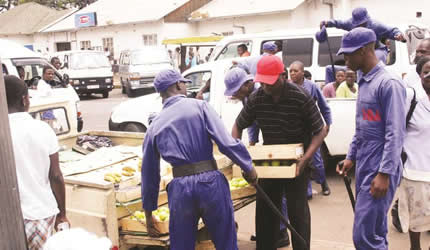
The ensuing drama is always the same.
The vendors spot the navy blue and grey uniform and brown boots and they know. They whistle or shout warnings to each other and then scatter in different directions weaving through traffic, hiding behind cars, running into shops, buildings or sanitary lanes, They either leave their goods behind or throw them into ditches or other hiding places.
If they are unlucky and get caught, they pay the price. Their goods are impounded, they are taken to Harare Central, the main police station and either locked up or forced to pay a fine or both. It takes a few days before they recover both financially and emotionally and then they are back on the streets.
The cycle continues.
The vendors are chased off the streets because they do not have a licence to sell. Seldom are they arrested because of hygiene. Yet the vendors are associated with paper wrappers, empty cigarette boxes, banana peels, the husks of green mealies and, of course, used airtime cards. There is trash and dirt lying everywhere.
Immediate post-independent Zimbabwe was the pride of Africa. Aptly named the Sunshine City, Harare is famous for it’s wide streets and avenues lined with magnificent jacarandas and flamboyance.
There was order and safety. Traffic lights worked and the streets were clean. Bulawayo, Gweru, Mutare, Masvingo had equally enviable reputations.
Three decades later, all this has changed and even more so in the capital city Harare. The city council is mandated to clean the streets as stipulated under the Urban Councils Act. Though the Act is in place, every morning of every day, papers, tin cans, plastic packets, green shells of maize, rotten tomatoes and lots of other rubbish is removed from streets.
Within a few hours, the litter is seen mounting again on the streets. This cycle continues on a daily basis.
The city authorities have failed.
Food that is sold to the public is placed in unclean plastic containers or on pieces of cardboard on the ground, irrespective of the Food Hygiene By-laws Section 8 k (II) which says “(the public should) not place any food lower than 500 millimetres from the ground on any pavement or in or about any forecourt or yard . . . ensure that open food, while displayed or exposed for sale or during delivery, is kept covered or is otherwise effectively screened so as to prevent any infection or contamination”.
In Zimbabwe, the health of the people who consumed food in restaurants and canteens was protected by the Food Hygiene by-laws of 1975. On the other hand, the vendors’ operations remain guided by the Hawkers and Street Vendors by-laws of 1978.
Combined Harare Residents Association representative Mfundo Mlilo mentioned that “Zimbabwe has a strong by-law system, but the challenges in having vendors in Harare central business district is because of a strong existing conflict between the law and the current economic situation in the country.”
“Policy monitoring, implementation and lack of adequate human resources in the city council are also attributing factors leading to poor service delivery as opposed to having the 1975 by-laws,” said Mlilo.
In the last decade, the capital city standards, the operations of the restaurants, fast food outlets and canteens, food hygiene and vending has begun to deteriorate. At the core of this deterioration is the implementation of health by-laws. Vendors operate without the required licence documents.
The Hawkers and Street Vending by-law Section 11 which restricts street vendors from conducting business for longer than 15 minutes in one place is also not respected.
On the flip side, canteens and backyard restaurants have visible sub-standard facilities that do not show respect of food hygiene.
International best practice document for the United Kingdom “Regulatory Guidance and Best Advice for Food Business Operators” states that hands should be washed and dried before food is handled.
Chapter Four of the Regulation (EC) 852/2004 on the hygiene of foodstuffs strengthens the requirement by saying that “no person suffering from, or being a carrier of a disease likely to be transmitted through food or afflicted, e.g. with infected wounds, skin infections, sores or diarrhoea is to be permitted to handle food or enter any food handling area in any capacity if there is any likelihood of direct or indirect contamination”.
Other mobile canteens sell tea, sadza and rice in plastic containers along the street corners in Harare at prominent places like the FBC Centre along Samora Machel Avenue near RBZ, the University of Zimbabwe Gate, stadiums and many other areas dotted around the city. Most of them do not have certificates from Harare City Council.
Both vendors and food outlets that are selling food to the public are failing to conform to health by-laws requirements. Food Hygiene by-laws of 1975 and Hawkers and Street Vendors by-laws of 1978 are two regulations embedded in the Urban Councils Act Chapter 29:15 enacted on December 22 1995.
The by-laws try to protect the spread of communicable diseases such as tuberculosis. In the existing face of the health by-laws, the ordinary citizens continue to vend and do not care about meeting the set standards.
Restaurants, food outlets and vendors are not adhering to health standards that are set out in the by-laws through the Urban Councils Act Chapter 29:15.
Options for Constitution Protections: Economic, Social and Cultural Rights in Zimbabwe Report page 54, states that “unfortunately, the countries public health system today is a faint relic of its former self. Since 1990, the average life expectancy has decreased from 62 to 34 years”.
Zimbabwe’s Tourism Statutory Instrument 128 of 2005 also strengthens the requirements of the two by-laws on health through its call for a need to adhere to the sanitary norms through Section 18 which states that “every tourist facility shall ensure that its premises present no risk of contamination for the foodstuffs . . . that all rooms used for preparing food, interior walls and equipment shall be cleaned and disinfected after each period of work”.
The Municipal Police on the streets fight vendors and confiscate their products because they label them as “people operating outside of the law.”
The emphasis is on trading licences and less on health and hygiene.
When vendors run away from the Municipal Police, it is because they do not
have a licence. The Hawkers and Street Vendors by-law Section 4a) requires that “no person shall, whether as principal, agent or servant, carry on the business of a hawker unless he is in possession of a valid licence or a disc . . . ”
Interviews conducted with those who are into vending, brought out that they do not pay for licence discs because “they are charged US$140 for a hawker licence and allocated a space for selling where no one comes”.
For these reasons they prefer to operate in the city centre where there is a big market. These vendors go against Hawkers and Street vendors by-law 4(1) b which requires them to work “in the area specified”.
But the question on many vendors’ minds is where they will go if they are chased away from the streets.



 Online Reporter