admin
admin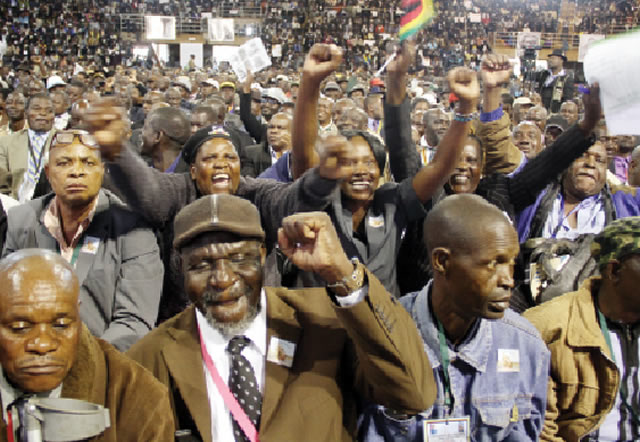

Obadiah Thembani Moyo
THE history of Zimbabwe cannot be complete without the mention of the war veterans of the country’s liberation struggle.
During the 1960s and 1970s thousands of young men and women abandoned everything, including their education, to join the war of liberation.
The motivation to join the struggle was to liberate the citizens from the yoke of colonialism that limited the education, socio-economic and political opportunities for local people (blacks).
Those who fought in the war had at the back of their minds the plight of the majority of the people, whose lives were sunk in poverty.
Blacks were not allowed to study certain fields, that were reserved for whites and some jobs were a preserve of whites only.
This history and the Rhodesian racism is well documented and stands as a reminder that oppression of any kind, including segregated living conditions, negates all democratic values.
Through the barrel of a gun, they became our liberators and forced the colonialists to agree to a one man – one vote election that led to the independence of Zimbabwe in 1980.
Last week war veterans met President Robert Mugabe and demanded government support, including education assistance for their children.
It boggles the mind why the war liberation heroes chose to talk only about the education needs of their children without mentioning the support for children of the masses, on whose behalf they fought.
This is a clear departure from the founding principles of the liberation struggle and the legacy of the war veterans.
I expected the war veterans to tell the President of Zimbabwe about the Basic Education Assistance Module (BEAM), whose coffers have gone dry, and the need for beefing it up with the required funds to enable the education of children from poor families.
We read in the newspapers that Treasury has released an amount of $6 million education support for the children of war veterans. There is no mention of support to children of other poor families.
The massive expansion of the education sector at independence was motivated more by political correctness and the need to correct the past imbalances.
We also expected matching political correctness from war veterans who should have requested the President to give an overall and holistic attention to our ailing education sector.
Statistics from the Ministry of Primary and Secondary Education show that the country’s education system rapidly expanded to cater for thousands of children whose education had been disrupted by 15 years of the liberation struggle.
Up to 1,082 primary and 46 secondary schools countrywide had closed due to the war, thus affecting 274,000 pupils.
In 1979, there were 2,401 primary schools with a total enrolment of 819,596 pupils and 177 secondary schools with an enrolment of 66,215 pupils. Due to the government’s policy of education for all, these numbers rapidly rose to 4,161 primary schools with an enrolment of 2,132,304 pupils and 1,129 secondary schools with an enrolment of 416,413 students.
Annual increases in enrolment grew at 21.2 percent for the next five years before coming down to a rate of 1.75 percent between 1985 and 1990. Three quarters of these developments were taking place in the rural areas where the government felt politically indebted to close the gap between urban and rural areas.
The education expansion was not without its shortcomings – shortage of teachers, books, classroom blocks, furniture and other facilities was a common norm.
In the rural areas, the period up to 1985, over 50 percent of the teachers were untrained while the pupil-teacher ratio stood at 1 to 45 as opposed to the recommended 1 to 35.
Though rural pupils did not pay school fees and received the government per capita grant to buy textbooks and stationery, the money was barely enough to cater for every child individually.
As a result, up to four or five pupils were forced to share textbooks.
Pass rates at national examinations were very low, a situation still prevailing in most rural areas to this day.
The poor background of parents struggling to re-build their own shattered lives, homesteads, cattle herds and getting to grips with the fast changing political and economic environment diverted their attention from putting maximum efforts on the development of schools.
In parts of the Midlands and the entire Matabeleland region, the post-independence political conflict severely disrupted all economic activities and the education system suffered a double blow as some of the schools were forced to close intermittently until December 1987 when the warring political parties signed a Unity Accord which brought hostilities to an end.
Much attention to the education sector through provision of adequate funding and parents’ ability to pay levies saw Zimbabwe improve in the quality of its education.
In the past decade we have seen the decline in government funding and the inability of some families to meet the education needs of their children, thus negatively impacting on our past gains.
Our education sector needs the attention and support of all citizens, including war veterans.
We appeal to war veterans not to bury their legacy of fighting for all, by ensuring that funds from Treasury address the education needs of all needy children.
It should be noted that poor parents have no possibilities to meet the President and present the education needs of their children. Such parents look up to the war veterans to speak on their behalf, as they did during the war of liberation.
Zimbabwe’s efforts in educating its citizens are well known throughout the world; it is an achievement that should remain the flagship of the nation.
War veterans, with their direct access to the President, should guarantee that education is accessible to all, an ideology that won the fight for Independence.
Obadiah Thembani Moyo is the Secretary General of the Rural Libraries and Resources Development Programme (RLRDP) and writes in his personal capacity. He can be contacted on 077 3 064 320 or 071 5 341 465 via email [email protected]


 Online Reporter