admin
admin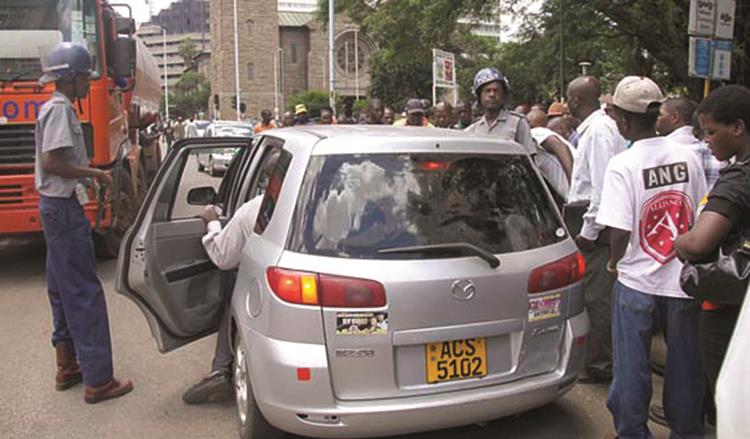
Elias Z. Mapendere
For the past two or so weeks, the police have been having a cat and a mouse relationship with motorists, especially those picking passengers at undesignated places.
The operation was code-named Operation Mushikashika Wapera.
This kind of interaction ended up spilling into the courts of law. One such case is Raymond Madamombe v Commissioner–General of the ZRP and 2 others (Case Number HC2226/16), where Justice Tsanga ordered that the vehicle of the applicant be realised within two hours of the order.
I was privileged to represent the applicant in that matter and my active involvement with the case made me to seriously reflect on the lawfulness of the whole operation.
I wish to share my reflections with members of the public in this paper.
I wish to start with clearing the air on a misconception that might develop in the minds of some amongst us that the parties who approached the courts have anything against the constitutional mandate of the police.
Far from it.
Any person in his right frame of mind would appreciate that when the police discharge their constitutional mandate in terms of Part 3 of Chapter 11, of amongst others, maintaining law and order, surely, they are not doing this just to get a salary at the end of the month.
They do so for the benefit of the nation at large. Thus, they deserve our support because we are the direct beneficiaries, as citizens, of law and order.
However, there are certain practices which the police might need to guard against.
Without exhausting the list, one such tendency is the conduct of overzealous and over–enthusiastic elements which are common in any such organisation as big as the police service.
For instance, one cannot doubt that it was never the intention of the people who came up with the operation to weed out pirate taxis that the operation would end up targeting driving schools dropping off learner drivers.
Similarly, it was never the intention of the architects of the operation that even professional people coming from work picking up their wives who had been shopping would end up losing their cars. Such conduct ends up alienating the police from the citizens who are supposed to support them.
The other consideration is whether the operation complies with the rule of law. The starting point for the analysis of the rule of law or lawfulness of any conduct is the supreme law of the land, the Constitution of Zimbabwe.
The Constitution becomes the starting point because Zimbabwe is a constitutional democracy.
Authority to the effect that Zimbabwe is a constitutional democracy can be found in a number of cases such as Smith v Mutasa NO & Anor, Biti & Anor v Minister of Justice, Legal and Parliamentary Affairs & Anor etc.
In the latter case, Justice Ebrahim held that “Zimbabwe, unlike the United Kingdom, is not a parliamentary democracy, but a constitutional democracy”.
As Olivier puts it, in a constitutional democracy, the constitution is regarded as representing “the deepest societal values and is the grundnorm for the democratic process”.
Having said that, it is pertinent to note that Section 2 of the Constitution of Zimbabwe, in no uncertain terms, provides that the constitution is the supreme law of Zimbabwe, and any law, practice, custom or conduct inconsistent with the constitution is invalid.
Although police operations such the one aforesaid cannot be law, there are obviously no difficulties in classifying them as conduct or practice.
Thus, as conduct or practice, their operations should conform to the constitution.
One such constitutional principle that is of vital importance is the principle of rule of law.
This principle is provided for under Section 3(1)(b). It ranks second to the principle of supremacy of the Constitution.
In simple terms, the principle requires that all conduct of the state should be authorised by law.
The Legal Dictionary defines rule of law in the following terms: The rule of law requires the government to exercise its power in accordance with well-established and clearly written rules, regulations, and legal principles.
If we are to unpack the operation under spotlight one would realise that if the police were to arrest a traffic offender, he or she would be penalised by either paying an admission of guilty fine or be taken to court.
All this is authorised by the criminal procedure and evidence Act.
The vehicle would have to be impounded at Chikurubi Police Camp. The offender would then be given a form with nine stakeholders that must clear the vehicle.
These ranged from all sorts of government departments such as VID, Vehicle Theft Squad, Zinara and ZBC to mention but a few.
While there is nothing wrong with said departments from conducting vehicle checks, surely there is no law that provides that once an offender has been penalised, the vehicle should be impounded and only released after being cleared by a number of government departments.
What I find amusing is that some of the facts can be ascertained by the arresting detail upon looking at the windscreen. For instance, by merely looking at the windscreen one can easily ascertain whether the vehicle has a valid Zinara or ZBC disc.
What then is the importance of resorting to calling such officials?
Meanwhile, the said officer take their time to come while the vehicle is accruing storage charges.
Be that as it may, it is important to note, as we argued before the High Court, that I am unaware of any law that says that once the police arrest a person for a traffic offence, they must hold on to the vehicle and release it when they fill like doing so.
Further, I am also unaware of the any law stipulating that the accused person should get clearance from the said departments or stakeholders.
In the absence of law authorising the seizure of the vehicles in the manner aforesaid, it is safe to conclude that Operation Mushika shika wapera violated property rights of vehicle owners enshrined in section 208 (2)(d) of the Constitution of Zimbabwe.
The operation also comes short of the principle of the rule of law enshrined in the Founding Values and Principles of the Constitution of Zimbabwe.
Elias Z Mapendere is a partner with Mapendere and Partners Legal Practitioners. The views expressed above are entirely his own. Feedback: [email protected] and WhatsApp 0772 882 355



 Online Reporter