

 admin
admin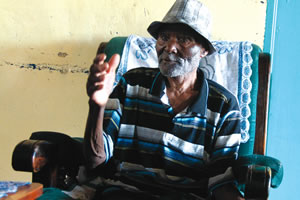
activities, which, strictly speaking, are poled between bed rest and moments out in the sun or in his lounge.
There he attempts to speak – and it takes a lot of effort on his part – one is exposed to a mire of what has happened in his life and family and work.
In the kaleidoscope that his life and memory are, a particular subject matter inevitably entwined or seasoned with others.
A greeting can be met with an enquiry after a grandchild or how the plants are doing.
Caring attendants have to continuously carefully direct the old man back on course, or if he veers off again finally give up, all in love and respect.
Perhaps there is a lot to talk about in the reminder of a journey well traversed.
There is so much to bequeath and impart and share in a life well-lived and that has fruits to show for it.
On one level, the fruits are his biological offshoots – 10 of them – which have gone on to have so many of their own and still another generation being born.
But there are other fruits, too, that make old Kahuni’s legacy indelible.
The man is responsible for what can be described as a little Mazowe of Mutoko, as he has maintained a big plantation of citrus fruit, mainly oranges and naartjies.
It is strongly redolent of the Mazowe area in Mashonaland Central which is famed for producing world-class citrus fruits.
“My grandfather was a great visionary,” coos Zvikomborero Kahuni, his grandchild who has been helping out at the plantation.
He is responsible for the regeneration of life at the plantation, which he tenders with help from a few others.
“To think that he was a tailor in Bulawayo and he came back and started
planting mango trees and then oranges. It is amazing.
“He has managed to feed and educate his children through this and we are also benefiting from it,” said Zvikomborero, himself a beneficiary of old Kahuni’s vision and industry.
It all started in 1938, Zvikomborero recounts, when Claudius Kahuni planted his first mango trees on the hill behind his homestead, a brave step, what with the marauding baboons from the Chigwina and Nyamhepo hills.
Today, the mango trees – about 300 of them – stand almost at home among the indigenous species, looking old and grey and skeletal.
In the 1950s, after being inspired by a visit to Mazowe, Kahuni started budding orange trees and developed the orchard that today stands at around four acres.
He forged a relationship with extension officers and officers from Mazowe which was to bear fruit.
But the Chigwina and Nyamhepo hills have one big secret.
This is the secret that Kahuni used to make what is the envy of many in the area and beyond.
Ensconced between the two hills is a spring whose water coolly oozes from the rock and has become the lifeblood of the Kahuni family.
Zvikomborero explains: “What my grandfather did was to harness this water so that it could water the trees.
“He dug a reservoir where the spring would flow into and bought pipes to begin irrigation. However, he was forced to dump PVC pipes for metals ones because at first some villagers were opposed to his project believing he was abusing the spring. So they would cut the PVC pipes with axes in anger and jealousy.”
He persevered and the project grew and over the years people around began appreciating the industry of the man.
He was to nurture several varieties of oranges including wash navel, valencia lete, premier and three varieties of naartjie.
He got his plants from Mazowe, where he also got technical skills.
On the other hand, he grew other crops such as cucumbers, squash, beans and mangoes.
This set the family up for success that a big homestead, better than most in the area seems to confirm.
Customers came from far and wide as the family supplied All Souls Mission and surrounding villages, highway produce sellers and sold the produce in Harare.
Felix Kahuni, son to the old visionary explains: “This is a viable project and we get an average of US$4.500 a year and we could get as much as US$10 000 to US$12 000 if things could work out the way we wanted.”
The family has not been getting any financial assistance and loans from outside and
this has severely curtailed their potential.
“The last time we got a loan was in 2007 when Agribank extended one to us. Nothing has happened since,” said the younger Kahuni.
The family has had to rely on its own resources that have not been helped by an unyielding economy.
Yet something sad is brewing which threatens to close the chapter on the exploits of Claudius Kahuni.
Back on the pass of the hills, the spring is slowly petering out and life is slowly oozing out of it.
This phenomenon has taken a worrying direction in these past years.
On a hot day – like most of the dry season has been and traditionally worse in this part of the country – the water flows miserably out of the hot, shimmering rock.
The leaves that trees shed as nature’s way to counter the energy-sapping heat, are blown into or land in the spring, blocking the pipes.
The result is an increasingly mean supply of water downfield, much to the disadvantage of the ripening plants during the peak months of August and September.
Tonnes of fruit have been lost, as have money.
Trees have wilted and dried.
And each passing year is worse, and the future threatens gloom.
The family now has awoken to the reality and bought a water pump and used other sources the main one being a man-made dam from a neighbour.
“Water is now the biggest problem. We need a reliable water source such as a borehole but at the moment we do not have money to sink it among other interventions,” Felix explains.
He says the whole project might require up to US$6 000.



 Online Reporter